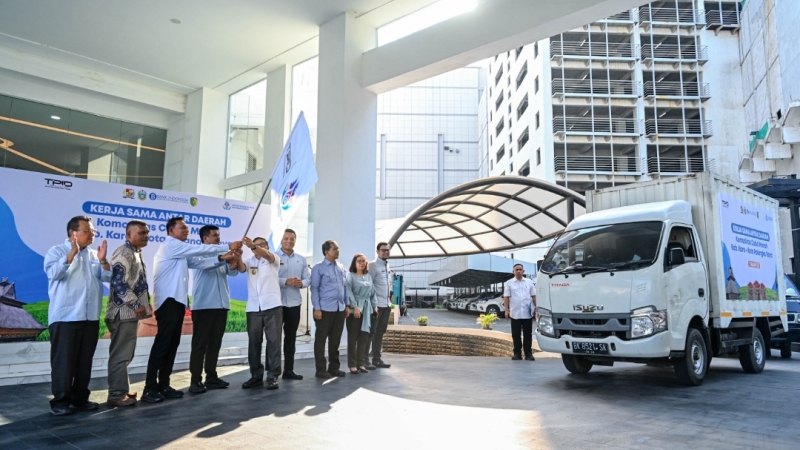
The Governor of North Sumatra, Muhammad Bobby Afif Nasution, released the shipment of 1.050 tons of red chili from Karo Regency to Palangkaraya City, Central Kalimantan Province. This shipment is part of an interregional cooperation (KAD) to maintain market balance between producing (surplus) and consuming (deficit) regions.
The release of the red chili took place at the North Sumatra Governor’s Office Yard on Jalan Pangeran Diponegoro, Medan City, Wednesday (April 22, 2026).
In addition to maintaining supply balance, Bobby emphasized that KAD is expected to control inflation and stabilize prices, both at the farmer and consumer levels. This program is also believed to ensure supply availability, increase farmers’ income, and expand market access.
“Please make KAD a flagship program. If many districts or cities have already established interregional cooperation, prioritize those that have made KAD commitments,” he said.
The North Sumatra Provincial Government targets implementing KAD in 12 districts or cities this year. He is optimistic that the program can improve farmers’ welfare while maintaining price stability at the consumer level.
“This is a remarkable breakthrough; it has already helped chili farmers in Karo. What we are doing is purely for the welfare of the farmers,” he said.
He ensured that this cooperation would not reduce the supply of red chili in North Sumatra. According to him, the availability of chili is still sufficient, especially after the religious holiday period.
Meanwhile, the Deputy Regent of Karo, Komando Tarigan, stated that the cooperation between the Karo Regency Government and Palangkaraya was only established this year. The current shipment is the third phase, with a total of 1.050 tons of red chili distributed in three stages.
“This KAD really helps the farmers in Karo. Because the price of red chili at the farmer level had dropped. It once fell to Rp9,000 per kilogram. After KAD, the price then rose, and is now at Rp25,000 per kg,” he said.
Karo Regency is one of the centers of red chili production in North Sumatra, with a land area of about 4,000 hectares. In addition to Palangkaraya, red chili from this area is also supplied to West Sumatra and Riau.
The head of the Gapoktan Terpuk Sisiwa, Pedoman Ginting, assessed that interregional synergy is an effective solution in maintaining supply and price balance. Its positive impact is now being felt by farmers.
“After KAD, the price of red chili in the market gradually rose, from Rp9,000 per kilogram, up to Rp18,000 per kilogram. The latest price is Rp25,000 per kilogram. For the KAD agreement price with Palangkaraya, we agreed on Rp21,000 per kilogram. The production cost in Karo is Rp18,000 per kg. That price still allows for profit,” he said.
Also present at the release were the Head of Bank Indonesia North Sumatra, the Head of the North Sumatra Department of Industry, Trade, Energy and Mineral Resources Dedi Jaminsyah Putra Harahap, and the Head of the Economic Bureau of the North Sumatra Provincial Secretariat Poppy Marulita Hutagalung.
North Sumatra Governor’s Office Yard
The North Sumatra Governor’s Office Yard, located in Medan, is a historic public space surrounding the colonial-era governor’s building, which was originally constructed in the late 19th century during Dutch rule. The yard often serves as a venue for official ceremonies and cultural events, reflecting the region’s administrative heritage. Its open layout and surrounding architecture highlight the blend of local and European influences that shaped North Sumatra’s history.
Jalan Pangeran Diponegoro
Jalan Pangeran Diponegoro is a major thoroughfare in Jakarta, Indonesia, known for its historical and cultural significance. It is named after Prince Diponegoro, a Javanese prince and national hero who led a major rebellion against Dutch colonial rule in the 19th century. The street is lined with colonial-era buildings and serves as a vibrant hub for commerce, dining, and nightlife in the city’s Menteng area.
Medan City
Medan, the capital of North Sumatra, Indonesia, was established in the late 16th century as a small village and grew into a major trading hub under the Dutch colonial rule in the 19th century. The city is known for its diverse cultural heritage, blending Malay, Batak, Chinese, and Indian influences, with landmarks like the Maimun Palace and the Great Mosque of Medan. Today, it serves as a bustling economic center and a gateway to nearby attractions like Lake Toba.
Karo Regency
Karo Regency is a region in North Sumatra, Indonesia, known for its stunning highland landscapes, including the active Mount Sinabung and Lake Toba. Historically, it was part of the ancient Batak kingdoms and later came under Dutch colonial influence in the 19th century. Today, it is celebrated for its unique Karo Batak culture, traditional architecture, and agricultural products like coffee and fruits.
Palangkaraya City
Palangkaraya is the capital city of Central Kalimantan, Indonesia, located along the Kahayan River. It was established in 1957 as part of President Sukarno’s vision to create a new national capital, though this plan was never realized. Today, the city serves as a cultural and administrative hub for the Dayak people, known for its traditional houses and proximity to lush rainforests.
Central Kalimantan Province
Central Kalimantan Province, located on the island of Borneo in Indonesia, is known for its vast rainforests, rivers, and the indigenous Dayak culture. Historically, it was established as a separate province in 1957, after previously being part of South Kalimantan, and has since been a center for the preservation of traditional Dayak customs and the conservation of its unique peatland ecosystems. The province is also significant for its role in Indonesia’s transmigration programs and ongoing environmental challenges related to deforestation and land use.
West Sumatra
West Sumatra, located on the Indonesian island of Sumatra, is renowned for its dramatic landscapes, including the stunning Lake Maninjau and the active Mount Marapi. The region is the homeland of the Minangkabau people, a matrilineal culture with a rich history dating back to the 7th century, and it was a key center of trade and Islamic scholarship during the 16th to 19th centuries. Today, it is celebrated for its unique architecture, particularly the iconic curved-roof *Rumah Gadang* traditional houses, and its vibrant cultural festivals.
Riau
Riau is a province on the island of Sumatra, Indonesia, known for its rich cultural heritage and historical importance as part of the powerful Malay Sultanates, particularly the Sultanate of Johor-Riau. The region was a major center for trade and Malay culture, with its capital, Pekanbaru, serving as a key hub. Today, Riau is celebrated for its traditional arts, such as the Malay dance and music, and its natural resources, including oil and palm oil plantations.