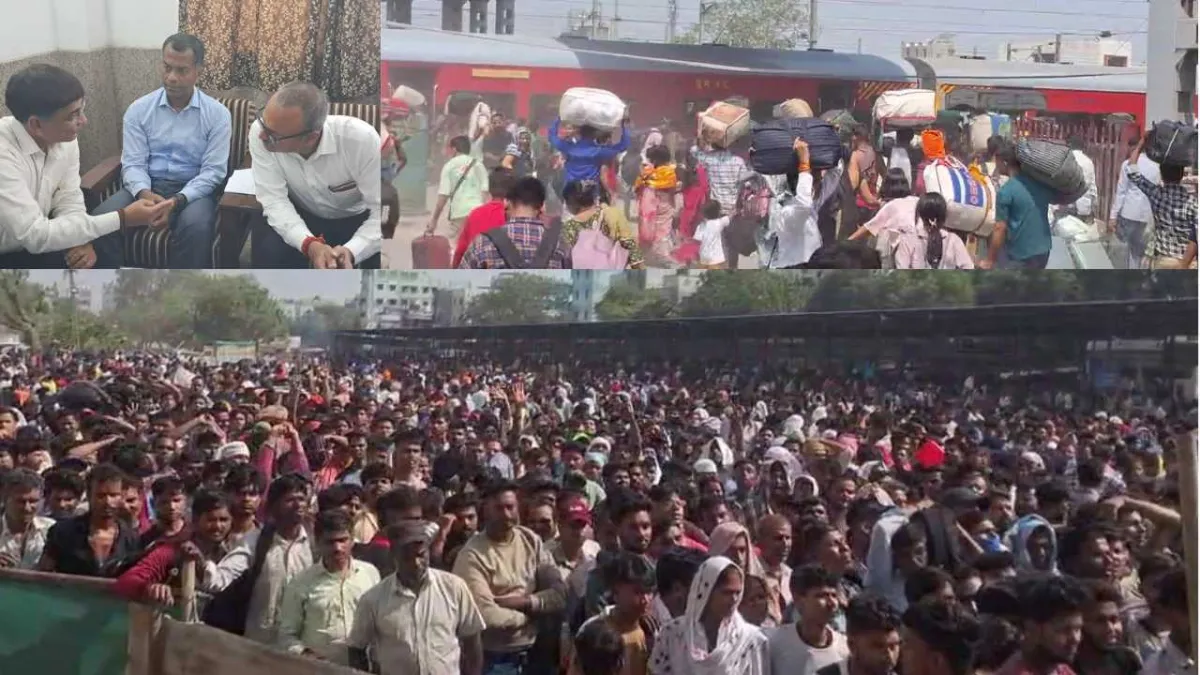
Chamber Delegation Presents Proposal to Western Railway GM; Suggests Using Other Stations to Reduce Pressure on Udhna Station
Surat. Following the stampede and chaos at Udhna railway station last Sunday, the Southern Gujarat Chamber of Commerce and Industry (SGCCI) has swung into action.
On Monday, April 20, 2026, a delegation from the Chamber’s railway committee met with Western Railway General Manager Ramashray Pandey at Udhna station and presented a detailed proposal to ensure safe travel for migrants.
Bhestan and Chalthan as alternatives to Udhna
Chamber President Nikhil Madrasi stated that currently, most holiday special trains are operating only from Udhna station, causing unbearable passenger pressure there.
To address this issue, the Chamber has proposed alternative stations to the railway authorities. Trains should be started from Surat, Bhestan, and Chalthan railway stations in addition to Udhna for destinations like Uttar Pradesh, Bihar, West Bengal, and Madhya Pradesh. Given the increasing crowds in April and May, sufficient new holiday special trains should be put on track.
The Chamber informed the railway administration that approximately 5 lakh migrant workers are employed in Surat’s industries. During school holidays, when these workers return home with their families, conditions at the stations become deplorable. Concrete and advance planning is needed to prevent the recurring chaos at Udhna station over the past two years.
Western Railway General Manager Ramashray Pandey listened seriously to the Chamber’s proposals and assured them of running new trains. However, he also gave an important suggestion:
“The railway is monitoring passenger numbers and will arrange additional trains. But industrial unit owners must also cooperate for crowd management. They should encourage workers to travel on other days of the week instead of only on Sundays, so that a huge crowd does not gather at the station on a single day.”
The meeting was attended by Railway Committee Chairman Rakesh Shah, Secretary Paulic Desai, and other members. The Chamber assured that they would coordinate with industrial units to distribute the travel load throughout the week and prevent untoward incidents at Udhna railway station.
Udhna railway station
Udhna railway station is a key railway junction located in Surat, Gujarat, India. It was established during the British colonial era as part of the development of the railway network to facilitate trade and transportation in the region. Today, it serves as an important stop for both passenger and freight trains, connecting Surat to major cities across India.
Bhestan railway station
Bhestan railway station is a small station located in the Surat district of Gujarat, India, serving the suburban area of Bhestan. It is part of the Western Railway zone and lies on the busy Mumbai–Ahmedabad main line, facilitating local and passenger train connectivity. The station has gained historical significance due to its role in the 1994 Bhestan violence, a tragic communal riot that resulted in multiple deaths and highlighted tensions in the region.
Chalthan railway station
Chalthan railway station is a small station located in the Surat district of Gujarat, India, serving the village of Chalthan. Established during the British colonial era as part of the railway network expansion, it lies on the busy Mumbai–Ahmedabad rail corridor. Today, it functions primarily as a local halt station, connecting the rural area to major cities.
Surat railway station
Surat railway station, located in Gujarat, India, is one of the busiest and oldest railway stations on the Indian Railways network, dating back to the British colonial era. It serves as a major junction on the Mumbai-Delhi main line and played a significant role in the development of Surat as a key commercial hub, especially for the textile and diamond industries. The station has undergone multiple renovations and modernizations to handle its heavy passenger traffic while retaining its historical importance.
Western Railway
The Western Railway is a major zone of Indian Railways, headquartered in Mumbai. Its history dates back to the mid-19th century, with the first passenger train in India running from Boribunder (Mumbai) to Thane in 1853, a line that later became part of the Western Railway. Today, it serves as a vital transportation artery, connecting the western coast of India and handling millions of commuters daily, particularly in the Mumbai suburban network.