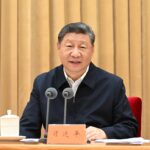
On the morning of April 14, President Xi Jinping met with visiting Crown Prince Khaled of Abu Dhabi of the United Arab Emirates at the Great Hall of the People in Beijing.
Xi Jinping pointed out that the UAE is China’s comprehensive strategic partner, and China always attaches great importance to developing relations with the UAE. Thanks to the joint efforts of both sides, China-UAE relations have maintained healthy and stable development, with deepening political mutual trust, steady progress in practical cooperation, and rich and diverse people-to-people exchanges. Consolidating and elevating China-UAE relations is the firm consensus of both sides and meets the expectations of the two peoples. China is willing to work hand in hand with the UAE to build a more solid, resilient, and dynamic comprehensive strategic partnership. The two sides should continue to support each other on issues concerning each other’s core interests and major concerns, maintain high-level exchanges, and strengthen strategic mutual trust. They should enhance the alignment of development strategies, tap potential in energy, investment, trade, technology, and other fields, and deepen mutually beneficial cooperation. They should promote greater progress in cooperation in education, civil aviation, tourism, and other areas, strengthen people-to-people exchanges, and consolidate public support. They should enhance coordination and cooperation on multilateral platforms such as the United Nations and BRICS, use the stability of China-UAE relations to address uncertainties in the international and regional situation, and jointly promote the building of a community with a shared future for mankind.
The two sides exchanged views on the current situation in the Middle East and the Gulf region. Xi Jinping emphasized China’s principled stance of promoting peace and talks, reiterating that China will continue to play a constructive role in this regard.
Xi Jinping put forward four proposals for maintaining and promoting peace and stability in the Middle East: First, adhere to the principle of peaceful coexistence. Middle Eastern and Gulf countries are closely linked and inseparable neighbors. It is necessary to support Middle Eastern and Gulf countries in improving their relations, promote the construction of a common, comprehensive, cooperative, and sustainable security architecture for the Middle East and the Gulf region, and solidify the foundation for peaceful coexistence. Second, adhere to the principle of national sovereignty. Sovereignty is the foundation for the survival and development of all countries, especially developing countries, and must not be violated. The sovereignty, security, and territorial integrity of Middle Eastern and Gulf countries should be earnestly respected, and the safety of personnel, facilities, and institutions of all countries should be effectively safeguarded. Third, adhere to the principle of international rule of law. The authority of international law must be upheld; it cannot be applied selectively or abandoned when inconvenient, nor should the world revert to the law of the jungle. It is essential to firmly uphold the international system with the United Nations at its core, the international order based on international law, and the basic norms of international relations based on the purposes and principles of the UN Charter. Fourth, adhere to the integration of development and security. Security is the prerequisite for development, and development is the guarantee of security. All parties should create a favorable environment for the development of Middle Eastern and Gulf countries and inject positive energy. China is willing to share the opportunities of Chinese modernization with Middle Eastern and Gulf countries, fostering a fertile ground for regional development and security.
Khaled stated that UAE-China relations have a long history and deep foundation, with the two countries always respecting and trusting each other and sharing broad common interests. The UAE attaches great importance to developing relations with China and is willing to work with China to implement the important consensus reached by the two heads of state, deepen cooperation in various fields, open up broader prospects for bilateral relations, and benefit the two peoples. The UAE appreciates China’s responsible and constructive role in international affairs and its active efforts to politically resolve the current Middle East crisis. The UAE is committed to maintaining close communication and coordination with China, promoting a ceasefire and cessation of hostilities among relevant parties, restoring regional peace and stability as soon as possible, safeguarding international shipping security, and preventing greater impacts on the global economy and energy security. The UAE will effectively protect the safety of Chinese citizens and institutions in the UAE.
Wang Yi attended the meeting.