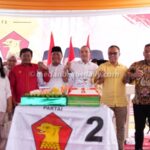
The 59th Musabaqah Tilawatil Qur’an (MTQ) for the City of Medan was officially opened on Jalan Jenderal Gatot Subroto in the Medan Sunggal District. The opening ceremony was marked by the beating of a traditional drum together with the Deputy Mayor, the Chairman of the Medan City Council, members of the regional leadership coordination forum, the Chairperson of the Medan City Family Welfare Movement, and the City Secretary.
In the opening speech, it was conveyed that the MTQ is not only a competition but also a moment to broadcast Islamic teachings and strengthen the practice of the values of the Qur’an in daily life.
It was stated that the MTQ is a source of pride for Medan, expected to produce a generation of accomplished male and female Qur’an reciters at the provincial, national, and international levels.
The importance of a smooth-running MTQ was emphasized, with a fair and professional judging system to produce the best participants who can serve as role models in the community.
Furthermore, appreciation was expressed for the improved quality of this year’s MTQ organization, both in terms of venue arrangement and the involvement of micro, small, and medium enterprises from all districts.
On this occasion, the importance of using technology wisely was also highlighted, without neglecting the religious values contained in the Qur’an.
The 59th MTQ of Medan carries the theme “Building True Obedience to Allah Subhanahu wa Ta’ala and His Messenger towards a Blessed Medan,” inspired by Surah An-Nisa verse 59 concerning obedience to Allah, the Messenger, and leaders.
Meanwhile, it was reported that this event is taking place and is being participated in by 692 contestants from 21 districts as well as state and private Islamic senior high schools.
The MTQ commenced with a ‘ta’aruf’ parade involving approximately 11,000 participants. Eight categories are being contested, including the art of Qur’anic recitation, qira’at, memorization, interpretation, comprehension, explanation, calligraphy, and Qur’anic scientific writing.
In addition to the competitions, the event also features exhibitions by regional government organizations, participation from all 21 districts, and an MSME bazaar with 112 business participants facilitated by the Medan City Government.
Musabaqah Tilawatil Qur’an (MTQ)
The Musabaqah Tilawatil Qur’an (MTQ) is a prestigious Indonesian national competition for the recitation of the Quran, established to preserve and promote the art of *tajwid* (proper pronunciation and intonation). First held officially in 1940, it has grown into a major cultural and religious event, with participants competing at various regional levels before advancing to the national finals. The MTQ not only serves as a platform for showcasing recitation skills but also reinforces Islamic values and fosters unity among Indonesia’s diverse Muslim communities.
Medan
Medan is the capital city of North Sumatra, Indonesia, and a major economic hub on the island of Sumatra. Historically, it grew from a small village into a significant trading center during the late 19th century, largely due to the establishment of tobacco and rubber plantations by Dutch colonialists. The city’s multicultural heritage is reflected in landmarks like the Maimun Palace, built by the Sultanate of Deli, and its diverse architecture blending Malay, Chinese, and European influences.
Jalan Jenderal Gatot Subroto
Jalan Jenderal Gatot Subroto is a major thoroughfare in Jakarta, Indonesia, named in honor of General Gatot Soebroto, a national hero from the Indonesian War of Independence. Historically, the road developed as part of the city’s post-independence expansion and modernization in the mid-20th century. Today, it is a central business and governmental corridor, lined with skyscrapers, ministries, and corporate headquarters.
Medan Sunggal District
Medan Sunggal is a district in Medan, Indonesia, historically known as a significant center for the Karo Batak people. Its name is derived from the Karo words “sunggal,” meaning “to gather,” reflecting its past role as a communal meeting place. Today, it is a bustling urban area that retains its cultural identity while being part of the city’s commercial and residential landscape.
Medan City Council
The Medan City Council is the legislative body of Medan, Indonesia, formed to represent the city’s residents and oversee local governance. Its modern structure was established following Indonesian independence and decentralization reforms, evolving from earlier colonial-era municipal institutions to shape the policies and development of North Sumatra’s capital.
Medan City Family Welfare Movement
The Medan City Family Welfare Movement (PKK) is a community-based organization in Medan, Indonesia, focused on promoting family well-being, health, and education. It was established as part of the national PKK program initiated by the Indonesian government in the 1970s to involve women in community development and social welfare at the local level. The movement’s activities typically include family planning guidance, nutritional education, and initiatives to improve household incomes and sanitation.
Surah An-Nisa
“Surah An-Nisa” is not a physical place or cultural site, but a chapter (the fourth) of the Quran, the central religious text of Islam. It is a lengthy Medinan surah revealed after the establishment of the Muslim community in Medina, primarily addressing social legislation, family law, inheritance, and the rights of women and orphans. Its history is tied to the early Muslim community’s need for a comprehensive social and legal framework in the 7th century CE.
MSME bazaar
The MSME Bazaar is a marketplace and promotional platform designed to support Micro, Small, and Medium Enterprises (MSMEs), a vital economic sector in many countries like India. It typically refers to organized physical or digital events that connect these businesses with customers and investors, helping to foster entrepreneurship, local production, and economic growth. While not a single historical site, its concept has gained significant momentum in recent decades as governments and institutions have recognized the need to empower small-scale industries.