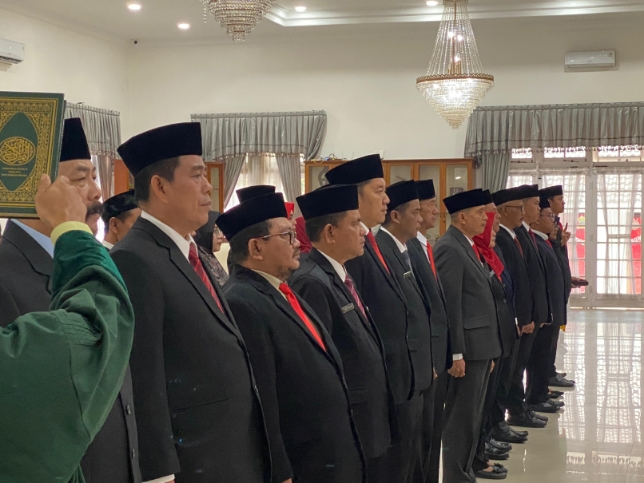
A total of 24 Civil Servants were officially inaugurated and sworn into their positions by the Regent of Sumedang at the Sumedang State Building.
Of that number, three were appointed as First High Leadership Officials or equivalent to Heads of Agencies, namely the Head of the Social Service, the Head of the Tourism, Culture, Youth and Sports Service, and the Head of the Fire and Rescue Service. In addition, 10 administrative and supervisory officials and 11 functional officials were also inaugurated.
The inauguration included the swearing-in/oath-taking of Civil Servants for positions of First High Leadership, administrator, supervisor, and functional positions within the Sumedang Regency Government.
In his speech, the Regent emphasized that a position is not merely a formality or a change of post, but a great trust that must be carried out with full responsibility for the public interest.
“This inauguration momentum is not just about a transfer of duties, but in essence it is a transfer of mandate. There is new responsibility, new targets, and a new spirit. The people also have new expectations for the performance of civil servants,” said the Regent.
He also reminded state civil apparatus not to play around with the positions entrusted to them by the state. According to him, every position is both a moral responsibility and a performance contract with the public.
“What is the point of being a civil servant if one’s life is not blessed. Never try to break the rules, because in the end it will certainly be discovered,” he said.
The Regent also said that amid the high public interest in becoming civil servants, civil servants should be more grateful for being given the opportunity to serve. This gratitude, he said, must be realized through optimal and integrity-filled performance.
“Straighten our intentions wherever we are placed. Make work a part of worship to God. If the intention is already straight, then what we do will have merit,” he said.
According to him, a straight intention will give rise to positive thoughts, positive speech, and become habits that shape character and determine a person’s future. Therefore, civil servants are asked to carry out their duties as well as possible and avoid shortcuts that violate the rules.
“Many want to become civil servants, some have to be contract workers first, then part-time government employees with work agreements, then full-time, before becoming a civil servant. After becoming a civil servant, one wants to have a position, then get promoted again. All of that must be appreciated, not misused,” he said.
He emphasized that gratitude must be proven with quality performance, not just fulfilling administrative obligations. After being inaugurated and sworn in, work results must be better and have a real impact.
In addition, the Regent also asked civil servants to love their work, quickly adapt to new work environments, understand the strengths and weaknesses of the organization, and continuously make improvements.
“If you already love your job, you will do anything. Know yourself, know the problems in the agency, and know the field of work. A Chinese philosopher said, if you want to win the battlefield, know yourself, know your enemy, and know your terrain,” concluded the Regent.