The Intersection of High-Speed Rail Logic, Yokohama’s Urban Planning, and the Fate of a Wetland: A “Miraculous Pinpoint”
The location of Shin-Yokohama Station is a “crossroads of coincidence and necessity,” where three long-term contexts perfectly overlapped with one practical reality:
① Securing a high-speed, straight route for the Tokaido Shinkansen
② Alignment with Yokohama City’s urban planning (the Twin Core concept)
③ Expansion of the wide-area network via subway, Sotetsu, and Tokyu lines
and
④ The practical reason that the area around Shin-Yokohama at the time was “wetland, making it easy to acquire.”
The middle of rice paddies, which was neither a tourist spot nor a downtown area, evolved into one of the largest transportation hubs in the metropolitan area due to this background.
◆ Chapter 1: Why Couldn’t a Shinkansen Station Be Built at Yokohama Station or Higashi-Kanagawa Station?
The Tokaido Shinkansen (opened in 1964) was required to have a straight route design above all else, due to the absolute condition of “connecting Tokyo and Osaka in the shortest possible time.”
Given this premise, Yokohama Station and Higashi-Kanagawa Station, while considered, were ultimately “impossible locations.”
1. Sharp Curves Required = Loss of Speed
To reach Yokohama Station, the line would need to wind significantly through urban areas.
The Shinkansen has strict technical standards for curve radius and gradient; sharp curves mean a significant speed reduction.
This contradicts its mission as a “high-speed railway.”
※ For similar reasons, Osaka = Shin-Osaka and Kobe = Shin-Kobe also avoid city centers.
2. Simply “No Space”
Yokohama Station was densely packed with JR and private railway lines, already at full capacity.
The area around the current Takashimaya/Sotetsu exit was concentrated with surface lines, leaving absolutely no room for Shinkansen platforms.
3. Terrain and Land Acquisition Were Hopeless
The area around Yokohama Station is a mix of hills with weak ground.
By 1959, it had already become a bustling district.
Land acquisition involving evictions would have been fatal for a national project with the absolute deadline of “completion before the Olympics.”
4. The “Second Candidate,” Higashi-Kanagawa Station, Was Also Abandoned Due to Construction Timeline
“What about Higashi-Kanagawa then?” was considered, but this area was also urbanized, making land acquisition difficult and the construction timeline unpredictable.
■ Absolute Condition: Opening Before the 1964 Tokyo Olympics
This deadline weighed heavily on the then Japanese National Railways.
A “route with a predictable construction period” that could be built in the shortest time was required.
As a result, the plan to pass through Higashi-Kanagawa was also deemed too difficult.
◆ Chapter 2: Not a Reluctant Choice, But Why Shin-Yokohama Was the Optimal Solution
Both Yokohama Station and Higashi-Kanagawa Station “were simply impossible” to meet the Shinkansen’s conditions.
So, under such strict conditions, why was Shin-Yokohama, which was nothing but rice paddies and wetlands, chosen?
The answer boils down to two points.
1. Land acquisition was overwhelmingly easier.
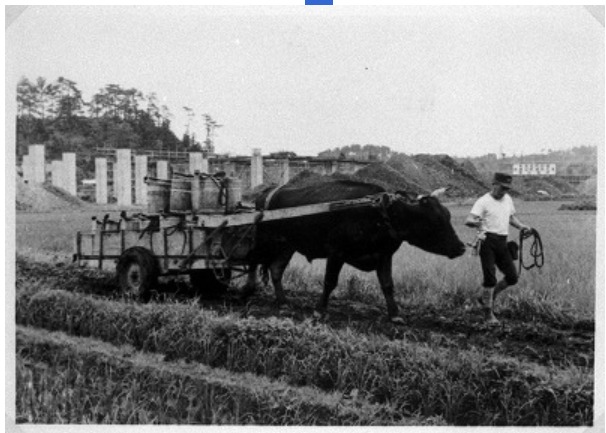
The state of the land in front of Shin-Yokohama Station
The area around Shin-Yokohama was a wetland locally called “Shobuda.”
It was land that made farmers weep, where nothing grew in winter and floods were frequent.
However, from the perspective of railway construction:
Few residential areas, almost no evictions needed = could meet the deadline.
This became the deciding factor.
→ In other words, it was not chosen because it was “peaceful,” but due to project rationality: minimal resistance and fastest construction.
2. It