75th Anniversary Celebration of Hindi Milap: Discussion Held on Story Collection ‘Open Drawer and Scattered Fragrances’
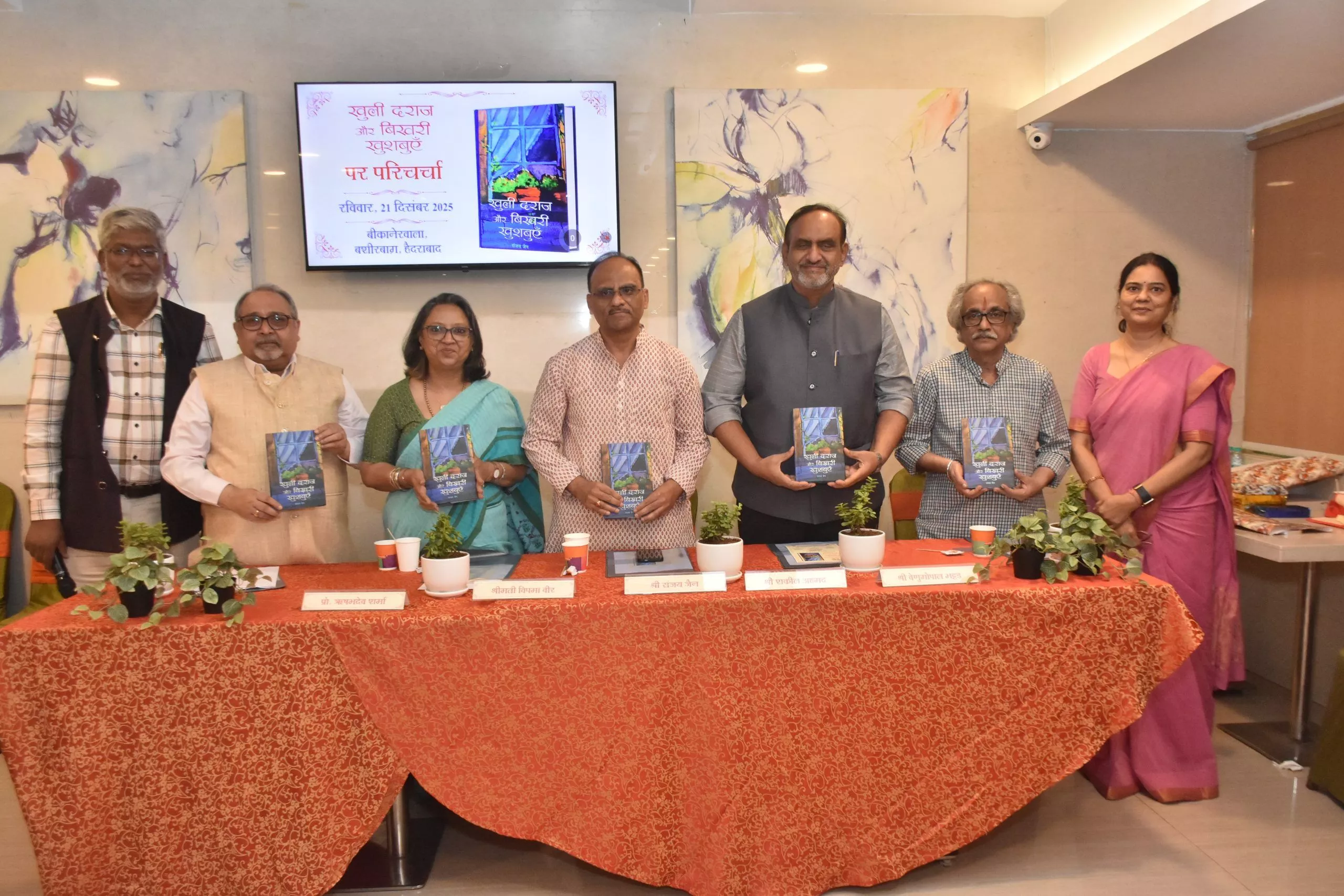
Hyderabad, On the occasion of the 75th-year celebration of Hindi Milap, a discussion on the story collection ‘Khuli Daraj Aur Bikhri Khushbuayein’ by author Sanjay Jain was organized at Bikanervala in Bashirbagh. The event, chaired by the editor of Daily Hindi Milap, saw guests on the dais shed light on various aspects of the book, describing it as a powerful and sensitive expression of experiences.
Sanjay Jain’s Stories Heighten Curiosity
The chief guest of the event stated that the greatest feature of Sanjay Jain’s story collection ‘Khuli Daraj Aur Bikhri Khushbuayein’ is that after reading one story, curiosity for the next one remains. They said the emotional essence of the stories in this collection connects readers to Jagjit Singh’s ghazal ‘Ye Daulat Bhi Le Lo, Ye Shohrat Bhi Le Lo…’. A suggestion was made for the story collection to be translated into other languages. Congratulations were also extended to Hindi Milap for completing a remarkable 75-year journey in Hindi journalism.
Stories Blend Sensitivity, Visual Imagery, and Social Reality
In the keynote address, the story collection’s title was linked to lines from Agyeya. The speaker described Sanjay Jain as a writer of poetic prose, stating that reading this story collection provides the pleasure of reading refined prose, which is a rare quality of the author.
It was noted that all the stories in the collection beautifully blend visual imagery with reflection, and the presented with the un-presented. The author has taken experiences related to themes like the generation gap, loneliness, commercialization, the loss of locality, and cultural change, processed them through feeling, and molded them into refined prose. It was emphasized that in today’s virtual world, it is very necessary to preserve sensitivity within oneself, and this collection is an example of that.
A special guest shared brief thoughts on the story collection. Sanjay Jain, in his author’s statement, said he aims to understand various ironies between life’s small and large joys and sorrows and make them part of his creativity.
Hindi Milap
“Hindi Milap” is a historic and culturally significant newspaper founded in 1923 in Fiji, primarily serving the Indo-Fijian community. It was established during the British colonial period to advocate for the rights and interests of Indian indentured laborers and their descendants, playing a vital role in community cohesion and political awareness. Today, it remains one of Fiji’s oldest and most prominent Hindi-language publications, reflecting the diaspora’s heritage and ongoing cultural identity.
Khuli Daraj Aur Bikhri Khushbuayein
“Khuli Daraj Aur Bikhri Khushbuayein” (Open Stairs and Scattered Fragrances) is a poetic and evocative phrase, not the name of a specific historical place or widely recognized cultural site. It is likely the title of a literary work, song, or piece of art, possibly describing a metaphorical or sensory experience rather than a physical location. Therefore, it does not have a concrete history as a cultural monument.
Bikanervala
Bikanervala is a popular Indian restaurant chain that originated in Old Delhi in 1950, originally as a small shop selling traditional sweets and snacks. It has since grown into a global brand, renowned for its North Indian vegetarian cuisine, particularly its sweets like *sohan papdi* and savory items like *chaat*. While not a historical monument, its story reflects the entrepreneurial spirit and culinary heritage of the Bikaner region of Rajasthan.
Bashirbagh
Bashirbagh is a historic garden and residential area located in Hyderabad, India, originally established in the early 19th century. It was built by Sir Khurshid Jah, a noble in the court of the Nizam of Hyderabad, and named after his father, Bashir ud-Daulah. Today, it is primarily known as a bustling commercial and residential neighborhood, though some remnants of its palatial past remain.
Jagjit Singh
Jagjit Singh is not a place or cultural site, but a legendary Indian ghazal singer and composer. He is celebrated for popularizing and modernizing the ghazal genre of music in the 20th century, bringing it to a global audience. His career, spanning over five decades, left an indelible mark on Indian music with his soulful voice and profound renditions.
ghazal
“Ghazal” is not a specific place or cultural site, but a major form of lyric poetry originating in 7th-century Arabia. It became highly developed in Persian literature and later spread to many languages, most famously in Urdu, where it is a central pillar of classical music and poetic expression. Traditionally exploring themes of love, loss, and mysticism, the ghazal consists of rhyming couplets and a refrain, with each couplet standing alone as a complete thought.
Agyeya
“Agyeya” is not a specific place or cultural site, but the pen name of the influential 20th-century Hindi writer **Sachchidananda Hirananda Vatsyayan**. Under this name, he was a leading figure in modern Hindi literature, known for pioneering the *Nayi Kahani* (New Story) literary movement. His work often reflected the social and political upheavals of post-independence India.