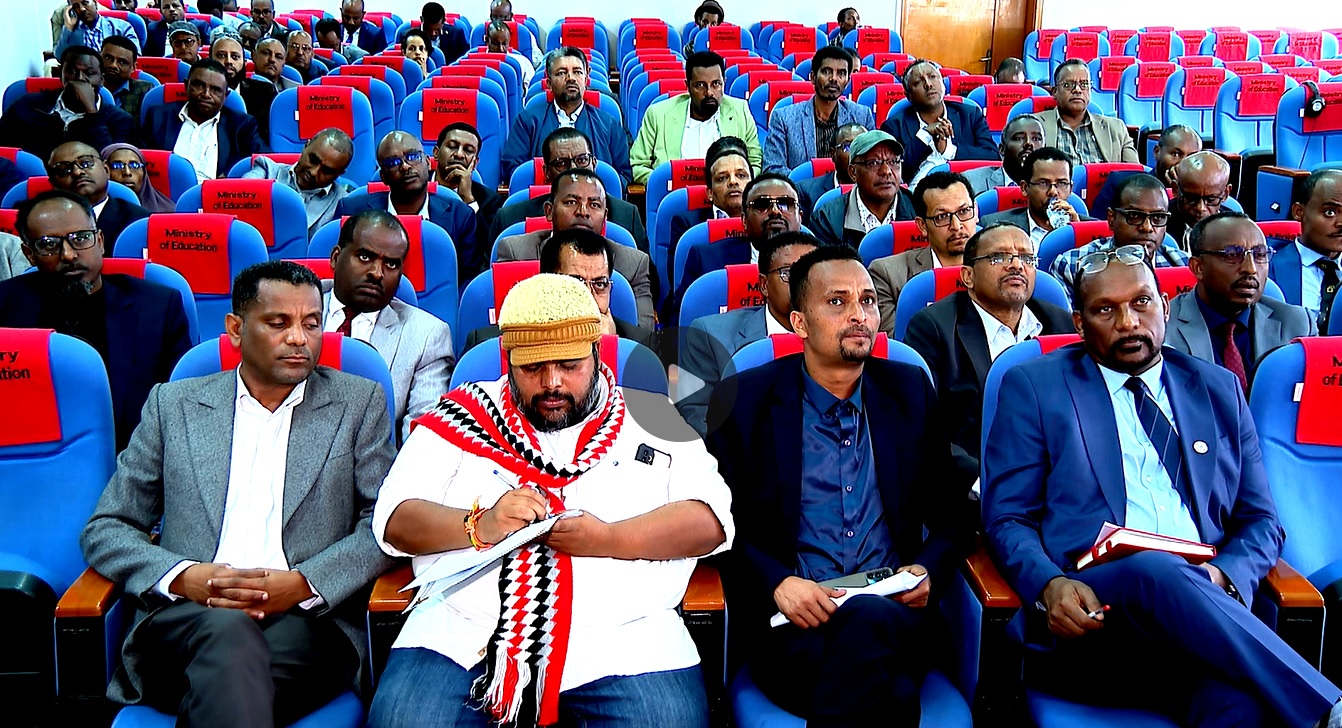
The “Mobility for PhD” program was launched today, offering PhD certifications to more than 1,000 Ethiopian researchers in India or under joint supervision with Indian mentors over the next five years.
The Ethiopian-Indian Mobility for Advancing Higher Education and Scientific Research program aims to enhance cooperation in research, technology, and innovation between higher education institutions in Ethiopia and India.
In a speech on this occasion, the State Minister for Education praised the growing partnership between the two countries at bilateral and multilateral levels, noting the importance of their strong cooperation within the BRICS framework and South-South cooperation. It was added that the program is a growing initiative for joint research, focusing on academic exchange and capacity building in areas such as technology.
For the State Minister, the program, which lasts from one to one and a half years, will enable world-class research, as the program is essential for enhancing capacity building and innovation that supports research programs.
It was revealed that between 1,000 and 1,200 PhD students are expected to benefit from this initiative with the support of Ethiopian and Indian professors, and high-level Indian institutions backed by advanced technologies. It was noted that the program will begin through 8 Indian Institutes of Technology (IITs).
The Ethiopia-India Joint PhD Program Coordinator stated that Ethiopia stands out as a leading country in the field of technology, especially in artificial intelligence and startups.
Efforts for technological transformation and digitization in Ethiopia have already accelerated in recent years, significantly supported by the “Digital Ethiopia 2025” strategy. This national initiative aims to leverage digital opportunities to drive economic growth, improve public services, and create jobs across various sectors.
It was said: “Therefore, this strategic partnership between India and Ethiopia has been integrated to enhance bilateral relations in the fields of agriculture, sustainable technology, clean energy, as well as education and mining.” It was affirmed that this relationship gives a new shape to the world under the BRICS partnership.
The programs of the Indian Institutes of Technology involve strong academic cooperation, in partnership with the Ethiopian Ministry of Education, for joint PhD certifications with shared supervision and exchange.
During his historic first visit to Ethiopia this week, the Indian Prime Minister affirmed that education is the foundation of any nation; and that India is proud of the fact that the greatest contribution to Indian-Ethiopian relations has come from teachers.
It was emphasized: “The future belongs to partnerships built on vision and trust. We wish to strengthen this cooperation with Ethiopia, a cooperation that addresses global challenges and also creates new opportunities.”
Educational cooperation between Ethiopia and India has long been crucial for Ethiopia, as Indian teachers formed the backbone of its modern education system for decades and contributed significantly to training generations of professionals.
Indian Institutes of Technology (IITs)
The Indian Institutes of Technology (IITs) are a network of prestigious, autonomous public engineering and technology institutes in India, established to train scientists and engineers after independence. The first IIT was founded in Kharagpur in 1951, with the institute system expanding over the decades through acts of parliament. They are globally renowned for their rigorous academic standards and have produced many of India’s leading technologists, entrepreneurs, and innovators.
Digital Ethiopia 2025
“Digital Ethiopia 2025” is a national strategic initiative launched by the Ethiopian government to drive the country’s digital transformation by 2025, aiming to create a digital economy and improve service delivery through technology. Historically, it builds upon earlier ICT policies and represents a concerted effort to leverage digital tools for economic growth, governance, and social inclusion in one of Africa’s fastest-growing economies.
Ethiopia
Ethiopia is a historically rich nation in the Horn of Africa, widely considered one of the oldest sites of human civilization and home to the ancient Kingdom of Aksum. It is unique in Africa for largely maintaining its sovereignty during the colonial era and is renowned as the origin of coffee and for its ancient Christian heritage, including rock-hewn churches in Lalibela. Its long history as a powerful empire and crossroads of cultures has left a profound legacy of diverse traditions, languages, and UNESCO World Heritage Sites.
India
India is a vast South Asian country with one of the world’s oldest continuous civilizations, dating back over 5,000 years to the Indus Valley. Its long and complex history is marked by the rise of major religions like Hinduism and Buddhism, successive empires, Mughal rule, and British colonization before gaining independence in 1947. Today, it is a vibrant, pluralistic republic renowned for its diverse cultures, languages, and iconic sites like the Taj Mahal.
Ethiopian Ministry of Education
The Ethiopian Ministry of Education is the federal government body responsible for formulating and implementing national education policy. Its modern structure was established following the fall of the Derg regime in 1991, with a focus on expanding access and decentralizing the system. Historically, formal education in Ethiopia was largely confined to the Ethiopian Orthodox Church until the early 20th century, when secular schools began to develop under Emperor Menelik II and were significantly expanded during Emperor Haile Selassie’s reign.
South-South cooperation
“South-South cooperation” is not a physical place but a framework for collaboration among developing countries in the Global South, primarily focused on sharing knowledge, technology, and resources. It emerged as a formal concept in the mid-20th century, gaining momentum after the 1955 Bandung Conference, as nations sought to promote collective self-reliance and reduce dependence on traditional Western aid. Today, it is a major pillar of international development, exemplified by initiatives like China’s Belt and Road and regional trade blocs.
Ethiopia-India Joint PhD Program
The Ethiopia-India Joint PhD Program is an academic collaboration launched in 2023, formalized through an agreement between the Ministry of Education of Ethiopia and the Indian Council for Cultural Relations (ICCR). It aims to build high-level research capacity in Ethiopia by enabling Ethiopian scholars to pursue doctoral degrees at premier Indian universities, focusing on fields critical to Ethiopia’s development. This initiative reflects a long-standing history of educational cooperation between the two nations, strengthening their bilateral ties through knowledge exchange and human resource development.