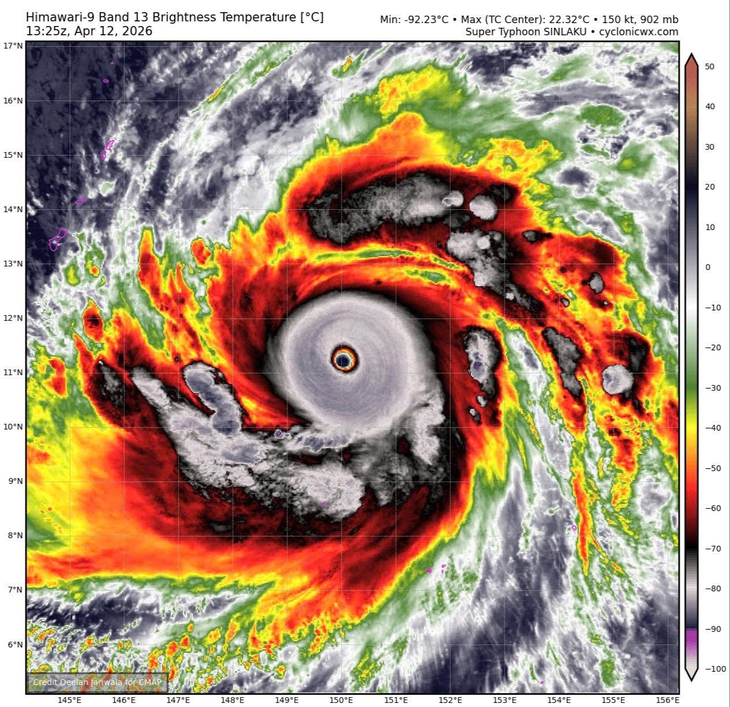
Sinlaku intensifies into a super typhoon, becoming the strongest storm worldwide since the start of the year.
The National Center for Hydro-Meteorological Forecasting reported that on the evening of April 12, Typhoon Sinlaku in the northwestern Pacific Ocean intensified into a super typhoon. The maximum wind speed near the storm’s center reached level 16 (190 km/h), with gusts above level 17.
This is the first super typhoon of 2026.
So far this year, Sinlaku is the strongest storm in the world at present, with a central pressure of 920 hPa, surpassing Typhoon Maila in the Australian region (924 hPa).
This is also only the third time since 1977 that a super typhoon has formed in April, the previous one being Super Typhoon Surigae in 2021.
Currently, Super Typhoon Sinlaku remains approximately 3,000 km east of the Philippines.
The satellite image shows the distinct eye of Super Typhoon Sinlaku, with strong convective cloud development and a symmetrical circulation.
The National Center for Hydro-Meteorological Forecasting stated that current environmental conditions over the sea area are favorable, such as high sea surface temperatures, abundant oceanic heat content, and weak upper-level wind shear, creating conditions for the storm to intensify rapidly within the next 24 hours.
The forecast predicts the peak intensity of Super Typhoon Sinlaku to be around level 16-17 (185 – 220 km/h), with gusts above level 17.
Regarding its movement direction, it is forecast that tonight and tomorrow, Super Typhoon Sinlaku will move northwest at a speed of about 15 km/h.
Subsequently, Super Typhoon Sinlaku will change its course to the north, and is likely to change direction again to north-northeast around April 16-17, heading towards the sea area east of Japan, with its intensity gradually weakening.
“Current storm forecasts all indicate that the typhoon is unlikely to enter the South China Sea area,” the National Center for Hydro-Meteorological Forecasting stated, adding that it continues to closely monitor the storm’s developments.
On the morning of April 10, a tropical depression in the northwestern Pacific Ocean strengthened into a storm, with the international name Sinlaku. It was forecast that in the coming days the storm would continuously intensify and could reach level 15 (50 m/s), but was unlikely to enter the South China Sea.
National Center for Hydro-Meteorological Forecasting
The National Center for Hydro-Meteorological Forecasting (NCHMF) is Vietnam’s primary government agency responsible for weather forecasting, hydrology, and climate monitoring. It was established to provide critical early warnings for natural disasters like storms and floods, playing a vital role in national safety and economic planning. Its history is rooted in the development of Vietnam’s meteorological service, which has evolved with modern technology to enhance the accuracy and lead time of its forecasts.
Northwestern Pacific Ocean
The Northwestern Pacific Ocean is not a specific cultural site but a vast oceanic region, historically significant as the setting for major exploration, trade routes like the Spanish Manila Galleons, and pivotal World War II naval battles. Its surrounding rim, known as the Pacific Ring of Fire, is geologically active and has shaped the cultures and histories of nations like Japan, the Philippines, and the west coast of North America.
Philippines
The Philippines is an archipelagic nation in Southeast Asia with a rich history shaped by centuries of colonization, most notably by Spain for over 300 years and later by the United States, before gaining full independence in 1946. Its culture is a vibrant fusion of indigenous Malay traditions with significant Spanish, American, and Asian influences, evident in its festivals, cuisine, and historic landmarks like the Baroque churches and the ancient rice terraces of Banaue. Today, it is known for its stunning natural beauty, warm hospitality, and a dynamic society where over 170 languages are spoken.
South China Sea
The South China Sea is a major marginal sea of the western Pacific Ocean, bordered by several Southeast Asian nations. Historically, it has been a crucial maritime trade route for centuries, connecting East Asia with the Indian Ocean and beyond. Today, it is also a region of significant geopolitical importance due to competing territorial claims and rich natural resources.
Japan
Japan is an island nation in East Asia with a rich cultural history spanning over a millennium, from its early imperial courts and samurai era to its modern transformation after World War II. It is renowned for its unique blend of ancient traditions, such as Shinto shrines and tea ceremonies, and cutting-edge technology, with iconic sites including historic Kyoto temples and the bustling metropolis of Tokyo.
Australian region
The Australian region, as a geographic and cultural concept, refers to the continent of Australia and its surrounding islands, including Tasmania, New Guinea, and parts of eastern Indonesia. Its human history spans over 65,000 years, beginning with the continuous cultures of Aboriginal and Torres Strait Islander peoples, followed by European exploration and colonization starting in the late 18th century. This layered history has created a unique modern identity, blending ancient Indigenous traditions with diverse immigrant influences.
Super Typhoon Surigae
“Super Typhoon Surigae” is not a place or cultural site, but a powerful tropical cyclone that formed in the western Pacific Ocean in April 2021. It holds the record for the strongest typhoon ever recorded in the Northern Hemisphere for the month of April, with peak winds reaching 190 mph (305 km/h). While it fortunately did not make direct landfall over major populated areas, it brought significant impacts to parts of the Philippines and Micronesia.
Typhoon Maila
“Typhoon Maila” does not refer to a specific cultural site or place, but rather to a powerful tropical cyclone. Typhoon Maila (also known internationally as Typhoon Nina) struck the Philippines in November 1987, becoming infamous for its catastrophic impact. It is historically significant for causing the collapse of the Pantabangan Dam’s dike, which led to devastating floods and thousands of casualties in the province of Nueva Ecija.