Metro lines connecting Ho Chi Minh City with Long Thanh Airport, Binh Duong, Ba Ria – Vung Tau, free trade zones, TOD areas… will be implemented under a special mechanism for rapid deployment.

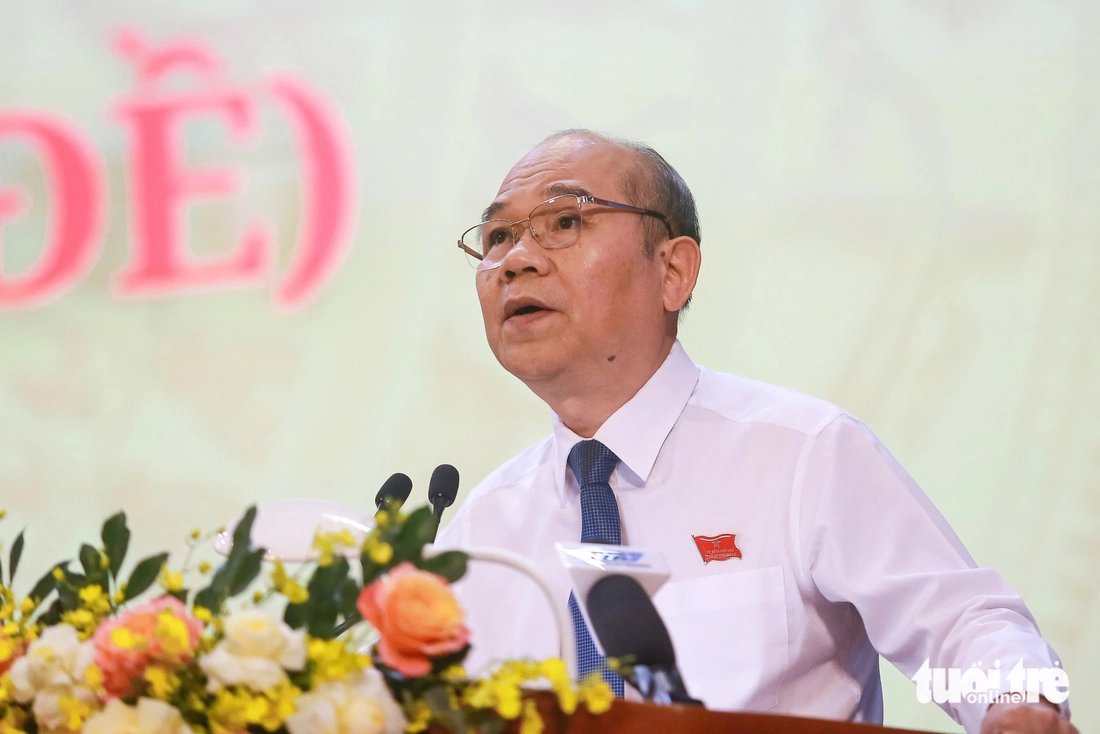
On December 26, at the Ba Ria – Vung Tau Conference Center, Ba Ria Ward, the People’s Council held its seventh (thematic) session.
This is an important session in the context of the National Assembly having just passed Resolution No. 260 on December 11, amending and supplementing several articles of Resolution 98 on piloting a number of mechanisms for the development of Ho Chi Minh City.
Chairman of the Ho Chi Minh City People’s Committee Nguyen Van Duoc, Chairman of the Ho Chi Minh City People’s Council Vo Van Minh, and leaders of the City Party Committee, People’s Council, People’s Committee of Ho Chi Minh City, along with delegates and guests attended the session.
Concretizing the National Assembly’s Resolution
In his opening speech, Deputy Secretary of the City Party Committee, Chairman of the Ho Chi Minh City People’s Council Vo Van Minh stated that amending and supplementing the special resolution is of particular significance, unclogging and filling institutional bottlenecks in decentralization and devolution of power.
Thereby, it mobilizes and utilizes resources, maximizes the potential and advantages of Ho Chi Minh City post-merger, creating new momentum for sustainable growth and development.
The Ho Chi Minh City People’s Council will focus on reviewing and deciding important contents to concretize the implementation of Resolution No. 260/2025/QH15 amending Resolution No. 98/2023/QH15, ensuring special mechanisms and policies are promptly put into practice.
Unclogging and creating strong momentum for socio-economic development, enhancing the effectiveness and efficiency of state management, and stabilizing people’s lives.
The City People’s Council will also consider, discuss, and decide on other contents that have a direct and broad impact on the implementation of socio-economic development tasks, people’s lives, and enhancing the effectiveness and efficiency of state management by the city government in the coming time.
Including land price tables, policies for key public and inter-regional investment projects, railway project investment procedures, list of land areas planned for pilot projects, and other important issues in the fields of culture – society, and national defense – security.

“Extending” metro lines, building free trade zones…
Reporting at the session, Vice Chairman of the Ho Chi Minh City People’s Committee Tran Van Bay said that formulating and issuing a Resolution of the Ho Chi Minh City People’s Council to implement Resolution No. 260/2025/QH15 has a legal basis and is necessary to continue concretizing the provisions of the National Assembly’s Resolution into specific content, with implementation timelines and responsible agencies.
Specifically, the Ho Chi Minh City People’s Committee submits to the City People’s Council for consideration and approval contents to concretize Resolution No. 260 regarding: deciding on the use of local budget to implement independent public investment projects for compensation, support, and resettlement work for investment projects according to separate urban design plans.
Urban planning for areas adjacent to stations of approved railway lines, and areas adjacent to traffic intersections along the Ring Road 3 section within the city’s territory.
For land recovery, urban renovation and development, resettlement implementation, creating a land fund for auctioning land use rights to implement projects or for payment to investors implementing railway projects under the BT (Build-Transfer) model.
The City People’s Council will also pass contents related to the Ho Chi Minh City master plan, regulations on procedures for establishing, expanding, adjusting boundaries of free trade zones, adjusting and supplementing new railway projects located within Ho Chi Minh City…
These are