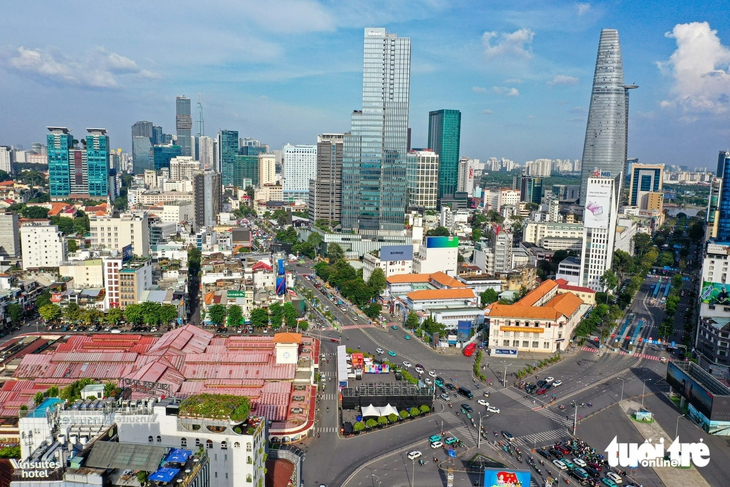
Metro Line 2 (Ben Thanh – Tham Luong) has been adjusted to increase its length by approximately 200 meters, connecting to Ben Thanh Station to ensure the requirement for synchronized connection with Metro Line 1.
The Ho Chi Minh City People’s Committee has just issued a decision approving the route plan and project location along the route for the mid-term report of the feasibility study adjustment for the project (Ben Thanh – Tham Luong).
Accordingly, the Metro Line 2 project will have a total length of nearly 11.27 km, starting at Ben Thanh Station and ending at Tham Luong Depot. The project passes through 14 wards in Ho Chi Minh City, including Ben Thanh, Ban Co, Xuan Hoa, Hoa Hung, Vuon Lai, Nhieu Loc, Tan Hoa, Tan Son Nhat, Bay Hien, Tan Binh, Tan Son, Tay Thanh, Tan Son Nhi, and Dong Hung Thuan.
The main contents related to adjusting the route plan and project location involve increasing the length of the Metro Line 2 project by about 200 meters to ensure the requirement for synchronized connection with Metro Line 1 at Ben Thanh Station.
The project’s boundaries have also been adjusted at some station locations, primarily utilizing public land without reclaiming residential land.
The Ho Chi Minh City People’s Committee assigned the City’s Urban Railway Management Board to continue reviewing and assessing the impact of the Ben Thanh – Can Gio railway project and other metro projects in the area on the route plan and project location of Metro Line 2.
Simultaneously, the board is to report to the Chairman of the Ho Chi Minh City People’s Committee for consideration and decision on not organizing an architectural design competition for the projects along the route.
The Ho Chi Minh City Urban Railway Management Board is to complete the determination of the conventional center points of stations and the depot in the Metro Line 2 project dossier as a basis for determining the centers of TOD areas.
The Ho Chi Minh City Department of Agriculture and Environment, in coordination with the City’s Urban Railway Management Board, will review and assess the possibility of land reclamation within the adjusted boundary area at Ben Thanh Station.
According to the Ho Chi Minh City Urban Railway Management Board, Metro Line 2 is the first project to apply specific mechanisms and policies under National Assembly Resolution No. 188.
After switching the funding source from ODA to public investment, the city is currently organizing procedures to adjust the Metro Line 2 (Ben Thanh – Tham Luong) project. The total adjusted investment is estimated at approximately 57,000 billion VND.
According to the plan, Ho Chi Minh City will organize the groundbreaking ceremony for the entire line before January 15, 2026, to welcome the 14th National Party Congress.
The city has currently approved the technology plan to be applied for Metro Line 2 and has requested the Ministry of Construction to consider and agree on the list of primary regulations and standards to be applied for the project.
Accordingly, Metro Line 2 will upgrade its automation level to GoA4, meaning fully automated operation without a train driver or onboard staff. The selection of the new technology complies with the principles of applying the European standard system, integrating advanced technology, and fully meeting current Vietnamese regulations and standards.
The Ho Chi Minh City Department of Construction has just sent an urgent document to the Ho Chi Minh City People’s Committee regarding the technology plan, regulations, and primary technical standards to be applied for Metro Line 2 (Ben Thanh – Tham Luong).