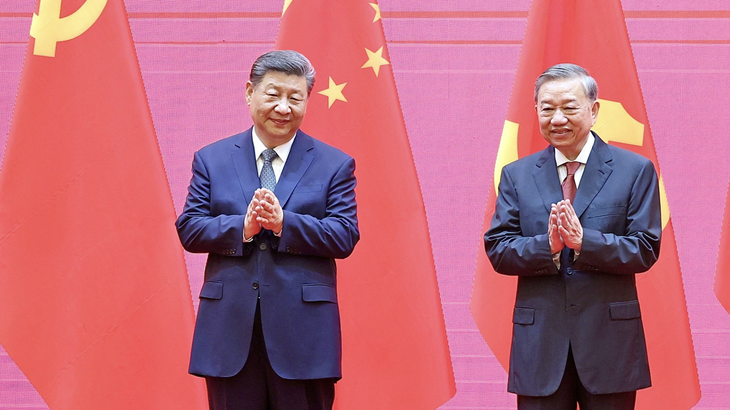
State visit to China by General Secretary and President To Lam marks the third bilateral visit by the top leaders of the two Parties and countries in less than two years.
At the invitation of General Secretary and President of China Xi Jinping and his wife, along with his wife and a high-level Vietnamese delegation, will pay a state visit to China from April 14 to 17.
Special Significance of the Visit
In a pre-visit interview, it was stated that this is the first state visit by General Secretary and President To Lam in his capacity as the top leader of the Party and State, taking place exactly one year after the visit to Vietnam by General Secretary and President Xi Jinping (from April 14 to 15, 2025).
“Simultaneously, this is the third time in less than two years that the top leaders of the two Parties and countries have exchanged bilateral visits,” it was added.
This visit, according to the official, holds three special significances.
First, the visit marks a new beginning in bilateral relations as both countries enter new development phases: Vietnam steps into a new development era following the very successful 14th National Party Congress, and China begins implementing its 15th Five-Year Plan for Economic and Social Development.
“The early organization of this visit by both sides demonstrates the top priority and high determination of both parties to develop the ‘comrades and brothers’ relationship to become more stable, solid, and substantive in the time ahead,” the official assessed.
Furthermore, the visit is a very important occasion to elevate the strategic bond and establish a new height for the relations between the two Parties and countries.
The top leaders of the two Parties and countries will jointly identify new orientations and breakthroughs in economic-trade, and tourism cooperation, supply chain and production chain cooperation, education and training, science and technology, and work together to realize the development goals and aspirations of each country.
Another significance, according to the official, is that the visit will contribute to strengthening political trust, promoting solutions to resolve some remaining differences and obstacles, and enhancing people-to-people exchanges and local cooperation. Thereby, it will contribute to making the bilateral relationship increasingly stable and solid, making positive contributions to peace, stability, and cooperation in the region and the world.
“It can be seen that the increasingly stable, effective, and substantive relationship between the two countries will significantly contribute to realizing the development goals of both Vietnam and China in the new era, contributing to maintaining stability, security, cooperation, and development amidst the current unstable and uncertain global and regional situation.
Therefore, this visit is expected to be a visit of special significance, creating a mark and new momentum for bilateral relations,” the official affirmed.
Foundation for Bilateral Relations to Enter a New High-Level Development Phase
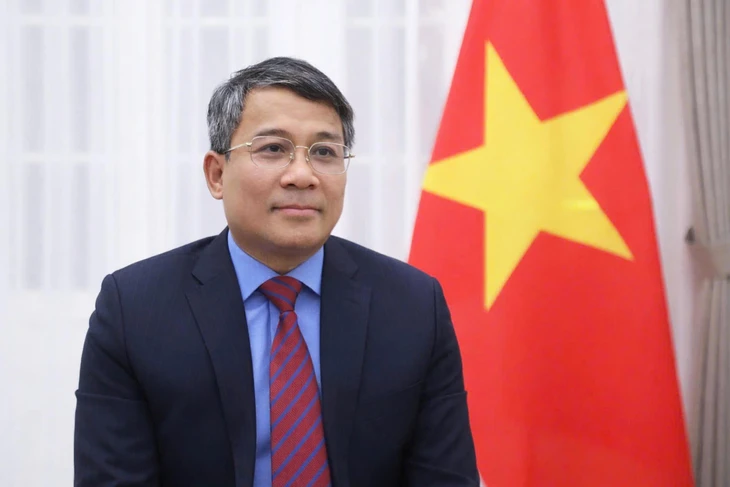
Vietnam-China relations have maintained positive development momentum in recent times, with many clear and relatively comprehensive progress steps.
Among these, political trust between the two sides has been consolidated and strengthened, continuing to play its role of strategic orientation, guiding the development of bilateral relations across fields.
Cooperation in the fields of diplomacy, national defense, and security has seen many substantive marks and transformations. Notably, the two sides have successfully organized the first session of the 3+3 Strategic Dialogue at the Ministerial level of Foreign Affairs, National Defense, and Public Security.
Substantive cooperation across fields, especially in economy, trade, and investment, has maintained strong development momentum, becoming a bright spot in the relations between the two countries. Vietnam has maintained its position as China’s largest trading partner in ASEAN for 10 consecutive years, and for two consecutive years (2024, 2025) as China’s 4th largest trading partner globally.</p