Strengthening and Restructuring Hanoi’s State Economic Sector
In Resolution No. 79-NQ/TW, the scope of the state economy has been comprehensively defined for the first time with six pillars: Land and resources; public assets and infrastructure; state budget; state-owned enterprises; state credit institutions; and public non-business units.
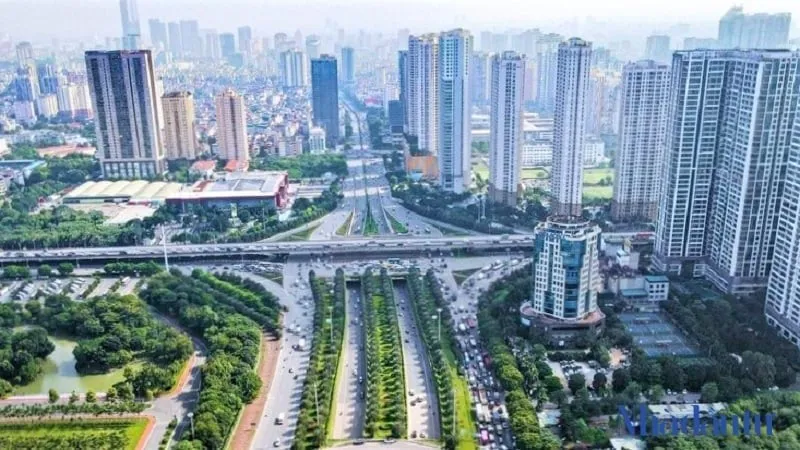
Through a comprehensive review and assessment of these six resource pillars, it is evident that the city still has significant room for developing the state economy. Currently, Hanoi holds very large state economic resources. Hanoi has a large area of 335,984 hectares, offering potential for development. The city manages 5,773 office buildings, operational facilities, and specialized housing funds across 784 locations. Simultaneously, it manages a large technical and social infrastructure system, including a road network with a total length of 24.8 thousand kilometers, 2,438 public educational institutions from preschool to university, 42 public hospitals and a grassroots healthcare system in 126 communes and wards, 6,489 historical-cultural relics, and 4,570 cultural institutions.
The city has 54 enterprises with state capital, where the total state capital held is 28,623 trillion VND. State-owned enterprises play a core role in providing essential public services and in some sectors with a spreading effect; there are 2,867 public non-business units, playing an important role in providing essential public services such as education, healthcare, culture…
Hanoi is not only a large locality but must also play a central role in leading, creating, and spreading development. Therefore, strengthening and restructuring the state economic sector is seen as an important foundation, creating “material internal strength” for the Capital to make breakthroughs in the new period.
In the multi-sector economic structure of the Capital, the state economy has always been determined to play a leading role, especially in key areas such as transport infrastructure, energy, finance – budget, land, and public services. However, in the context of deep and broad integration and increasingly high competition, the requirement to enhance the efficiency, governance capacity, and competitiveness of this sector is more urgent than ever.
Resolution No. 79-NQ/TW is not merely about adding new policies but shows an important step in perfecting the strategic architecture of national development.
For Hanoi – a place that converges great national strength and resources, this is not only a policy implementation requirement but also an opportunity to affirm its role as a locomotive, a center for spreading value and shaping development standards for the whole country.
Nevertheless, it is necessary to distinguish between the Central state economy in Hanoi and Hanoi’s own state economy for accurate assessment, because the operational mechanism of the Central state economy is decided by the Central government. Hanoi’s state-owned enterprises are being managed under the common national institutional framework. Hanoi has a large scale, so the Central government has issued separate resolutions multiple times to address issues for Hanoi. However, it must be emphasized that Hanoi has a completely different stature, and such solutions are still insufficient. Hanoi’s state economic sector remains constrained by the common institutional framework.
Fundamentally, it can be seen that Hanoi’s state economy has made good efforts, but the institutional framework has not reached a level that allows Hanoi to grow in line with its advantages and actual capacity. Opening up for Hanoi should not only be about loosening mechanisms, as that would make it difficult for Hanoi to achieve breakthroughs.
“Hanoi’s state economy needs to be unblocked, including in terms of resources, not just in the enterprise sector. Hanoi needs to go first, creating a development model; not competing with the whole country but competing with major cities in the region and the world.”
Granting Maximum Authority and Responsibility for the Capital to Rise
Regarding the requirements for Hanoi’s state economy in the coming period, it is emphasized that first, the city’s leadership apparatus must establish a non-linear vision, transitioning to a different era of development.
To shape the game, Hanoi must clearly envision its future, meaning it must compete globally, stand shoulder to shoulder with the world, and from there build a path to that goal. The primary mission is to establish a vision for semiconductor industry,