Traffic barriers and lane diversions begin for construction of two underground stations on Metro Line 5.
Before the official barriers are installed, a trial barrier setup and test operations will be conducted over three days to observe and adjust the traffic plan to suit actual conditions.
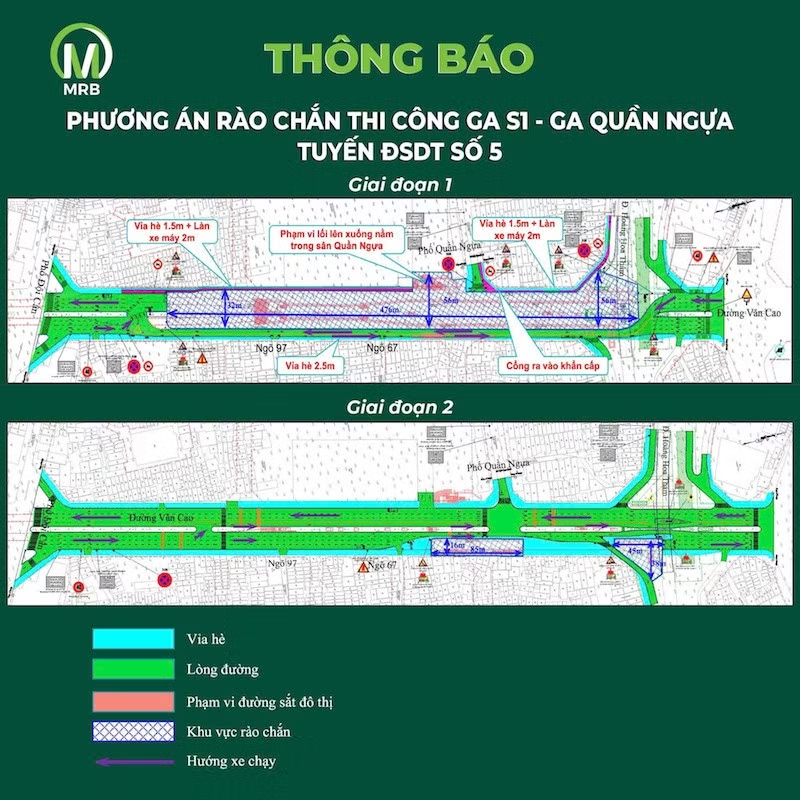
In the area of station S1 (Van Cao Street), the barrier installation and traffic organization plan will be divided into two phases.
Phase 1: Install fixed barriers on the central median and the entire carriageway of Van Cao Street on the side of Quan Ngu Stadium (length 476m, width from 20m to 40m); Organize fixed barriers on the central median of Van Cao Street for approximately 3 lanes adjacent to the existing median, in the direction of West Lake (length 476m, width from 12m to 16m).
Phase 2: Install barriers to serve the construction of auxiliary structures in the area opposite Quan Ngu Street (length 85m, width about 16m) and the area near the ramp to the Hoang Hoa Tham overpass in the direction of West Lake (length 45m, width from 38m); simultaneously, the sidewalk on Van Cao Street will be cut to create a temporary road. The remaining traffic lane width will be about 2m (on the stadium side) and 7.5m (on the West Lake direction side).
Barrier plan for the construction of station S3 (Ring Road 1 Station).
In the area of station S3 (the Nguyen Chi Thanh – La Thanh intersection), barrier installation will be organized in multiple phases to construct the diaphragm walls, main structure, and auxiliary structures.
The project will closely coordinate its schedule with the Ring Road 1 project in this area.
The plan here is to cut the sidewalk on Nguyen Chi Thanh Street (approximately 276m long) to create a temporary road, ensuring a remaining road width of 6.5m to 7.5m on each side for vehicle traffic.
Comprehensive measures will be implemented to ensure traffic safety and environmental hygiene.
According to this plan, 2.5m high reflective metal sheet barriers will be installed, along with a system of remote guidance signs, lighting, and warning lights for nighttime.
At corners, B40 mesh will be used to ensure visibility for traffic participants.
Construction sites will be equipped with misting systems for dust suppression, vehicle washing facilities on-site, and timely removal of construction waste to ensure environmental hygiene; traffic guidance personnel will be arranged for 24/7 duty in coordination with Traffic Police to promptly handle incidents and avoid congestion.
Urban railway line No. 3 Nhon-Hanoi Station has put the elevated Nhon-Cau Giay section into operation, contributing to improved traffic on the route from the western gateway into the capital center.
Line No. 5 has the following route: starting from the area where Van Cao Street intersects with Hoang Hoa Tham Street, running underground along Van Cao-Lieu Giai-Nguyen Chi Thanh-Tran Duy Hung streets. After passing the National Convention Center, the line runs at grade on the central median of Thang Long Avenue and the Hoa Lac-Hoa Binh Expressway to the end of the line. The project concludes at station S20 (in Hoa Lac commune area), with provisions reserved to potentially extend the line in the future to the area of the Vietnam National Village for Ethnic Culture and the Hanoi-Phu Tho inter-regional railway, should the need arise.
Urban railway line No. 5 has a total length of 39.585km, of which 6.56km is underground, 5.21km is elevated, and 27.815km is at grade. The maximum design speed is 120km/h (the tunnel section is 90km/h).
The line has 20 stations.
<div class="my-4 p-4 rounded-lg shadow-md
Quan Ngu Stadium
Quan Ngu Stadium is a multi-purpose stadium located in Da Nang, Vietnam, primarily used for football matches. It was originally built during the French colonial period in the 1950s and has since undergone several renovations. The stadium serves as the home ground for SHB Da Nang FC and has hosted various national and regional sporting events.
West Lake
West Lake is a renowned freshwater lake in Hangzhou, China, celebrated for its picturesque scenery of gardens, pagodas, and temples that have inspired poets and artists for centuries. Its cultural landscape was intentionally crafted, with much of its current form and surrounding structures dating back to the Tang and Song dynasties, when it became a symbol of idealized harmony between humans and nature. Recognized as a UNESCO World Heritage Site, it remains a prime example of Chinese landscape design and a cherished cultural treasure.
Hoang Hoa Tham overpass
The Hoang Hoa Tham overpass is a major traffic interchange in Hanoi, Vietnam, constructed to alleviate chronic congestion at a key intersection near the city’s West Lake area. It was completed and opened to traffic in 2015, named after the national hero Hoang Hoa Tham, a leader of anti-colonial resistance in the late 19th and early 20th centuries. The structure is a vital part of the city’s modern transportation infrastructure, improving connectivity between several central districts.
Nguyen Chi Thanh – La Thanh intersection
The Nguyen Chi Thanh – La Thanh intersection is a major traffic junction in Hanoi, Vietnam. It is named after General **Nguyen Chi Thanh**, a prominent military leader in the Vietnam War, and **La Thanh**, an ancient name for a section of the Thang Long citadel walls, linking the site to Hanoi’s historic defenses. Today, it is a bustling modern crossroads near significant government and diplomatic institutions.
National Convention Center
The National Convention Center is a major modern venue in Beijing, China, built for large-scale international conferences and exhibitions. It was originally constructed to host the 1995 United Nations Fourth World Conference on Women and has since been a key site for major political and economic events, including the 2008 Summer Olympics and the annual China Development Forum.
Thang Long Avenue
Thang Long Avenue is a major modern thoroughfare in Hanoi, Vietnam, named after the ancient Thang Long Citadel, the historic political and cultural heart of the city for over a millennium. While the avenue itself is a contemporary development, its name honors the legacy of the former imperial capital, symbolizing the connection between Hanoi’s rich past and its rapid modern growth.
Vietnam National Village for Ethnic Culture
The Vietnam National Village for Ethnic Culture is a large open-air museum and cultural complex located on the outskirts of Hanoi. Established to preserve and promote the heritage of Vietnam’s 54 ethnic groups, it features authentic reconstructions of traditional houses, communal spaces, and hosts regular festivals and craft demonstrations. It serves as both a living museum and a center for cultural exchange, officially opening to the public in 2010.
Hanoi-Phu Tho inter-regional railway
The Hanoi-Phu Tho inter-regional railway is a planned railway line in northern Vietnam, intended to connect the capital Hanoi with Phu Tho province. Its history is rooted in modern development plans, designed to improve regional connectivity, reduce road congestion, and support economic growth in the Red River Delta region. As of now, it remains a key infrastructure project under development, not yet constructed or operational.