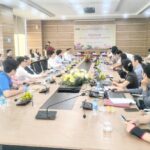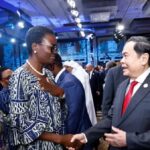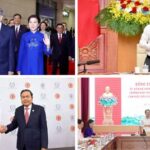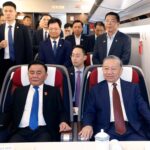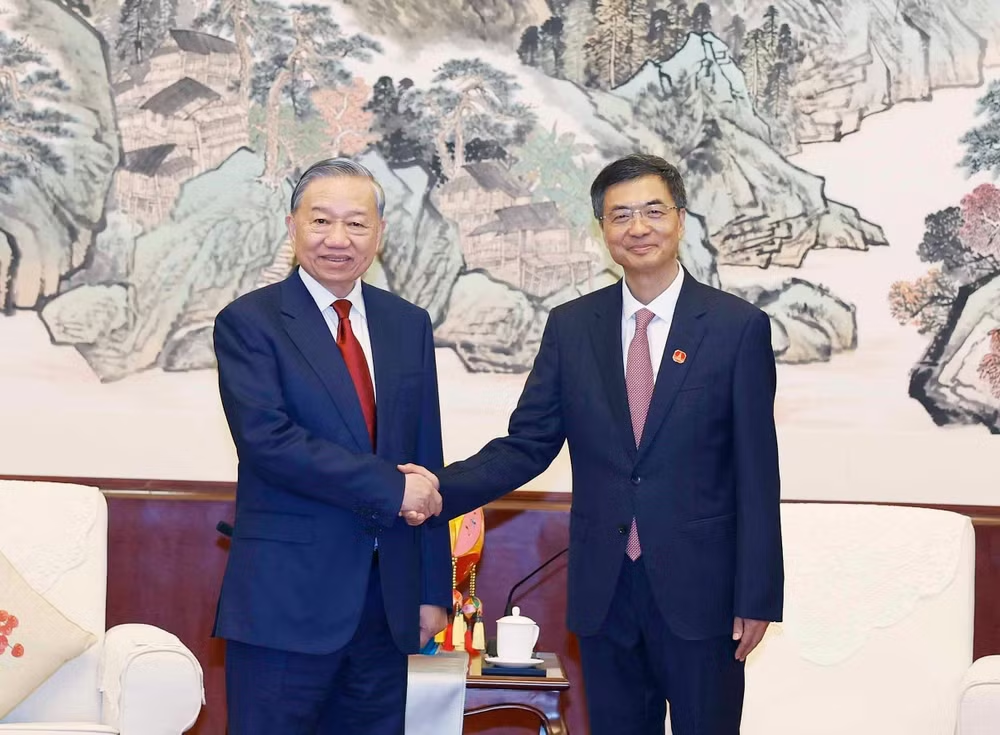
During the meeting, General Secretary and President To Lam congratulated Guangxi on its development achievements; expressing confidence that Guangxi will become a prosperous, beautiful, and modern socialist autonomous region.
The General Secretary and President expressed deep appreciation that Guangxi was once the “great rear area” in Vietnam’s struggle for national independence, the place where, 85 years ago, President Ho Chi Minh returned to Cao Bang to directly lead the Vietnamese revolution; hoping that Guangxi will continue to promote friendship, leverage its geographical proximity, and play a leading role in creating breakthroughs in strategic connectivity in cooperation with Vietnamese localities.
Secretary of Guangxi Chen Gang expressed his delight and honor in welcoming General Secretary and President To Lam to Guangxi during his state visit to China. Emphasizing that Vietnam is a close neighbor, a dear friend, and a top partner for Guangxi, Comrade Chen Gang affirmed that the Party Committee and government of the Guangxi Zhuang Autonomous Region attach special importance to friendly relations and cooperation with Vietnamese localities; they will continue to take the lead in comprehensively and effectively implementing the important common perceptions of the two General Secretaries and Presidents, contributing to deepening exchange and cooperation and strengthening the friendly sentiments between China and Vietnam.
Both sides were pleased to review the positive progress in exchanges and cooperation between Vietnamese ministries, sectors, localities and Guangxi in recent times, especially the regular exchanges and contacts at various levels, and the promotion of economic, trade, and scientific-technological cooperation. Vietnam has been Guangxi’s largest trading partner for 27 consecutive years.
Regarding future cooperation, it was proposed that Guangxi and Vietnamese localities create breakthroughs in five strategic connections: development policies, economy-trade, logistics infrastructure, science, technology, and social foundations.
Accordingly, the General Secretary and President expressed hope that Guangxi will effectively implement the Spring Meeting program between Provincial/City/Regional Party Committee Secretaries, and between border provinces/cities, expanding cooperation with other localities in Vietnam.
The two sides shared experiences on development policies and local planning; strengthening exchanges, promoting deeper and broader economic linkages, especially in trade and infrastructure, ensuring smooth customs clearance; linking bilateral trade with infrastructure connectivity, logistics connectivity, supply chain connectivity, and market connectivity; accelerating multimodal rail, road, and sea connections; giving the highest priority to railway cooperation, including the standard-gauge railway lines Lang Son-Hanoi and Mong Cai-Ha Long-Hai Phong.
Regarding science-technology connectivity, General Secretary and President To Lam proposed that both sides enhance cooperation in artificial intelligence application, implementing projects in Vietnam for green agriculture, clean energy, renewable energy, and high-tech processing. The General Secretary and President also hoped that both sides would cooperate closely, manage the land border well, promptly resolve existing and arising issues; create favorable conditions for people-to-people exchanges, fully exploit tourism potential, contributing to the overall success of the Vietnam-China Tourism Cooperation Year 2026-2027.
Expressing strong agreement with the important guiding opinions of General Secretary and President To Lam, Secretary Chen Gang affirmed that Guangxi will have specific action programs to implement the common perceptions of the two General Secretaries and Presidents; hoping that both sides would further promote substantive cooperation in various fields, infrastructure connectivity, especially railways, and cooperate with Vietnam in high-tech fields that Guangxi is focusing on developing, such as AI and big data.
Emphasizing that Vietnam’s high-quality agricultural products are always favored by Guangxi consumers, Secretary Chen Gang affirmed that Guangxi is ready to promote the import of more agricultural products, not only to meet the needs of the Guangxi market but also to reach other parts of China through Guangxi. Secretary Chen Gang also proposed that both sides accelerate the construction of smart border gate pilot projects, facilitating goods trade; strengthening friendly exchanges and mutual understanding between the people and localities of Vietnam.