Facing increasing pressure from organic waste in Vietnam, black soldier flies were once seen as an effective solution. However, practical implementation has shown that the challenge lies not only in technology but also in market thinking, financial structures, and investment culture, demanding a more comprehensive approach.
The Storm of Organic Waste and Untapped Potential
Every day, Vietnam generates over 60,000 tons of domestic waste, with organic waste accounting for a large proportion. The pressure for treatment is increasing, while traditional methods like landfilling remain widely used, making the environmental issue not just a technical matter but also one of development thinking and corporate financial structure. In this context, black soldier fly technology was once hoped to be the “golden key” for organic waste treatment, but actual implementation has proven to be a bumpy journey.
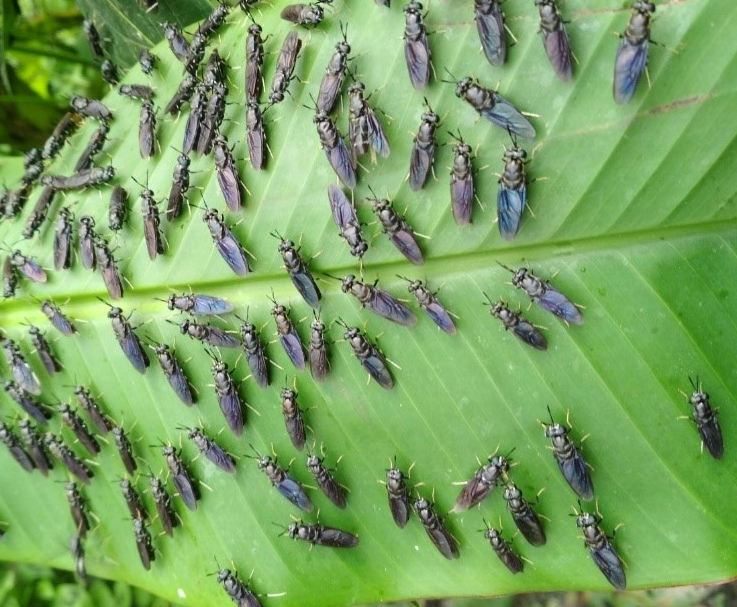
Vietnam is currently among the countries generating large amounts of waste in Southeast Asia. More than half of the waste is organic, but most of it is still treated by landfilling. This method pollutes soil and water and emits greenhouse gases. Notably, within this “mountain of waste” lies a potential source of renewable resources. Technology using black soldier fly larvae allows for rapid processing of food waste, significantly reducing the initial waste volume while creating economically valuable products like protein-rich animal feed or organic fertilizer. However, this potential remains underutilized, as businesses are hesitant to invest and the market is not yet ready to accept it.
Paradoxes in the Stock Market and “Empty” Commitments
Looking from the stock market, the bottlenecks in the environmental sector become even clearer. Many listed companies still operate with short-term profit logic, viewing environmental services as a regular business segment rather than a commitment to sustainable development. The proportion of profits retained for reinvestment in technology remains low, while cash dividends are maintained at high levels. This makes innovative projects like black soldier fly technology difficult to develop in the long term.
Another paradox lies in how the market values environmental companies. Despite holding an essential role, many companies in the sector are undervalued, with P/E ratios often significantly lower than the general average. Behind the financial story is a cultural factor: waste treatment work is still not properly valued and is even associated with social prejudices. When investors do not see this as a field that creates sustainable value, long-term capital flows are difficult to attract.
A lack of transparency in information disclosure also contributes to worsening this situation. Although most companies declare they pursue environmental protection goals, reports often stop at general commitments. Many businesses, even in the environmental sector, still do not provide sufficient data on emissions or ESG indicators, making it difficult for investors to assess the actual effectiveness of sustainable operations.
From Technical Efficiency in Soc Trang to the Problem of Ecological Intelligence
The practical implementation of new technology also reveals significant challenges. Soc Trang Urban Works Joint Stock Company (stock code: USD) is the only environmental company on the stock exchange that has experimented with investing in a black soldier fly project to treat organic waste. According to the project manager, with just 10 grams of black soldier fly eggs, the system can process 10 kg of organic waste, while producing 10 kg of nutrient-rich larvae in just 15 days.
Although the waste processing capability of black soldier flies is promising, the company has currently had to suspend the project’s operations. The reason does not lie in the technology, but in the product output. The main product of the process is fresh larvae, which can only be supplied to niche markets like ornamental chicken farms. This makes scaling up difficult. Additionally, the lack of source-separated organic waste also increases costs and hinders the mechanization process.
These difficulties show that the limited consumption capacity of output products and the lack of integrated planning in the waste separation and treatment process can significantly affect the success potential of projects using biological technologies like black