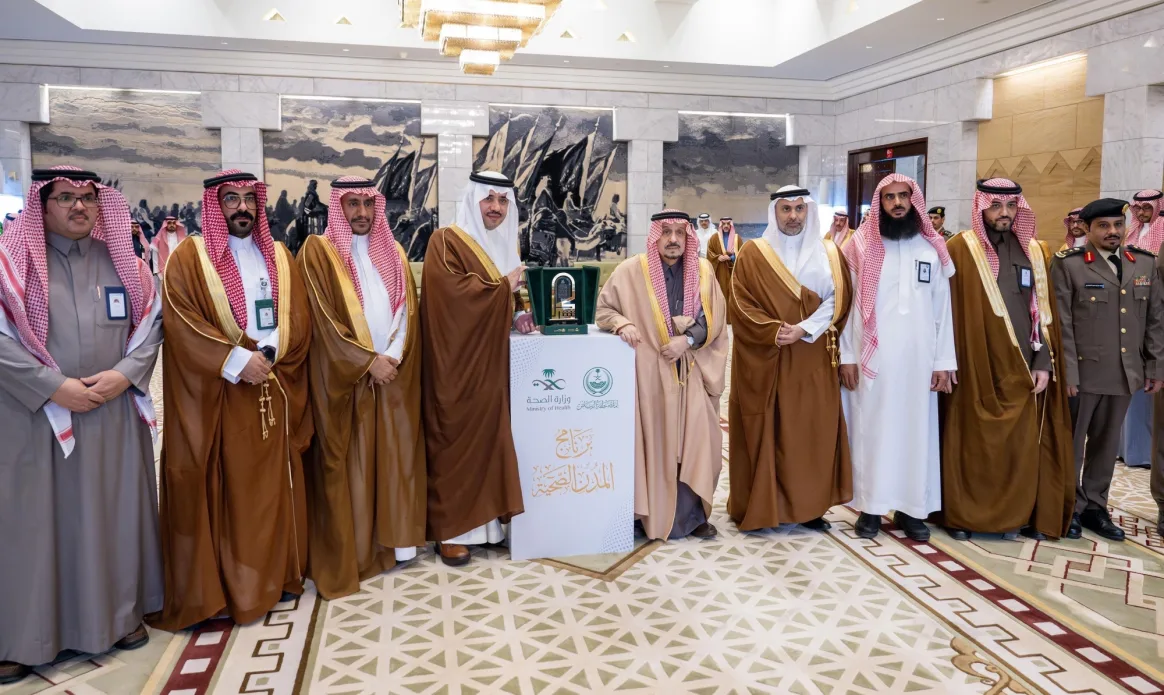
Prince Faisal bin Bandar bin Abdulaziz, the Emir of the Riyadh Region, received the certificates accrediting Al-Ghat and Al-Zulfi governorates as healthy cities from the World Health Organization. This occurred during his reception of the Minister of Health, Fahad Al-Jalajel, in his office.
The Emir of the Region praised this health achievement, which adds to the region and its governorates. He emphasized that the significant support received by the health sector from the leadership enhances the quality of services and aligns with the goals of Vision 2030.
The accreditation of Al-Ghat and Al-Zulfi as healthy cities reflects the Kingdom’s commitment
For his part, the Minister of Health explained that the accreditation of Al-Ghat and Al-Zulfi as healthy cities reflects the Kingdom’s commitment to promoting prevention and quality of life. It represents a model of integration between governmental and community entities in building sustainable healthy environments.
With this accreditation, the number of healthy cities in the Kingdom rises to 16 cities. This enhances its leadership at the level of the Eastern Mediterranean and North Africa region and contributes to building sustainable urban and healthy environments that promote quality of life.
Al-Ghat
Al-Ghat is a historic oasis town in Saudi Arabia’s Riyadh Province, known for its lush palm groves and traditional Najdi architecture. It served for centuries as a vital resting point on ancient trade and pilgrimage routes across the Arabian Peninsula. Today, it is recognized for its well-preserved mud-brick fortress and as a cultural hub included in Saudi Arabia’s development plans for heritage tourism.
Al-Zulfi
Al-Zulfi is a city in the Riyadh Province of Saudi Arabia, historically significant as a major settlement in the Najd region. It developed around a vital oasis and ancient trade routes, and its history is deeply intertwined with the formation of the First Saudi State in the 18th century. Today, it is a modern administrative hub while retaining its cultural heritage as part of the country’s heartland.
Riyadh Region
The Riyadh Region is the central heartland of Saudi Arabia, home to the nation’s capital and largest city, Riyadh. Historically a pivotal oasis settlement and the seat of the historic First and Second Saudi States, it transformed dramatically in the 20th century following the discovery of oil, becoming a modern global metropolis and the country’s political, administrative, and financial center.
Kingdom
“Kingdom” is too broad a term for a specific place or cultural site, as it could refer to many historical or modern nations (like the United Kingdom), ancient realms (like the Kingdom of Kush), or even theme parks (like Disney’s Magic Kingdom). For a meaningful summary, please specify a particular kingdom. For example, the **Kingdom of Saudi Arabia** is a modern sovereign state founded in 1932, unifying the regions of Najd and Hejaz under the House of Saud.
Eastern Mediterranean
The Eastern Mediterranean is a historically rich region encompassing the coastal lands and islands around the eastern basin of the Mediterranean Sea. It is famously considered a cradle of Western civilization, having been home to ancient cultures like the Egyptians, Phoenicians, Greeks, and later the Byzantine and Ottoman Empires. Its history is deeply marked by trade, cultural exchange, and conflict, leaving behind a legacy of archaeological sites, diverse religions, and layered traditions.
North Africa
North Africa is a vast region encompassing countries such as Morocco, Algeria, Tunisia, Libya, and Egypt, historically defined by the Sahara Desert and Mediterranean coast. Its history is a rich tapestry of ancient indigenous Berber civilizations, major empires like Carthage and Rome, and later Arab-Islamic conquests that profoundly shaped its culture and identity. This legacy is visible in its diverse archaeological sites, historic medinas, and unique blend of Arab, Amazigh (Berber), and European influences.
Vision 2030
“Vision 2030” is not a specific physical place or cultural site, but rather Saudi Arabia’s comprehensive strategic framework to transform its economy and society by the year 2030. Launched in 2016 under Crown Prince Mohammed bin Salman, its history is rooted in the need to diversify the nation away from oil dependency, focusing on developing sectors like tourism, technology, and entertainment. The plan has led to the creation of major projects like the futuristic city NEOM, which serve as physical manifestations of this national vision.
World Health Organization
The World Health Organization (WHO) is a specialized agency of the United Nations, established in 1948 with the primary objective of promoting global public health. It coordinates international responses to health emergencies, sets health standards and guidelines, and works to ensure the highest attainable level of health for all people worldwide.