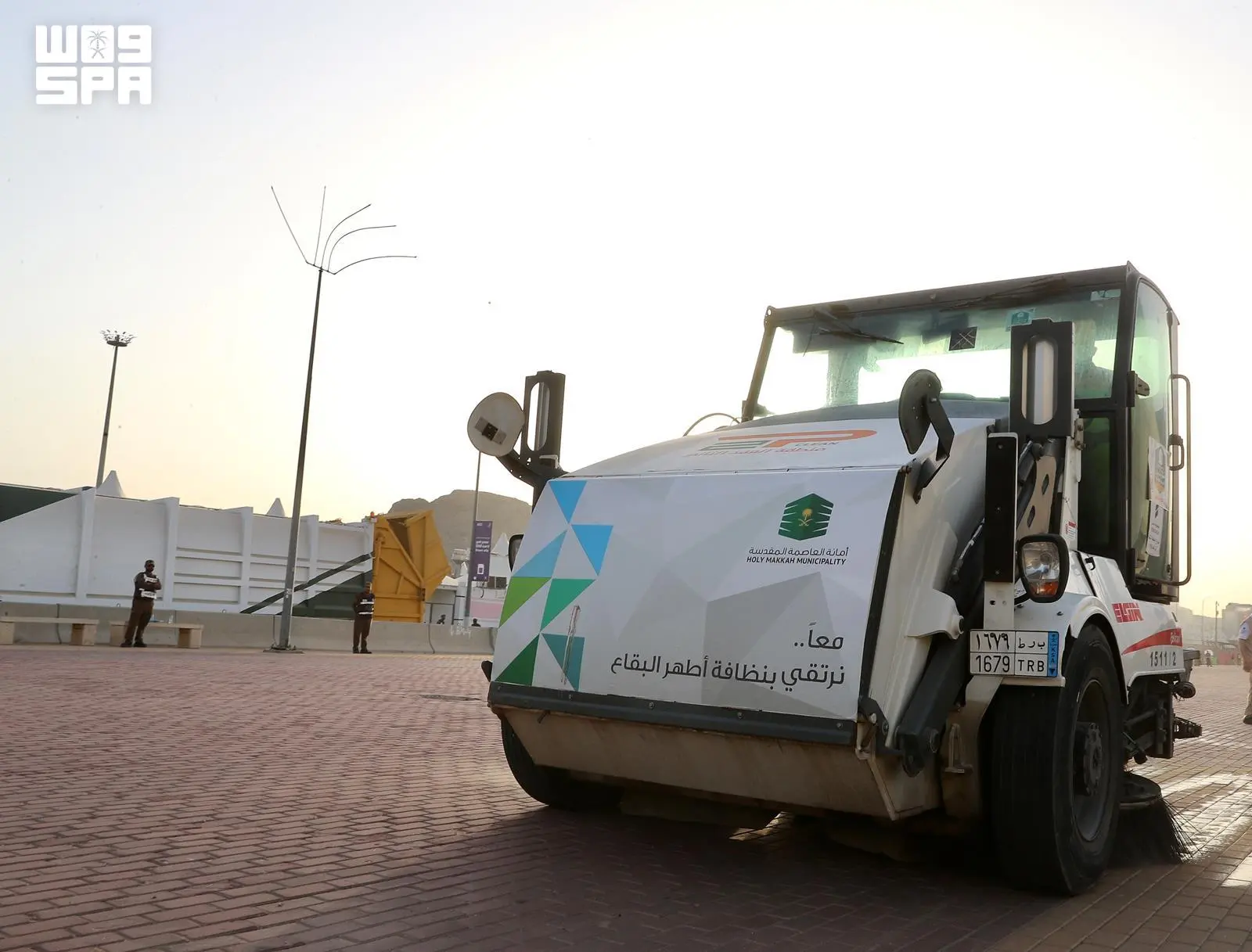
The Ministry of Municipalities and Housing, represented by the Holy Capital Municipality, intensified its field efforts in the Arafat area as part of the services provided to pilgrims during the Hajj season of 1447 AH. More than 5,000 tons of waste were removed and cleared, equivalent to the load of over 330 large transport trucks, as part of maintaining public cleanliness and enhancing environmental health in the holy sites.
The work included operating and equipping specialized machinery, vehicles, and field units, along with deploying approximately 8,000 waste containers distributed across various locations in Arafat. This contributed to improving the efficiency of continuous waste collection, transport, and disposal. Additionally, environmental sanitation, washing, and sterilization operations were carried out around the clock in high-density areas.
The municipality bolstered its operational efforts with specialized field teams and machinery for rapid cleaning and removal, ensuring the readiness of the holy sites and the continuity of services during crowd movements and transfers between the sites, especially around pilgrim camps and pedestrian pathways.
Inspection teams continued their intensive work on catering kitchens and commercial activities to ensure compliance with health regulations and organizational guidelines, guaranteeing the safety of food provided to pilgrims and the quality of services offered to them.
During the Hajj season, the ministry recorded over 38,000 inspection rounds on commercial activities and catering kitchens, in addition to testing more than 5,000 food samples and addressing over 770 field reports through the unified reporting center (940). This was part of its efforts to enhance health and regulatory compliance and improve the efficiency of immediate response in the holy sites.
In terms of waste management and environmental sanitation, the amount of waste and debris removed from the holy sites during the season exceeded 16,000 tons, supported by more than 22,000 personnel, including workers, supervisors, and employees. This was complemented by an integrated operational system comprising over 88,000 cleanliness units distributed across the holy sites, supported by 123 waste compactors, 45,000 containers, 1,235 compacting bins, and more than 3,000 pieces of machinery and vehicles that participated in operational and field work during the season.
Arafat
Arafat is a plain located about 20 kilometers east of Mecca, Saudi Arabia, and holds immense religious significance in Islam as the site where the Prophet Muhammad delivered his final sermon. It is a central location for the Hajj pilgrimage, where pilgrims gather on the 9th day of Dhul Hijjah for the “Standing at Arafat,” a key ritual of prayer and reflection. Historically, it is also believed to be where Adam and Eve were reunited after their expulsion from paradise.
Holy Capital Municipality
The Holy Capital Municipality refers to the administrative region encompassing Mecca, Saudi Arabia, the holiest city in Islam. As the birthplace of the Prophet Muhammad and the site of the Kaaba, Mecca has been a spiritual center for over 1,400 years, drawing millions of pilgrims annually for the Hajj and Umrah. The municipality manages the city’s infrastructure and services, balancing its sacred heritage with modern development to accommodate the growing number of visitors.
Arafat
Arafat is a plain located about 20 kilometers east of Mecca, Saudi Arabia, and is the most important site of the Hajj pilgrimage. It is traditionally considered the place where the Prophet Muhammad delivered his Farewell Sermon in 632 CE, and where, according to Islamic belief, Adam and Eve were reunited after their fall from paradise. Pilgrims gather there on the 9th day of Dhu al-Hijjah for the Day of Arafat, a key ritual of prayer and reflection.
<div class="my-4 p-4 rounded-lg shadow-md bg-blue-50 border-l-4
Arafat
Arafat is a plain located about 20 kilometers east of Mecca, Saudi Arabia, and holds immense significance in Islam as the site where the Prophet Muhammad delivered his final sermon. It is the most important location of the Hajj pilgrimage, where pilgrims gather on the 9th day of Dhu al-Hijjah for the Day of Arafah, a day of prayer and reflection. Historically, it is also believed to be where Adam and Eve were reunited on Earth after their expulsion from paradise.
Mecca
Mecca, located in Saudi Arabia, is the holiest city in Islam and the birthplace of the Prophet Muhammad. It is home to the Masjid al-Haram, which contains the Kaaba, the direction of prayer for Muslims worldwide. Historically, Mecca has been a major pilgrimage site since the time of Muhammad, and today it hosts the annual Hajj, one of the largest religious gatherings on Earth.
Holy Capital Municipality
The Holy Capital Municipality is the administrative district encompassing Mecca, Saudi Arabia, the holiest city in Islam. Its history is deeply tied to the city’s role as the birthplace of the Prophet Muhammad and the site of the Kaaba, towards which Muslims pray. For centuries, the municipality has managed the influx of millions of pilgrims during the Hajj and Umrah, while overseeing the expansion of the Grand Mosque and modern infrastructure.
Kaaba
The Kaaba is a cube-shaped structure located in the center of the Grand Mosque in Mecca, Saudi Arabia, and is the most sacred site in Islam. According to Islamic tradition, it was originally built by the Prophet Abraham and his son Ishmael as a house of monotheistic worship, and it has been a focal point for pilgrimage for centuries. Muslims around the world face the Kaaba during their daily prayers, and it is the destination of the annual Hajj pilgrimage, which dates back to the time of the Prophet Muhammad.