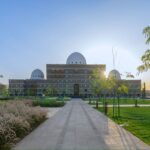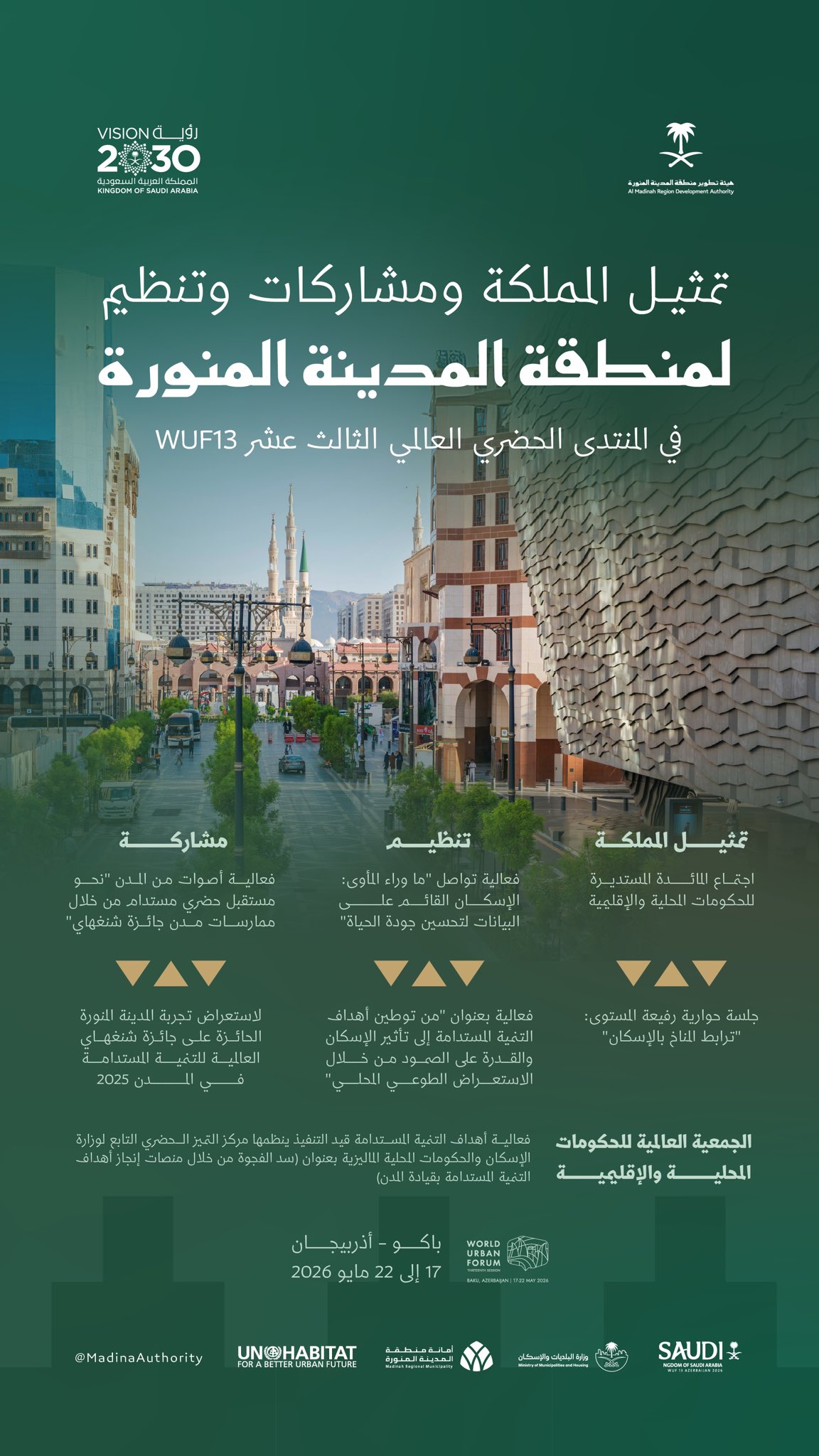
The Madinah region, as part of the Kingdom’s delegation, is participating in the thirteenth session of the World Urban Forum (WUF13), hosted by the city of Baku in the Republic of Azerbaijan from May 17 to 22. This presence highlights the Kingdom’s role in shaping the future of sustainable urban development globally. During the forum, Madinah is showcasing its experience in developing integrated urban models that redefine the concept of housing as a pillar of quality of life and a foundation for building more sustainable, efficient, and human-centered cities. The delegation from the Kingdom and the region is represented in several key forum events, including the Global Assembly of Local and Regional Governments and high-level sessions, notably the Roundtable Meeting for Local and Regional Governments and a dialogue session on the relationship between climate and housing. The Madinah Region Development Authority is organizing special events, most notably an event titled “Beyond Shelter: Data-Driven Housing for Better Quality of Life,” which presents Madinah’s model of using data as a strategic tool for urban decision-making, improving planning efficiency, and enhancing the human experience in the city. The participation also highlights Madinah’s leadership in localizing sustainable development goals at the local level through advanced urban initiatives and reports, reflecting the city’s ability to transform global frameworks into practical applications that contribute to building more resilient and sustainable communities. In recognition of its experience, Madinah is presenting its work within the “Voices from Cities” event, having won the 2025 Shanghai Global Award for Sustainable Development in Cities, affirming its status as an integrated urban model based on innovation and data, applicable globally. The region is also participating in the “Sustainable Development Goals in Action” event organized by the Centre of Urban Excellence of the Malaysian Ministry of Housing and Local Government, titled “Bridging the Gap through City-Led SDG Achievement Platforms,” aimed at showcasing Madinah’s practical experience in localizing sustainable development goals. The participation of the Madinah region as part of the Kingdom’s delegation embodies an urban transformation driven by a strategic vision that places people at the heart of development, enhancing integration between urban planning, environmental sustainability, and digital transformation, in line with the goals of welcoming 30 million visitors annually under the Kingdom’s Vision 2030. Through this participation, led by the Ministry of Municipalities and Housing, the Kingdom affirms its commitment to supporting international efforts in urban development, strengthening international partnerships, and actively contributing to building a more sustainable and prosperous urban future for people worldwide.

Madinah

Madinah, also known as Medina, is a city in western Saudi Arabia and the second holiest city in Islam. It holds profound significance as the final resting place of the Prophet Muhammad, who migrated there from Mecca in 622 CE, an event known as the Hijra that marks the beginning of the Islamic calendar. The city’s iconic Al-Masjid an-Nabawi (the Prophet’s Mosque), built around his original home and tomb, remains a major pilgrimage site for millions of Muslims each year.

Baku

Baku is the capital and largest city of Azerbaijan, located on the Caspian Sea. Its history dates back to ancient times, with the walled Inner City (Icherisheher) containing landmarks like the Maiden Tower and the Palace of the Shirvanshahs, reflecting its role as a key stop on the Silk Road. Today, Baku is known for its modern Flame Towers and vibrant culture, blending its historic heritage with rapid contemporary development.

Kingdom’s Vision 2030

“Kingdom’s Vision 2030” is Saudi Arabia’s ambitious economic and social reform plan, launched in 2016 under Crown Prince Mohammed bin Salman. Its history stems from the need to diversify the oil-dependent economy, reduce subsidies, and modernize society, aiming to transform the kingdom into a global investment

Madinah

Madinah, also known as Medina, is one of the holiest cities in Islam, located in western Saudi Arabia. It holds immense significance as the city where the Prophet Muhammad migrated in 622 CE (the Hijra), establishing the first Muslim community and mosque (Al-Masjid an-Nabawi). Today, it remains a major pilgrimage site, second only to Mecca, and is revered as the resting place of the Prophet.

Baku

Baku is the capital and largest city of Azerbaijan, located on the Caspian Sea. Its history dates back to ancient times, with the walled Inner City (Icherisheher) containing medieval structures like the Maiden Tower and the Palace of the Shirvanshahs, reflecting its role as a key trading hub on the Silk Road. In the modern era, Baku became famous for its oil boom in the late 19th and early 20th centuries, leading to rapid growth and a unique blend of historic and futuristic architecture.

Al-Masjid an-Nabawi (the Prophet’s Mosque)

Al-Masjid an-Nabawi, or the Prophet’s Mosque, is a major Islamic site located in Medina, Saudi Arabia, originally built by the Prophet Muhammad in 622 CE adjacent to his home. It served as the center of the early Muslim community and has undergone numerous expansions over the centuries, including a significant enlargement by the Umayyad caliph al-Walid I. Today, it houses the tomb of the Prophet Muhammad and is one of the holiest mosques in Islam, attracting millions of pilgrims annually.

Maiden Tower

The Maiden Tower is a iconic medieval tower located in the old city of Baku, Azerbaijan. Its exact origins are debated, but it is believed to have been built between the 12th century and the 7th century AD, serving various roles including a Zoroastrian fire temple, a defensive fortress, and later an astronomical observatory. Today, it is a UNESCO World Heritage Site and a symbol of Baku’s rich cultural history.

Palace of the Shirvanshahs

The Palace of the Shirvanshahs is a 15th-century architectural complex located in the old city of Baku, Azerbaijan. Built during the reign of the Shirvanshah dynasty, it served as the royal residence and includes a palace, mosque, mausoleum, and bathhouse, reflecting the region’s medieval Islamic culture. The site, now a UNESCO World Heritage landmark, survived centuries of change and remains a symbol of Azerbaijan’s rich history.

Flame Towers

The Flame Towers are a trio of skyscrapers in Baku, Azerbaijan, designed to resemble three tongues of fire, paying homage to the country’s historical association with fire worship and its natural gas reserves. Completed in 2012, the tallest tower reaches 190 meters and houses a hotel, while the other two contain residential and office spaces. Their facades are covered with LED screens that display dynamic flame animations, making them a striking modern landmark on Baku’s skyline.

Kingdom’s Vision 2030

“Kingdom’s Vision 2030” is Saudi Arabia’s ambitious economic and social reform plan, launched in 2016 to reduce the country’s dependence on oil and diversify its economy. The vision aims to develop public service sectors such as health, education, infrastructure, and tourism, while also empowering women and promoting cultural openness. It marks a historic shift for the kingdom, seeking to transform its society and economy by 2030 through initiatives like the NEOM megacity project and the opening of major entertainment and tourism venues.

Shanghai Global Award for Sustainable Development in Cities

The Shanghai Global Award for Sustainable Development in Cities is an international recognition program established to honor outstanding urban sustainability initiatives worldwide. Launched by the city of Shanghai in collaboration with UN-Habitat, the award aims to promote knowledge sharing and innovation in sustainable urban development practices. It highlights Shanghai’s commitment to global cooperation and serves as a platform to showcase cities that effectively balance economic growth, social equity, and environmental protection.