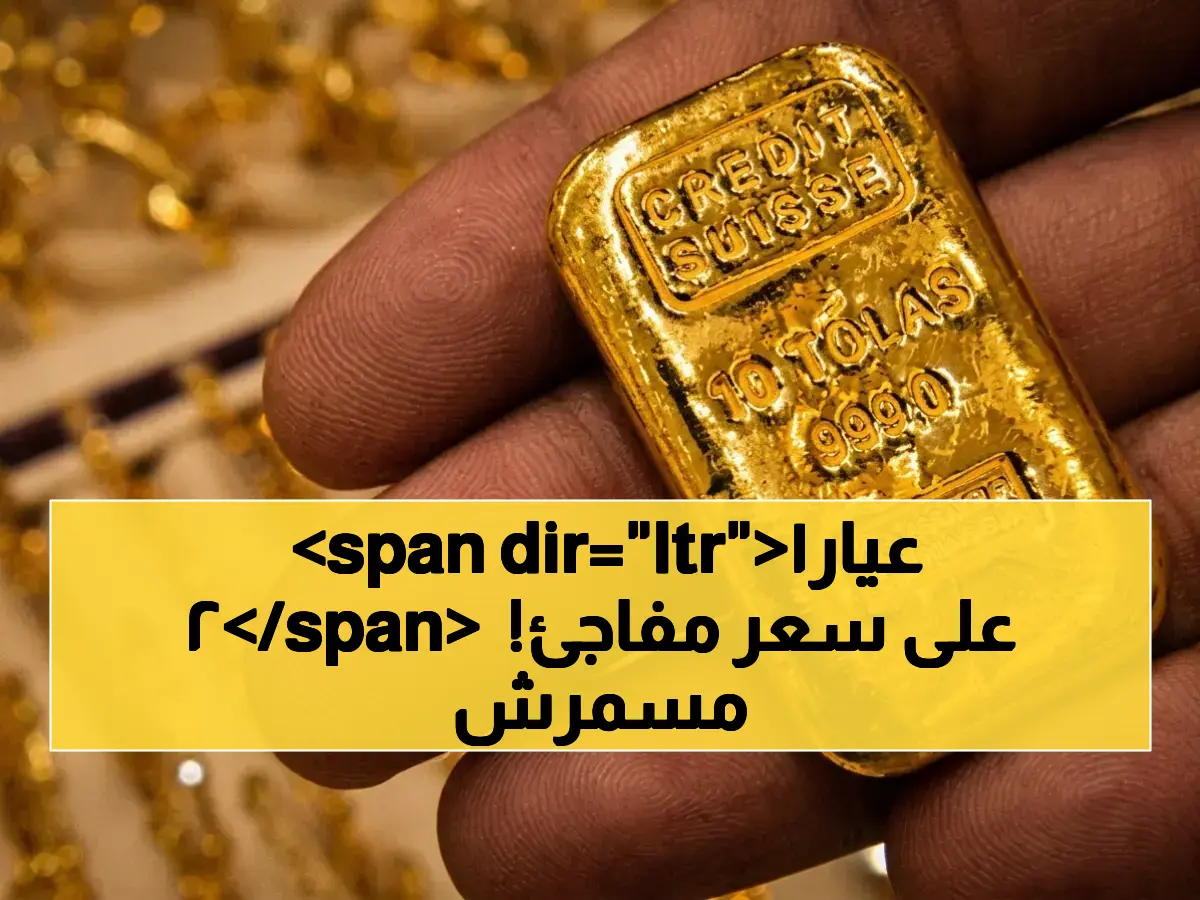
The price of a gold pound rose by 480 pounds in a single day before stabilizing at the start of Saturday’s trading session. This rapid surge was a direct response to a provocative Iranian announcement regarding the opening of the Strait of Hormuz to commercial ship traffic, which prompted investors to flee towards gold as a safe haven.
At the close of trading on Friday, the price of a gold pound was approximately 56,480 pounds, a price which does not include the manufacturing cost. The cashback value on a wrapped gold pound ranges between approximately 200 and 300 pounds.
On global markets, the ounce recorded a price of around $4,862. Meanwhile, the price of an ounce in the local market reached about 250,946 pounds.
During Saturday’s trading, prices stabilized in the local market. This notable stability reflects a relative balance between supply and demand and coincides with a calm in global price movements, which is directly reflected in the Egyptian market.
These developments come amid great anticipation from investors and citizens for global market movements, which directly affect prices locally, especially concerning US interest rate decisions and geopolitical developments.
Strait of Hormuz
The Strait of Hormuz is a strategically vital maritime chokepoint connecting the Persian Gulf with the Gulf of Oman and the wider Indian Ocean. Historically, it has been a key trade route for centuries, but in the modern era, its significance is defined by the transit of about one-fifth of the world’s oil supply. This has made it a focal point of geopolitical tensions and international security concerns for decades.
Egyptian market
The Egyptian market, often called the Khan el-Khalili in Cairo, is a historic bazaar district dating back to the 14th century Mamluk era. Originally a hub for caravans and traders, it remains a vibrant center for traditional crafts, spices, and souvenirs, embodying centuries of commercial and social life in the Islamic world.
Strait of Hormuz
The Strait of Hormuz is a strategically vital maritime chokepoint connecting the Persian Gulf with the Gulf of Oman and the Arabian Sea. Historically, it has been a key trade route for centuries, but in the modern era, its significance is defined by the transit of about one-fifth of the world’s oil supply. This has made it a focal point of geopolitical tensions and international security concerns.
Egyptian market
The Egyptian market, often called the Khan el-Khalili in Cairo, is a historic bazaar district dating back to the 14th century Mamluk era. Originally a hub for trade in spices, textiles, and precious goods, it remains a vibrant center of commerce and culture, famous for its labyrinthine alleys, traditional crafts, and coffeehouses.
Khan el-Khalili
Khan el-Khalili is a historic bazaar district in the heart of Islamic Cairo, Egypt, dating back to the 14th century during the Mamluk era. Originally established as a major trading hub for merchants, it remains a vibrant marketplace famous for its labyrinth
Strait of Hormuz
The Strait of Hormuz is a strategically vital maritime chokepoint connecting the Persian Gulf with the Gulf of Oman and the wider Indian Ocean. Historically, it has been a key trade route for centuries, but in the modern era, its significance is defined by the transit of about one-fifth of the world’s oil supply. This has made it a focal point of geopolitical tensions and international security concerns.
Egyptian market
The Egyptian market, often called the “Khan el-Khalili” in Cairo, is a historic bazaar district dating back to the 14th century Mamluk era. Originally a hub for caravans and traders, it remains a vibrant center for traditional crafts, spices, jewelry, and souvenirs, capturing the enduring commercial and social spirit of old Islamic Cairo.
Khan el-Khalili
Khan el-Khalili is a historic bazaar district in Cairo, Egypt, dating back to the 14th century when it was established as a major trading hub. Today, it remains a vibrant marketplace and cultural landmark, famed for its labyrinthine alleys, traditional crafts, coffeehouses, and Mamluk-era architecture.