Urgent – Education: 40 points determine averages.. and possessing a mobile phone “turned off” is a violation subject to 3 penalties.
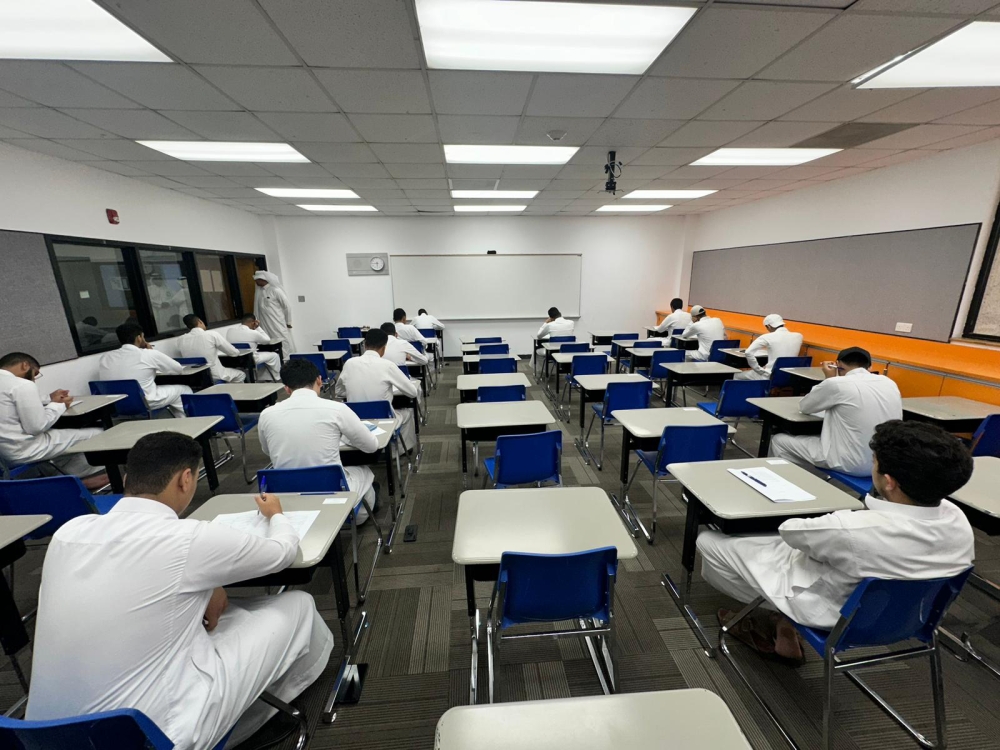
The Ministry of Education will sound the starting whistle tomorrow, Sunday, for the end-of-first-semester exams in all public education schools, amidst a comprehensive administrative mobilization to implement the technical standards contained in the “Fourth Edition” of the new exam guide for the year 1447 AH – 2025 AD. This aims to enhance the integrity of educational outcomes and control exam halls through a package of strict monitoring procedures that ensure equal opportunities for millions of male and female students.
Schools are entering this assessment marathon under the slogan “No leniency with violations,” as they confront cheating attempts and possession of smart devices with decisive, escalating penalties, while students compete seriously to earn the 40 written exam points, which are the most critical factor in determining their cumulative averages and their transition to the next educational stages.
Strict Control Procedures
The Ministry of Education has directed school leaders and exam committees to activate “strict” control procedures at the entrances to exam halls, to ensure students are completely free of any smart communication devices (“mobile phones”) or precise electronic watches.
The Ministry considered the mere possession of these devices inside the hall, even if turned off, to be an explicit violation of the regulations, requiring the immediate filing of a report against the student and the application of the penalty rules without hesitation.
The ministerial instructions emphasized that “technical inspection” and constant vigilance are the first line of defense to ensure the integrity of exams and prevent any attempts to leak questions or electronically circulate answers among students.
The full “40 points” for standard written subjects are at stake on Sunday, as the final exam carries the greatest weight in the academic balance, making it a pivotal point in the student’s educational journey.
Educational sources confirmed that the new guide obligated teachers to exercise extreme accuracy during grading and recording processes, not allowing any personal interpretations that contradict the centrally approved answer key.
These instructions come to ensure that the recorded grade reflects the student’s true and actual level without any increase or decrease, achieving the principle of absolute fairness among all examinees.
Penalties for Violators
As for students who might be tempted to manipulate the system, three escalating and firm penalties await them, which do not accept mediation, starting with canceling the score for the question in the first violation along with taking a binding written pledge.
The penalty doubles if the violation is repeated for the second time, to include canceling the entire subject exam and deducting from conduct grades, which places the student in the predicament of “completion” and threatens their overall success.
The strictness reaches its peak with the penalty of “total deprivation,” which pursues students who insist on
Ministry of Education
The Ministry of Education is a government department responsible for national education policy, curriculum standards, and the administration of public schools. Its history is tied to the formation of modern nation-states, with many countries establishing a formal ministry in the 19th or early 20th century to centralize and standardize education for all citizens. For example, Japan’s Ministry of Education was founded in 1871, while the UK’s equivalent department was created in 1856.
Fourth Edition
I’m sorry, but “Fourth Edition” is not a specific place or cultural site. It is a common phrase typically referring to the fourth version of a book, game, set of rules, or other published work (e.g., *Dungeons & Dragons Fourth Edition* or the fourth edition of a textbook). To provide a meaningful summary, I would need the specific name of the actual location or cultural monument you have in mind.
1447 AH
“1447 AH” is not a specific place or cultural site, but a year in the Islamic Hijri calendar, equivalent to approximately 2025-2026 CE. Therefore, it cannot be summarized as a location. In historical context, notable events from the original 1447 AH (which began in May 2035 CE) are not yet recorded, as it is a future date.
2025 AD
“2025 AD” is not a recognized historical place or cultural site. It appears to be a reference to a future year, likely used in speculative fiction or futuristic planning. Therefore, it has no established history or cultural significance as a location.
exam guide
“Exam guide” is not a specific place or cultural site, but rather a general term for study materials. Therefore, it has no physical location or history to summarize. It refers to books, websites, or courses designed to help students prepare for tests.
technical standards
“Technical standards” are not a single place or cultural site, but rather a foundational concept for modern industry and technology. They are documented agreements containing technical specifications or criteria, developed through consensus by organizations like ISO or IEEE, to ensure that products, services, and systems are safe, reliable, and compatible. Their history is intertwined with the Industrial Revolution, where the need for interchangeable parts and consistent measurements drove their systematic development to facilitate global trade and innovation.
exam halls
Exam halls are dedicated spaces, often within educational institutions, designed for the formal administration of written tests. Their history is tied to the standardization of academic and civil service examinations, which became widespread in the West during the 19th century with the rise of mass education and merit-based systems. Today, they are characterized by orderly rows of individual desks, strict protocols, and a controlled environment intended to ensure fairness and prevent cheating.
academic balance
“Academic balance” is not a specific place or cultural site, but a principle or concept in education and scholarship. It refers to the fair and objective presentation of different viewpoints, theories, and evidence within teaching and research, avoiding bias. Historically, this ideal has been central to the development of modern universities, aiming to foster critical thinking and intellectual integrity.