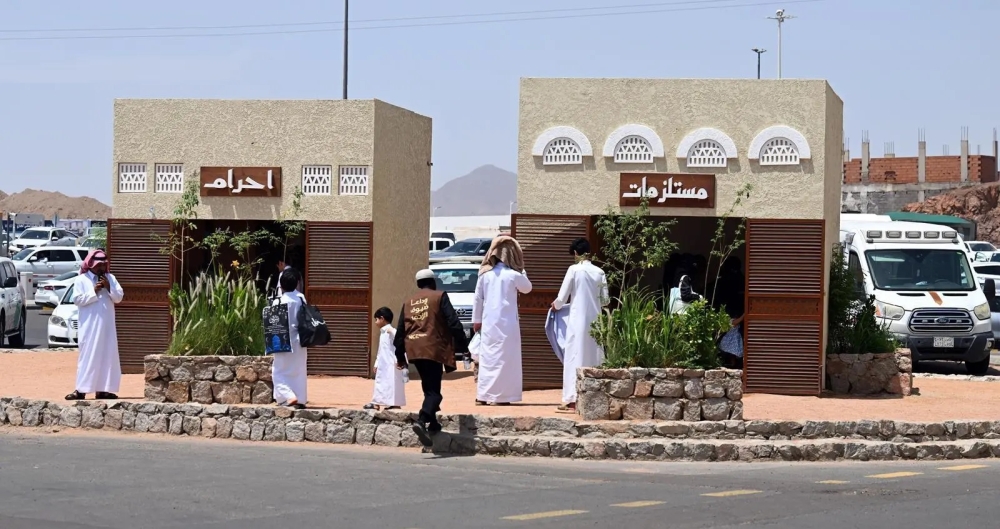
Miqat Dhul-Hulayfah in Medina serves as a major station during the Hajj season, witnessing the arrival of pilgrims from various nationalities. They are accompanied by comprehensive services and field efforts by relevant authorities to care for the pilgrims and manage their transfer by buses to the Holy House of God in Mecca, as part of their spiritual journey to perform the Hajj pilgrimage.
Dhul-Hulayfah has undergone development work supervised by the Medina Region Development Authority to rehabilitate the mosque, its surroundings, and facilities, increase its capacity, and enhance the comprehensive service system targeting pilgrims and Umrah performers passing through the miqat.
This includes transportation, health, security, awareness and guidance services, preparing the mosque to receive worshippers, and transforming the miqat into an integrated urban center that supports millions of visitors annually, in line with the goals of the Guests of God Service Program and Saudi Vision 2030.
Guidance and awareness services
Today, the miqat mosque saw crowds of pilgrims from several nationalities, wearing the Ihram garment, preparing to head to the Holy House of God in Mecca to perform Umrah at the start of their spiritual journey before performing the Hajj. They were accompanied by numerous services newly prepared at Dhul-Hulayfah, including stations offering guidance, awareness, and religious instruction to enable pilgrims to perform the rituals according to the prophetic tradition.
Drinking water points and fountains were also distributed in the mosque’s outer courtyards, and volunteers provided cold water bottles to pilgrims upon their arrival at the mosque.
Seating areas shaded by palm trees were also prepared in the courtyards, which were paved with marble that does not retain heat, helping to create a cool atmosphere during the day.
Smooth arrival of dozens of buses
The outer courtyard of the miqat mosque was also prepared in an urban manner to ensure the smooth arrival of dozens of buses to the mosque, allowing them to park simultaneously and in an orderly fashion, facilitating the smooth movement of pilgrims to the mosque facilities through gates for men and women.
Electric carts were also provided to transport the elderly and people with disabilities free of charge.
In addition, dozens of food outlets and stores selling Ihram supplies and clothing were fully prepared in the outer courtyard of the miqat, to provide all the requirements for the spiritual journey.
Miqat Dhul-Hulayfah
Miqat Dhul-Hulayfah, also known as Abyar Ali, is a historically significant miqat (station for assuming the state of ihram) located about 10 kilometers southwest of Medina, Saudi Arabia. It is the designated miqat for pilgrims coming from or through Medina to perform Hajj or Umrah, and it is closely associated with the Prophet Muhammad, who entered into ihram there during his farewell pilgrimage. Today, it features a large mosque and facilities to accommodate pilgrims, serving as a key spiritual and logistical starting point for their journey.
Medina
Medina, located in western Saudi Arabia, is the second holiest city in Islam after Mecca, originally known as Yathrib before the Prophet Muhammad’s migration (Hijra) in 622 CE. This event marked the beginning of the Islamic calendar and transformed the city into the political and religious center of the early Muslim community. Today, Medina is home to the Prophet’s Mosque, which contains Muhammad’s tomb, and remains a major pilgrimage destination for Muslims visiting the holy sites.
Holy House of God in Mecca
The Holy House of God in Mecca, also known as the Kaaba, is a cube-shaped structure at the center of Islam’s most sacred mosque, Al-Masjid al-Haram. According to Islamic tradition, it was originally built by the prophet Abraham and his son Ishmael as a monotheistic house of worship, and it has been a focal point for Muslim prayer and pilgrimage for centuries. Today, it is the direction (qibla) that Muslims face during daily prayers and the destination of the annual Hajj pilgrimage.
Mecca
Mecca, located in modern-day Saudi Arabia, is the holiest city in Islam and the birthplace of the Prophet Muhammad. It has been a major religious center since pre-Islamic times, housing the Kaaba, which Muslims believe was built by Abraham. Today, Mecca is the destination for the annual Hajj pilgrimage, a religious duty for all able-bodied Muslims.
Dhul-Hulayfah mosque
Dhul-Hulayfah Mosque, located near Medina in Saudi Arabia, is historically significant as the designated Miqat (pilgrim station) where pilgrims enter the state of Ihram for Hajj or Umrah, as established by the Prophet Muhammad. It is also known as Masjid al-Miqat or Abyar Ali, built at the site where the Prophet himself began his pilgrimage rituals. Today, it remains a key spiritual waypoint for millions of pilgrims traveling to Mecca.
Saudi Vision 2030
Saudi Vision 2030 is a strategic framework launched in 2016 to reduce Saudi Arabia’s dependence on oil, diversify its economy, and develop public service sectors such as health, education, infrastructure, recreation, and tourism. The plan was introduced by Crown Prince Mohammed bin Salman as part of a long-term effort to modernize the kingdom and open it to global investment and cultural exchange. Key initiatives include expanding the tourism sector, empowering women in the workforce, and launching mega-projects like NEOM, marking a historic shift from the country’s traditional oil-based economy.