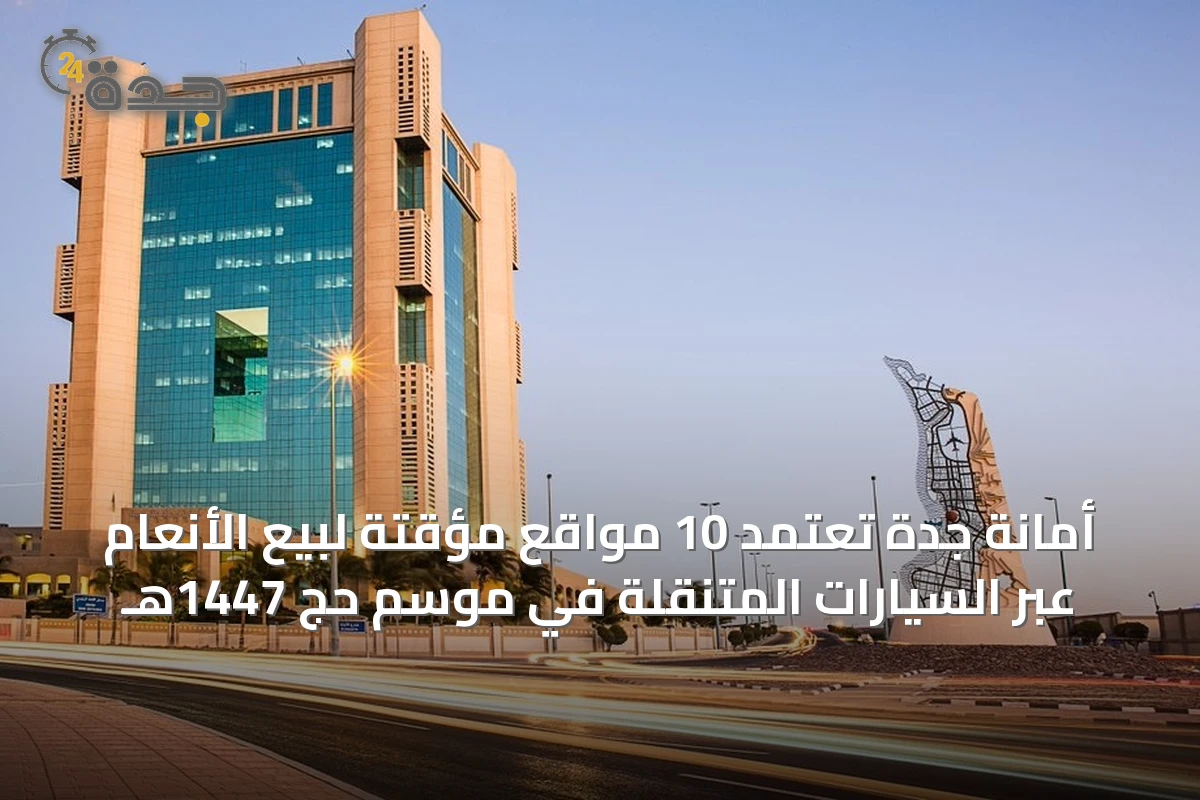
The Municipality of Jeddah Governorate has approved 10 temporary municipal sites for selling livestock via mobile vehicles during this year’s Hajj season 1447 AH. This initiative aims to regulate sales operations, ensure food safety, and reduce random practices, in coordination with relevant security authorities.
This step targets facilitating residents’ access to official livestock sales sites, ensuring smooth traffic flow, and serving a larger segment of citizens and residents, while applying the highest standards of safety and public health.
Distribution of sites across municipal districts
The temporary livestock sales sites via mobile vehicles are distributed across several municipal districts in Jeddah Governorate. The municipality allocated four sites in the Umm al-Salam Sub-Municipality district, including: (near the municipality’s model slaughterhouse, near the Nahdi Hall south of the Harazat signal, on Mecca Road – kilometer 26 – opposite the Al-Hudhaifat station, and in the Al-Harazat neighborhood north of the Sahari station).
In the Buraiman Sub-Municipality district, the municipality designated one site in the Al-Samer neighborhood on Al-Hussein Al-Sahwaji Street. In the South Sub-Municipality district, two sites were approved: the Al-Ajawid neighborhood on Al-Mundhir bin Haritha Street, and the Al-Hada neighborhood on Abu Dulaf al-Ajli Street.
Additional sites in Tayyibah and Dhahban municipalities
Two sites were also designated within the Tayyibah Sub-Municipality district: the first in the Al-Bashair neighborhood on Abdullah bin Umayyah Street, and the second in the Al-Wafa neighborhood behind the Omari Khamis station. Additionally, one site was designated in the Dhahban Sub-Municipality district, specified as near the Al-Rahma Mosque.
Warning against irregular practices
The municipality stressed the importance of purchasing from approved sites and not dealing with mobile vendors outside designated points, to preserve consumer health and safety. It affirmed that violators will face penalties under the municipal violations regulations in cooperation with relevant security authorities.
Umm al-Salam Sub-Municipality
Umm al-Salam Sub-Municipality is a district within the Greater Beirut area of Lebanon. Historically, it developed as a residential suburb, reflecting the urban expansion of Beirut during the 20th century. The area is known for its diverse community and serves as a local administrative unit managing urban services and development.
Buraiman Sub-Municipality
Buraiman Sub-Municipality is a locality within the city of Al-Mukalla in Hadhramaut Governorate, Yemen. Historically, it developed as an extension of the old port city, reflecting the region’s traditional architecture and coastal trading heritage. Today, it functions as a residential and commercial area, maintaining its cultural significance within the broader historical context of Hadhramaut.
South Sub-Municipality
The South Sub-Municipality is a local administrative division found in several cities worldwide, often responsible for managing urban services and governance in the southern districts of a metropolitan area. Its history typically traces back to municipal reorganization efforts, such as those in the 20th century, aimed at decentralizing city administration to improve efficiency and local representation. The specific historical and cultural significance varies by location, reflecting the unique development patterns and administrative reforms of the city it serves.
<h3 class="text-lg font-semibold mb-2 text
Umm al-Salam Sub-Municipality
Umm al-Salam Sub-Municipality is a district in the Manama area of Bahrain, known for its residential character and cultural landmarks. Historically, it was one of the early areas to develop as Manama expanded, featuring a mix of traditional Bahraini architecture and modern buildings. The area is home to the Al-Fateh Grand Mosque, one of the largest mosques in the world, which reflects the Islamic heritage of the region.
Buraiman Sub-Municipality
Buraiman Sub-Municipality is a district located within the city of Jeddah, Saudi Arabia. Historically, it developed as part of Jeddah’s urban expansion, transforming from a less populated area into a residential and commercial hub. Today, it is known for its diverse community and growing infrastructure, reflecting the broader modernization of the city.
South Sub-Municipality
The South Sub-Municipality is an administrative division within a larger city, often established to manage local governance and services at a more granular level. Its history typically reflects urban expansion and the need for decentralized administration, originating from municipal reforms aimed at improving efficiency and community representation. Specific historical details vary by location, but such entities generally evolved in the 20th or 21st century as cities grew and required sub-divisions for better resource allocation.
Tayyibah Sub-Municipality
Tayyibah Sub-Municipality is a district in the Eastern Province of Saudi Arabia, located near the city of Dammam. Historically, the area was part of the region’s development during the 20th century as the oil industry expanded, transforming it from a sparsely inhabited area into a residential and commercial hub. Today, it serves as a suburban community within the Dammam metropolitan area, reflecting the rapid urbanization tied to the country’s economic growth.
Dhahban Sub-Municipality
Dhahban Sub-Municipality is an administrative district located in the northern part of Jeddah, Saudi Arabia. It was historically a small village that has developed into a suburban area, reflecting the rapid urban expansion of Jeddah in recent decades. Today, it serves as a residential and commercial hub, connecting the city to surrounding regions.
Al-Rahma Mosque
Al-Rahma Mosque, also known as the Mosque of Mercy, is a prominent Islamic landmark located in the Jaffa area of Tel Aviv, Israel. Built in the early 20th century, it stands as a symbol of the region’s rich multicultural history, serving as a place of worship for the local Muslim community. Despite challenges over the years, including periods of neglect, the mosque remains an active religious site and a testament to the area’s diverse cultural heritage.
Al-Harazat neighborhood
Al-Harazat neighborhood is a historic district in Jeddah, Saudi Arabia, known for its traditional architecture and cultural heritage. Its name derives from the “haraz” (guard) posts that once protected the area, reflecting its role in the city’s defensive history. Today, it remains a significant site for visitors interested in exploring Jeddah’s old urban fabric and its development over centuries.
Al-Samer neighborhood
Al-Samer neighborhood is a historic district in the city of Al-Ahsa, Saudi Arabia, known for its traditional architecture and narrow alleyways. It dates back several centuries and was once a thriving center for trade and social gatherings, reflecting the region’s rich cultural heritage. Today, it remains a preserved site that offers visitors a glimpse into the area’s past, with its mud-brick houses and ancient mosques.