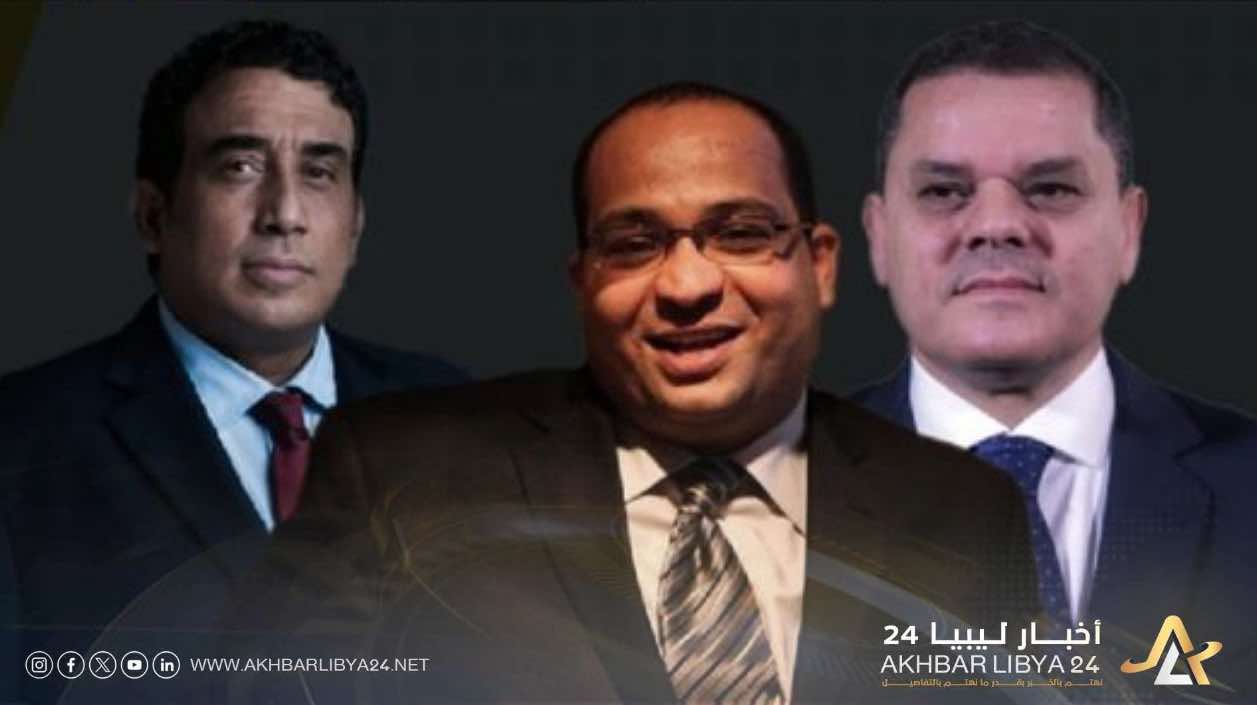
He highlighted the state of political tension in the capital, Tripoli, suggesting that the coming period will see a resolution to the ongoing conflict over sovereign positions, with the likely removal of Presidential Council President Mohamed Al-Menfi from the scene.
Al-Saghir’s statements came in response to a warning from the head of the outgoing Government of National Unity, Abdul Hamid Dbeibeh, to ambassadors and heads of Libyan diplomatic missions abroad, not to deal with any correspondence issued by the Presidential Council or any internal body outside official approved channels.
-
Hassan Al-Saghir: Dbeibeh’s position on this matter is based on a clear legal foundation
Al-Saghir explained, in a post on Facebook, that Dbeibeh’s position on this matter is based on a clear legal foundation, noting that Law No. 2 of 2001 explicitly states that all official correspondence between domestic and foreign entities must pass exclusively through the Ministry of Foreign Affairs, as the competent body for managing diplomatic affairs.
He affirmed that bypassing this mechanism constitutes a legal violation and may contribute to further complicating the political scene, especially amid the ongoing division between institutions.
-
Hassan Al-Saghir: For the first time, the law is on Dbeibeh’s side regarding letters and correspondence between domestic and foreign entities
He pointed out that what is happening reflects a clear struggle over powers and influence within the power structures in Tripoli, which signals the possibility of political changes in the coming period if the escalation between the different parties continues.
-
Hassan Al-Saghir: Law No. 2 of 2001 is clear and explicit; any correspondence or communication abroad towards embassies must pass through one and only channel, which is the Ministry of Foreign Affairs
He added that this conflict cannot continue for long without resolution, given the increasing internal and external pressures to reorganize the political scene and unify state institutions.
These developments come in the context of an ongoing political crisis in Libya, where sovereign files overlap with political disagreements, hindering the path to stability and further complicating the management of the state’s foreign relations.
Tripoli
Tripoli, the capital of Libya, is a historic port city on the Mediterranean coast with roots dating back to the 7th century BCE, when it was founded by the Phoenicians as Oea. It later became part of the Roman Empire and was influenced by various rulers, including the Byzantines, Arabs, and Ottoman Turks. Today, it is known for its blend of ancient and modern architecture, including the old medina and the iconic Arch of Marcus Aurelius.
Presidential Council
The Presidential Council refers to the collective leadership body of Libya, established under the United Nations-brokered Libyan Political Agreement in 2015. Its purpose was to unify the country’s warring factions after the 2011 civil war and subsequent instability, serving as the executive authority of the Government of National Accord. The council has faced ongoing challenges, including political divisions and armed conflict, but remains a key institution in Libya’s efforts toward peace and governance.
Government of National Unity
The “Government of National Unity” (GNU) is a political framework in which rival parties or factions come together to form a coalition government, often during periods of crisis or transition. A notable example is South Africa’s GNU formed in 1994 after the end of apartheid, led by Nelson Mandela’s African National Congress alongside the National Party and the Inkatha Freedom Party to promote reconciliation and stability. The term also refers to similar power-sharing arrangements in other countries, such as Israel and Libya, aimed at bridging deep political divides.
Ministry of Foreign Affairs
The Ministry of Foreign Affairs is a government building that serves as the headquarters for a nation’s diplomatic and foreign policy operations. Historically, such ministries were established to manage international relations, treaties, and embassies, often evolving from royal chanceries or colonial offices. Many notable examples, like the Ministry of Foreign Affairs in countries such as France or Japan, are housed in architecturally significant buildings that reflect their political and cultural heritage.
Libya
Libya, located in North Africa, is a country with a rich history that includes ancient civilizations such as the Phoenicians, Greeks, and Romans, as well as being a key part of the Ottoman Empire and later an Italian colony. It is home to several UNESCO World Heritage sites, including the ruins of Leptis Magna, one of the best-preserved Roman cities, and the rock art of Tadrart Acacus. Modern Libya gained independence in 1951 and has since experienced periods of monarchy, dictatorship under Muammar Gaddafi, and ongoing political instability following the 2011 revolution.