Libya’s Central Bank Governor Attends Closed IMF Committee Meeting in Washington.
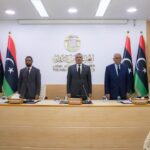
Washington — The Governor of the Central Bank of Libya participated in the closed-door meeting of the International Monetary and Financial Committee (IMFC) on Friday. The meeting was held at the International Monetary Fund headquarters in Washington, D.C., on the sidelines of the 2026 Spring Meetings.
According to a statement published by the Central Bank, the meeting discussed the most prominent current developments and challenges facing the global economy and reviewed the prospects for economic growth in the short and medium term.
The meeting also addressed ways to enhance the stability of the global financial system and support multilateral cooperation efforts to confront geopolitical and structural risks affecting financial markets.
This participation comes within the framework of the Central Bank of Libya’s follow-up on international economic and financial developments and its keenness to exchange views with international financial institutions and decision-makers. This is expected to positively reflect on the bank’s policies and enhance Libya’s standing in global financial forums.
International Monetary Fund
The International Monetary Fund (IMF) is a major international financial institution established in 1944 at the Bretton Woods Conference to foster global monetary cooperation and financial stability. Headquartered in Washington, D.C., its primary roles are to provide policy advice, financial assistance to member countries in economic difficulty, and promote sustainable economic growth.
Washington, D.C.
Washington, D.C., is the capital of the United States, founded in 1790 as a planned city to serve as the nation’s seat of government. It is home to iconic landmarks like the White House, the U.S. Capitol, and the National Mall, many of which were constructed in the neoclassical style to reflect democratic ideals. The city’s history is deeply intertwined with American politics, including its role during the Civil War and the 20th-century civil rights movements.
Central Bank of Libya
The Central Bank of Libya (CBL) is the country’s primary monetary authority, originally established in 1956 as the National Bank of Libya following independence. Its modern structure was solidified in 2005, and it has played a critical, though often divided, role in managing state finances and currency stability through Libya’s recent periods of conflict and political fragmentation.
International Monetary and Financial Committee
The International Monetary and Financial Committee (IMFC) is the primary advisory committee of the International Monetary Fund’s (IMF) Board of Governors. It was established in 1974, replacing the earlier “Committee of Twenty,” to advise on the supervision and management of the international monetary and financial system. The committee, which meets twice a year, consists of 24 members representing the IMF’s member countries and plays a key role in providing strategic direction to the Fund.
2026 Spring Meetings
The “2026 Spring Meetings” refer to the annual gatherings of the International Monetary Fund (IMF) and the World Bank Group scheduled for April 2026. These meetings, which have been held since the institutions’ founding in 1944, bring together finance ministers, central bank governors, and other officials to discuss global economic issues, policies, and financial stability.
<div class="my-4 p-4 rounded-lg shadow
International Monetary Fund
The International Monetary Fund (IMF) is an international financial institution established in 1944 at the Bretton Woods Conference to foster global monetary cooperation and financial stability. Its primary roles are to provide policy advice, financial assistance to countries in economic difficulty, and promote sustainable economic growth and high employment.
Washington, D.C.
Washington, D.C., is the capital of the United States, founded in 1790 as a federal district under the authority of the U.S. Constitution. It was established to serve as the nation’s permanent seat of government, distinct from any state, with its iconic layout designed by French architect Pierre L’Enfant. The city is home to historic landmarks like the White House, U.S. Capitol, and numerous monuments, many of which commemorate key events and figures in American history.
Central Bank of Libya
The Central Bank of Libya (CBL) was established in 1956 as the National Bank of Libya, following the country’s independence, to issue currency and manage monetary policy. It has played a critical and often contentious role throughout Libya’s modern history, including during the Gaddafi era and the subsequent conflicts, where it became a key institution contested by rival governments for control of state finances.
International Monetary and Financial Committee
The International Monetary and Financial Committee (IMFC) is the primary advisory committee of the International Monetary Fund’s (IMF) Board of Governors. Established in 1974 as the Interim Committee, it was made permanent in 1999 to oversee the management and adaptation of the international monetary and financial system. It meets twice a year to discuss global economic issues and provide strategic guidance to the IMF’s work.
2026 Spring Meetings
The “2026 Spring Meetings” refer to the annual gatherings of the International Monetary Fund (IMF) and the World Bank Group scheduled for April 2026. These meetings, which have been held since the institutions’ founding in 1944, bring together finance ministers, central bankers, and other officials to discuss global economic issues, policies, and financial assistance. The specific host city for the 2026 event is typically announced closer to the date.
Bretton Woods Conference
The Bretton Woods Conference was a landmark 1944 gathering of 44 Allied nations in New Hampshire, USA, to establish a new international monetary system after World War II. It led to the creation of the International Monetary Fund (IMF) and the World Bank, institutions designed to promote global economic stability and reconstruction. The conference effectively set the rules for commercial and financial relations among the world’s major industrial states for much of the mid-20th century.
White House
The White House is the official residence and workplace of the President of the United States, located in Washington, D.C. It was built between 1792 and 1800 after a design by James Hoban and has been the home of every U.S. president since John Adams. The building was reconstructed after being burned by British forces in 1814 and remains a powerful symbol of the American presidency and government.
U.S. Capitol
The U.S. Capitol is the seat of the United States Congress, located in Washington, D.C. Its construction began in 1793, and though it was burned by British forces in 1814, it was rebuilt and has since been expanded, most notably with its iconic cast-iron dome completed during the Civil War. It stands as a central symbol of American democracy and government.