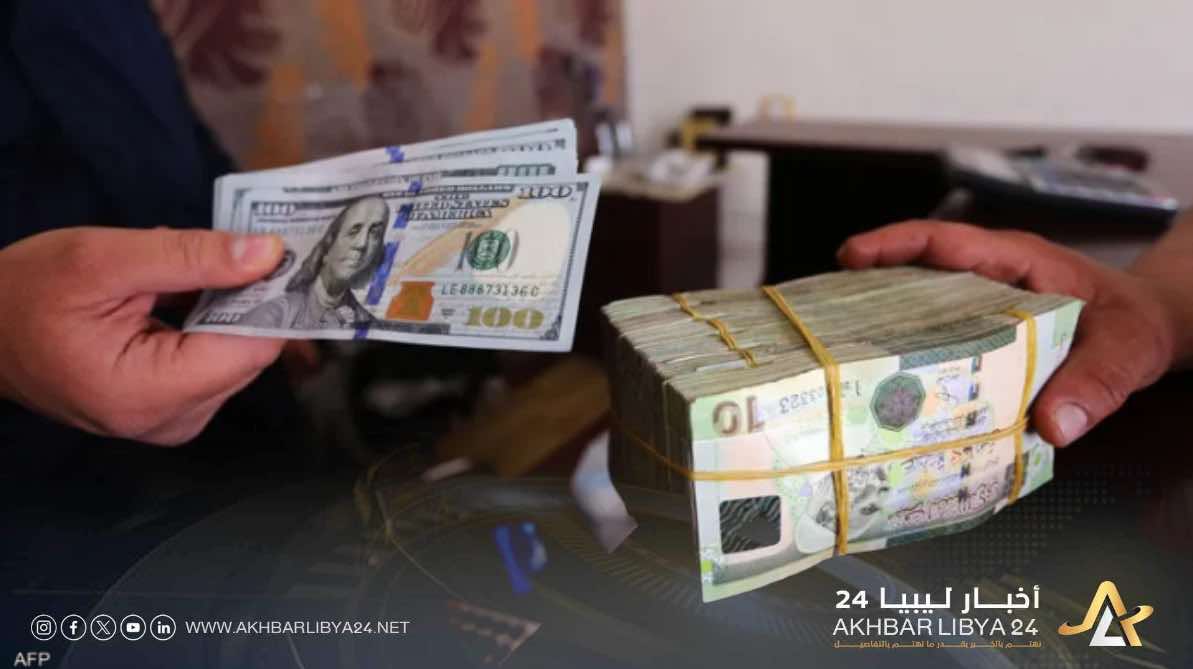
Warnings have been issued about the fragility of Libya’s parallel market, stressing that it is heavily influenced by rumors and inaccurate information, making it susceptible to sharp exchange rate fluctuations within short periods.

The parallel market suffers from weak foundations, making it quickly affected by any news or even unreliable posts. This weakness was clearly reflected in a recent case, where a set of circulated images caused the exchange rate to drop by more than 200 dirhams in less than two hours, demonstrating the extent of the impact and the speed of reaction to rumors.

  • A set of images caused the exchange rate to drop by more than 200 dirhams in less than two hours

Speculation plays a major role in deepening this crisis, described as a “malignant cancerous” activity that exacerbates economic chaos and leads to negative results for citizens’ financial and living stability. This type of behavior, along with manipulation of credits and financial and administrative corruption, directly contributes to weakening the national economy.

  • Speculation is a ‘malignant cancerous’ activity that exacerbates economic chaos

The continuation of these practices without strict oversight will lead to further deterioration in the value of the local currency and higher inflation rates, which negatively affects citizens’ purchasing power and increases living burdens.

  • Necessity of taking decisive measures to regulate the market

There is a call for the necessity of taking decisive measures to regulate the market, enhance transparency in monetary policies, and intensify oversight of speculation operations, which would contribute to stabilizing the exchange rate and reducing the impact of rumors.

The importance of raising citizens’ awareness about the danger of circulating inaccurate information due to its direct impact on markets was also stressed, emphasizing that economic stability requires cooperation between official bodies and society to limit financial chaos.

Libya

Libya is a North African country with a rich history rooted in ancient civilizations, most notably as the site of Phoenician, Greek, and Roman settlements along its Mediterranean coast. Its cultural landscape is profoundly shaped by its Berber heritage and its central role in the spread of Islam and Arab culture from the 7th century onward. In the modern era, Libya gained independence in 1951 and experienced significant political changes throughout the 20th and 21st centuries.

Libya

Libya is a North African nation with a rich history rooted in ancient civilizations, most notably as the site of Phoenician, Greek, and Roman settlements along its Mediterranean coast. Its cultural landscape is profoundly shaped by its role in the trans-Saharan trade routes and its centuries as a center of Islamic scholarship and empire. In the modern era, Libya gained independence in 1951 and experienced significant political changes throughout the 20th and 21st centuries.

Phoenician

The Phoenicians were an ancient maritime civilization originating along the coastal regions of modern-day Lebanon, Syria, and northern Israel, flourishing from around 1500 to 300 BCE. They are most famous as master seafarers and traders who established colonies across the Mediterranean and developed the first widely used alphabetic writing system, which greatly influenced later scripts like Greek and Latin. Their culture and city-states, such as Tyre, Sidon, and Byblos, were eventually absorbed by successive empires, including the Persians and Alexander the Great.</

Libya

Libya is a North African country with a rich history rooted in ancient civilizations, most notably as the site of Phoenician, Greek, and Roman settlements along its Mediterranean coast. Its cultural landscape is profoundly shaped by its long history as part of various empires and its central role in the trans-Saharan trade routes. In the modern era, Libya gained independence in 1951 and experienced significant political changes throughout the 20th and early 21st centuries.

Phoenician

The Phoenicians were an ancient seafaring civilization originating along the coastal regions of modern-day Lebanon, Syria, and northern Israel, flourishing from around 1500 to 300 BCE. They are most famous for establishing a vast trading network across the Mediterranean and for creating one of the first alphabets, which greatly influenced later writing systems. Their major city-states, such as Tyre, Sidon, and Byblos, were powerful centers of commerce and culture before eventually falling to successive empires like the Persians and Alexander the Great.

Greek

“Greek” broadly refers to the culture and history of Greece, a country in southeastern Europe with a profound influence on Western civilization. Its ancient history is marked by the rise of city-states like Athens and Sparta, the development of democracy, philosophy, and the arts, and the conquests of Alexander the Great. This rich heritage is embodied in iconic archaeological sites such as the Acropolis in Athens and the sanctuary of Delphi.

Roman

The term “Roman” broadly refers to the civilization of ancient Rome, which originated in the city of Rome in the 8th century BCE and grew to become a vast empire spanning Europe, North Africa, and the Middle East. Its enduring legacy includes foundational contributions to law, government, engineering (like aqueducts and roads), and architecture, exemplified by iconic sites such as the Colosseum and the Pantheon.

Berber

The Berber people, also known as Amazigh, are the indigenous ethnic group of North Africa, not a single place or site. Their history spans thousands of years, with a rich cultural heritage evident in ancient rock art, historic mountain villages, and distinct language and traditions. Today, their culture is preserved in regions across Morocco, Algeria, Tunisia, Libya, and other parts of the Maghreb.

Islamic

“Islamic” broadly refers to the religion of Islam and its associated cultural and historical traditions, rather than a single place. This rich heritage, originating in 7th-century Arabia with the revelations to Prophet Muhammad, encompasses diverse global sites like mosques, madrasas, and palaces. These structures, from the Dome of the Rock in Jerusalem to the Alhambra in Spain, reflect centuries of artistic, scientific, and architectural achievements across the Islamic world.

trans-Saharan trade routes

The trans-Saharan trade routes were a vast network of caravan paths connecting North Africa and the Mediterranean with sub-Saharan West Africa, flourishing between the 8th and 16th centuries. Primarily used to exchange gold, salt, ivory, and enslaved people, these routes facilitated not only commerce but also the spread of Islam, ideas, and technology. Their operation relied on expert Berber and Tuareg merchants navigating the harsh Sahara with camel caravans, leading to the rise of powerful empires like Ghana and Mali.

Islamic scholarship

Islamic scholarship refers to the rich intellectual tradition of study, interpretation, and debate within the Islamic world, centered on the Quran, Hadith (sayings of the Prophet Muhammad), law (Sharia), theology, philosophy, and sciences. It flourished from the 8th century onwards, with major institutions like madrasas and libraries in cities such as Baghdad, Cairo, and Cordoba preserving and advancing knowledge. This tradition not only shaped Islamic civilization but also critically contributed to the global transmission of classical learning during the Middle Ages, influencing fields from medicine to mathematics.