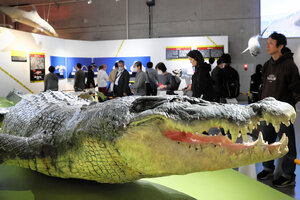
A special exhibition titled “Super Dangerous Creatures Exhibition” showcasing the ultimate techniques of creatures surviving in a dog-eat-dog world is being held in Ueno, Tokyo. It is bustling with families and has attracted over 170,000 visitors since its opening on the 14th of last month.
The exhibition focuses on skills honed through evolution. It is divided into areas for “physical attack” creatures, which use their bodies as weapons, and “special attack” creatures, which use poison or gas as weapons. Furthermore, based on the characteristics of these ultimate techniques, the creatures are categorized into eight types, such as “power fighter type” and “chemical attack type,” and explained from a scientific perspective.
In the “physical attack” area, highlights include displays of large specimens such as the full skeleton of an African elephant and a taxidermied polar bear. Haru Kojima (7), a second-grade elementary school student visiting from the city with a parent, loves creatures and always reads picture books about them. She said with a smile, “I thought polar bears were small, but it was huge—I was amazed.”
Small creatures feature “special attacks”
In the “special attack” area, many small creatures are featured, and visitors were seen deeply reading the explanations. The Blarina brevicauda, a shrew less than 10 centimeters in body length, paralyzes its prey with poisonous saliva. Mihoko Sato (66), a homemaker visiting from the city, said, “Not just the types of poison, but the various ways of delivering it, like biting or spraying, were cool.”
At the venue, visitors were also seen walking while taking photos of their favorite creatures and attack explanations with their cameras. Kana Yamakawa (40), a company employee living in Meguro Ward, said about her 5-year-old eldest son, whose eyes lit up at the exhibits, “Children remember things they’ve seen once more than we expect. I want to value experiences where they can see real objects and videos.”
Exhibition runs until June 14
The exhibition runs until June 14. Closed on Mondays (except April 27, May 4, and June 8) and May 7. Open from 9:00 a.m. to 5:00 p.m. From April 25 to May 6, it is open until 6:00 p.m. (last entry 30 minutes before closing).
Admission is 2,300 yen for general adults and university students, and 600 yen for elementary to high school students. Preschool children are free.