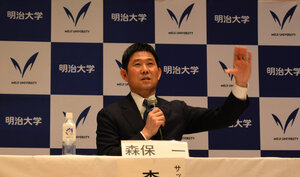
How did Japan become strong? Ahead of the World Cup in North and Central America opening in June, the coach of the Japanese national team gave a lecture on the 17th at the Surugadai campus. He expressed enthusiasm, saying, “Of course, we intend to go all the way to the final.”
The lecture was held as a special class for the Graduate School of Arts and Design. Expectations are rising for Japan’s performance after defeating strong teams during a tour of England in late March. When coach Moriyasu appeared on stage, about 1,000 students gave a thunderous round of applause.
Coach Moriyasu discussed the current state of Japan’s stronger national team in a dialogue with two sports experts: Kiyoshi Nimura, who holds a doctorate from the same graduate school, and Ichiro Ozawa, who is knowledgeable about European soccer. First, referencing the match against England, Moriyasu emphasized sharing the mindset of “fighting on equal terms” even against higher-ranked opponents. He analyzed that this leads to maximizing their own abilities. While it was once said that Japan’s strength was compensating for inferior physique and power with organization and technique, now that key national team players compete in European club teams, he proudly stated, “They have fully adapted. Japanese players can even knock opponents away.”
Furthermore, he said, “I think Japanese people have the world’s top ability to utilize the past and to think through processes to achieve goals.”
Assuming the team advances to the final in the World Cup, he mentioned that they expect “two or three penalty shootouts” along the way. He revealed that adding a former Japanese national team free-kick specialist as a coach just before the tournament was part of that preparation.
The 26-member World Cup squad will be announced around May 15, and a farewell match against Iceland will be held at the MUFG Stadium on May 31. The first match of the tournament will be early in the morning on June 15 (Japan time), facing the team that defeated them in the World Cup 16 years ago.