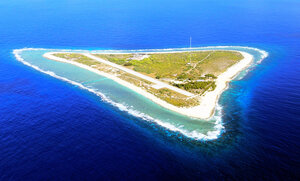
Regarding the selection of a site for the final disposal facility for nuclear waste, village mayor Shōaki Shibuya submitted a response document to the Minister of Economy, Trade and Industry on the 20th, stating that the national government should decide on the literature survey for the site on Minamitorishima, which the government had proposed to the village, and that “if it decides to proceed, we will accept it.”
The government’s decision in response to the village’s reply is expected to be communicated to Mayor Shibuya from the 21st onward.
Mayor Shibuya handed the response document to Director-General Yoshifumi Murase of the ministry on the morning of the same day. The document stated that while the village accepts the government’s decision, it also requests that the government should approach other municipalities for literature surveys, and included a total of five requests and opinions, including an assurance that conducting a literature survey does not mean a decision has been made to build the disposal facility on Minamitorishima. It also stated that the village “will not express an opinion on the next stage (overview survey)” until new approaches are made to other municipalities.
On March 3, at a stage when there was no voluntary offer from the village or a resolution in the village assembly, the government proposed to the village that a literature survey, the first stage of the selection process, be conducted on Minamitorishima. If the survey begins, it will be the fourth case following the towns of Suttsu and Kamoenai in Hokkaido and Genkai Town.
Minamitorishima
Minamitorishima, also known as Marcus Island, is a remote, isolated Japanese coral atoll located in the western Pacific Ocean, approximately 1,200 kilometers southeast of Tokyo. Discovered in 1864 by a Spanish ship, it was later claimed by Japan in the 1880s and has historically served as a strategic military outpost, particularly during World War II. Today, the island is uninhabited except for a small weather station and is strictly controlled as a nature reserve due to its unique ecosystem.
Suttsu
Suttsu is a small town located in Hokkaido, Japan, known for its scenic coastal views and historical significance as a former herring fishing hub during the Edo period. The area prospered in the 19th century due to the herring industry, attracting merchants and workers, and remnants of this era can still be seen in its traditional buildings and ruins. Today, Suttsu is a quiet destination that offers visitors a glimpse into Hokkaido’s maritime heritage and rustic charm.
Kamoenai
Kamoenai is a rural village located in the Shiribeshi Subprefecture of Hokkaido, Japan, known for its stunning coastal scenery along the Sea of Japan. Historically, the area was originally inhabited by the Ainu people, and its name is derived from the Ainu language, meaning “place where deer are abundant.” Today, Kamoenai is recognized for its natural hot springs, pristine beaches, and as a gateway for whale-watching tours.
Genkai Town
Genkai Town, located in Saga Prefecture, Japan, is a coastal community known for its scenic beauty and historical role as a gateway for cultural exchange with Asia. Its history includes being a key port for trade and diplomacy, particularly during the Yamato period, and it features landmarks like the Genkai Quasi-National Park and ancient burial mounds. Today, it blends natural attractions with a rich heritage tied to maritime connections.