It is expected to ease the congestion that has troubled passengers, but how does it work?
“Looking ahead to the busy Golden Week period, the newly introduced smart lanes at the security checkpoint are being brought in.”
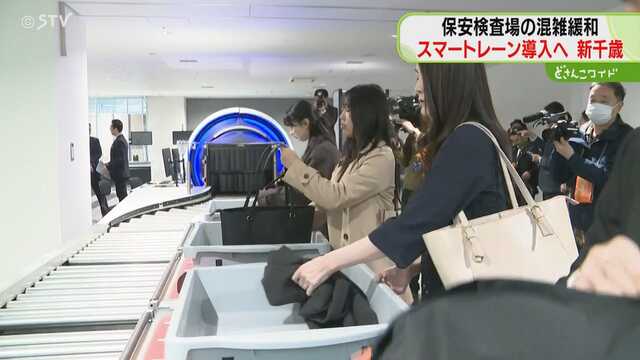
The design is sleek, resembling a spaceship.
Starting from the 24th, “Smart Lanes” will be introduced at New Chitose Airport.
Its biggest feature is—
“With conventional models, laptops and half-drunk plastic bottles had to be taken out of bags, but that is no longer necessary. You just place them on the lane as is.”
The smart lane enables 360-degree X-ray analysis.
Plastic bottles and laptops can be inspected while still inside the bag.
Previously, each passenger’s bottled drink had to be checked individually, but the processing capacity per lane has roughly doubled.
Furthermore—
“It is also smart after the inspection. Once you pick up your luggage, the tray automatically retracts. It is very convenient.”
Another feature is that up to four people can prepare at the same time.
It is expected to ease the congestion that has troubled passengers during busy periods.
“Although it will be a long-term construction project, by using conventional lanes together with smart lanes, we can proceed with the work without reducing the airport’s security screening capacity.”
The smart lanes will be introduced in stages from the 24th, and all lanes are scheduled to be replaced by the end of 2027.