In the accident where a cargo ship collided with a fishing boat off the coast of Toba City, Mie Prefecture, resulting in the deaths of two anglers, the Japan Transport Safety Board has begun its on-site investigation.
On the 20th of this month, the cargo ship “Shinsei Maru” collided with a fishing boat that had dropped anchor and was stationary off the coast of Toba City, Mie Prefecture. An 84-year-old man and a 67-year-old man on the fishing boat were killed, and ten others sustained serious or minor injuries.
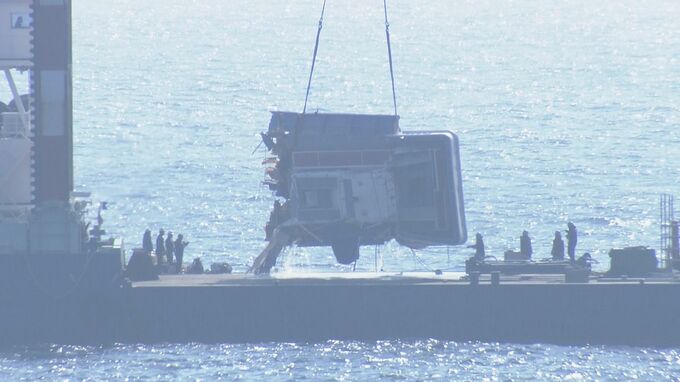
“It is 10 a.m. The stern of the boat has now been lifted by a crane.”
On the 22nd, work to lift the stern section of the fishing boat, which sank in the accident, was carried out.
The Coast Guard arrested the cargo ship’s second officer, suspect Haneoto Sugimoto (21), on suspicion of professional negligence resulting in death and other charges, and transferred him to the prosecutor’s office on the morning of the 22nd.
Furthermore, in response to the accident, investigators from the Japan Transport Safety Board have arrived on-site and are investigating the cause.
From the afternoon, they plan to check the condition of the cargo ship’s hull and conduct interviews with the crew.
Toba City
Toba City is a coastal city in Mie Prefecture, Japan, historically known as a center of pearl cultivation pioneered by Kokichi Mikimoto in the late 19th century. It is famous as the gateway to Ise-Shima National Park and is home to the Mikimoto Pearl Island museum, which celebrates this legacy. The city also has strong connections to the traditional female pearl divers, known as *ama*.
Mie Prefecture
Mie Prefecture, located in central Japan, is historically significant as the home of the Ise Grand Shrine (Ise Jingū), Japan’s most sacred Shinto site, which has been rebuilt every 20 years since the 7th century. The region was also the seat of power for the Ise branch of the Tokugawa clan during the Edo period. Today, it is famous for its spiritual heritage, pearl cultivation in Toba, and the scenic Kumano Kodo pilgrimage routes.
Japan Transport Safety Board
The Japan Transport Safety Board (JTSB) is an independent administrative agency established in 2001, responsible for investigating accidents and incidents in aviation, railways, and marine transport. Its primary mission is to determine causes and issue safety recommendations to prevent future occurrences, rather than to assign blame or liability. The agency was formed to centralize and enhance Japan’s transportation safety investigation framework following earlier models and international standards.
Shinsei Maru
The Shinsei Maru was a Japanese cargo ship built in 1944 that gained historical significance at the end of World War II. On August 24, 1945, it was attacked and sunk in the Sea of Japan by a U.S. submarine, unaware that Japan had already agreed to surrender, resulting in one of the war’s final and tragic maritime losses.
Coast Guard
The United States Coast Guard is a branch of the U.S. Armed Forces and a federal law enforcement agency responsible for maritime safety, security, and environmental protection. It was founded in 1790 as the Revenue Marine, later renamed the Revenue Cutter Service, before merging with the U.S. Lifesaving Service in 1915 to form the modern Coast Guard. Its unique role combines military, humanitarian, and regulatory missions to protect the nation’s coasts and waterways.