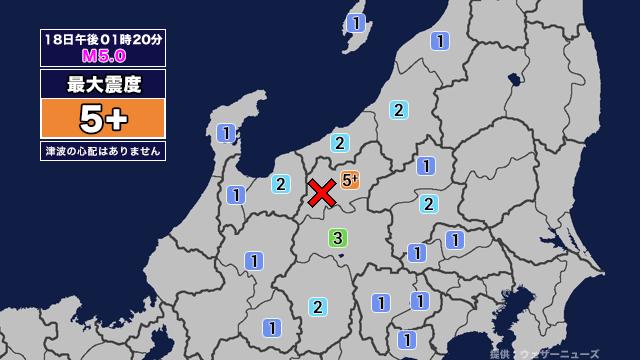
Around 1:20 PM on April 18, 2026, an earthquake with a maximum seismic intensity of upper 5 occurred, with its epicenter in northern Nagano Prefecture.
In Gifu and Aichi prefectures, tremors with a seismic intensity of 1 were observed.
The maximum intensity of upper 5 was observed in Nagano Prefecture.
There is no concern about a tsunami from this earthquake.
The depth of the epicenter is 10 km. The magnitude (M) of the earthquake is estimated to be M5.0.
Gifu Prefecture
【Seismic Intensity 1】
Takayama City, Nakatsugawa City, Ena City, Toki City
Aichi Prefecture
【Seismic Intensity 1】
Toyohashi City, Shinshiro City, Toyone Village, Nagoya Kita Ward, Nagoya Mizuho Ward, Toyota City, Kiyosu City
Areas across the country where a seismic intensity of lower 5 or higher was observed are listed below.
【Seismic Intensity Upper 5】
Nagano Prefecture: Omachi City
【Seismic Intensity Lower 5】
Nagano Prefecture: Nagano City
Nagano Prefecture
Nagano Prefecture, located in central Japan, is a mountainous region historically known as the province of Shinano. It is most famous for hosting the 1998 Winter Olympics and is home to cultural treasures like Zenkō-ji, a 7th-century Buddhist temple that is one of Japan’s most important pilgrimage sites. The area is also renowned for its historic post towns, scenic alpine landscapes, and traditional hot spring resorts.
Gifu Prefecture
Gifu Prefecture, located in central Japan, is a region rich in history and traditional crafts, historically known as the Mino Province. It is famous for sites like the historic thatched-roof villages of Shirakawa-gō (a UNESCO World Heritage site) and the former castle town of Takayama, which preserve Edo-period architecture. The prefecture also played a significant role in the Sengoku (Warring States) period, with Gifu Castle serving as a key base for the warlord Oda Nobunaga in the 16th century.
Aichi Prefecture
Aichi Prefecture, located in central Japan, is historically significant as the heart of the powerful Owari Domain and the birthplace of the “Three Unifiers” of Japan—Oda Nobunaga, Toyotomi Hideyoshi, and Tokugawa Ieyasu—during the 16th-century Sengoku period. Today, it is a major industrial and economic hub, best known as the home of the Toyota Motor Corporation and the culturally rich city of Nagoya, which features landmarks like Nagoya Castle.
Takayama City
Takayama City, located in the mountainous Hida region of Gifu Prefecture, Japan, is a historic city renowned for its exceptionally well-preserved Edo-period (1603-1868) streets in the Sanmachi Suji district. It flourished as a wealthy merchant town due to its high-quality timber and skilled carpenters, known as *Hida no takumi*, who were commissioned for work in Kyoto and Nara. Today, it is often called “Little Kyoto” for its traditional atmosphere, historic festivals, and sake breweries.
<div class="my-4
Zenkō-ji
Zenkō-ji is a historic Buddhist temple in Nagano, Japan, founded in the 7th century and famous for housing the first Buddhist statue ever brought to Japan. It is a significant pilgrimage site for both the Tendai and Jōdo sects, known for its unique main hall and the hidden “key to paradise” ritual. The temple played a central role in the development of Nagano city and remains a major cultural and religious landmark.
Shirakawa-gō
Shirakawa-gō is a historic village region in Gifu Prefecture, Japan, famous for its traditional *gasshō-zukuri* farmhouses with steep thatched roofs designed to withstand heavy snowfall. It was inscribed as a UNESCO World Heritage Site in 1995 for its outstanding example of a traditional way of life adapted to its environment and social and economic circumstances over centuries. The villages, such as Ogimachi, offer a preserved glimpse into Japan’s agricultural past and unique architectural heritage.
Gifu Castle
Gifu Castle is a mountaintop fortress located in Gifu City, Japan, originally built in the 13th century. It is most famously associated with the warlord Oda Nobunaga, who captured and renovated it in 1567, using it as a key base during his campaign to unify Japan. The current structure is a 1956 concrete reconstruction, which now serves as a museum and observation tower offering panoramic views of the city and Nagara River.
Nagoya Castle
Nagoya Castle is a historic Japanese fortress originally constructed in the early 17th century under the orders of Tokugawa Ieyasu, the founder of the Tokugawa shogunate. Although the main keep was destroyed during World War II, it was reconstructed in 1959 using modern materials and now serves as a museum showcasing the castle’s history and the region’s samurai culture. The site is also famous for its pair of golden *shachihoko* (mythical dolphin-like creatures) adorning the roof, which are iconic symbols of Nagoya.
Sanmachi Suji district
Sanmachi Suji is a beautifully preserved historic district in Takayama, Japan, featuring three narrow streets lined with traditional Edo-period merchant houses. Its well-maintained wooden buildings, many from the 17th to 19th centuries, offer a glimpse into the town’s prosperous past as a center for sake brewing and commerce under the direct control of the Tokugawa shogunate. Today, it functions as a popular tourist area with shops, museums, and sake breweries.
Hida no takumi
“Hida no Takumi” refers to the master carpenters of the Hida region in Gifu Prefecture, Japan, renowned for their exceptional woodworking skills. Historically, these artisans were so esteemed that they were often commissioned for the construction of important temples, shrines, and castles across Japan, including parts of the ancient capitals of Nara and Kyoto. Today, their legacy is celebrated at sites like the Hida Folk Village (Hida no Sato), an open-air museum featuring traditional thatched-roof houses showcasing their intricate craftsmanship.
Kyoto
Kyoto served as Japan’s imperial capital for over a thousand years, from 794 to 1868, making it the nation’s historical and cultural heart. It is renowned for its exceptionally well-preserved heritage, including over 1,600 Buddhist temples, 400 Shinto shrines, and iconic sites like the Golden Pavilion (Kinkaku-ji) and Fushimi Inari Shrine. This rich history and its status as a center for traditional arts, such as tea ceremony and geisha culture, led to its designation as a UNESCO World Heritage site.
Nara
Nara, located in Japan’s Kansai region, served as the country’s first permanent capital from 710 to 784 AD, a period known as the Nara Period. It is famed for its historic temples, particularly Tōdai-ji, which houses a giant bronze Buddha statue and is part of the UNESCO World Heritage site “Historic Monuments of Ancient Nara.” The city is also famous for its hundreds of freely roaming Sika deer, considered sacred messengers in the Shinto religion.