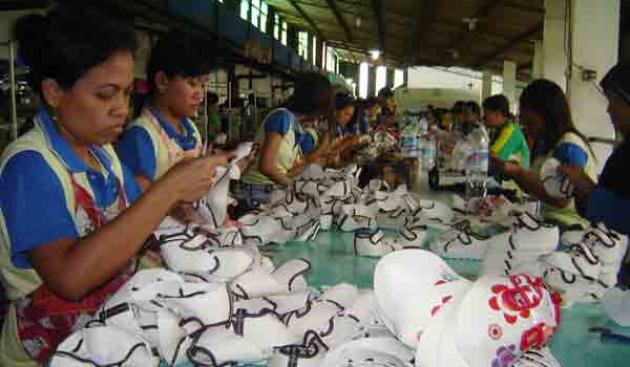
Workers at a shoe factory assembling shoes. (Illustration)
The economy of Tangerang Regency is showing impressive growth. The Central Statistics Agency recorded the region’s Economic Growth Rate reaching 5.67 percent, a significant jump compared to the previous year which was at 5 percent.
This increase is a positive signal of a massive increase in the production of goods and services in this industrial region. However, behind the high growth figures, a shift in the area’s economic power map is beginning to be seen.
5 Main Pillars Supporting the Economy
It was revealed that there are currently five main sectors that are the backbone of Tangerang’s economy, namely the Processing Industry, Construction, Real Estate, Trade, and Agriculture.
“To date, the highest sector is still held by Industry. One-third of the economy in Tangerang Regency is driven by this sector,” it was stated.
According to the statement, this economic growth of 5.67 percent is considered high compared to other regions. “This indicates an increase in the production of goods and services generated in Tangerang Regency,” it was added.
Predicted Shift: Industry Eroding, Construction Soaring
Although the industrial sector still holds the main control, an important note was given regarding the future of Tangerang Regency’s economy.
The trend shows an increasing number of factories choosing to leave the region, which is slowly eroding the dominance of the industrial sector.
It is predicted that the industry’s position as the number one support will soon shift. The construction sector is estimated to be a strong candidate to take over the economic throne in the future.
“In my view, industry in Tangerang Regency is slowly starting to erode, although it is still number one at the moment. In my opinion, it is the construction sector that will later displace industry,” it was concluded.
Tangerang Regency
Tangerang Regency is a regency within Indonesia’s Banten Province, located on the western outskirts of the Jakarta metropolitan area. Historically, it was a significant settlement for Chinese immigrants in the 17th century and later became a major industrial and manufacturing hub. Today, it is known for its blend of urban development, traditional Betawi culture, and historical sites like the Boen Tek Bio Temple.
Banten Province
Banten Province is a region on the western tip of Java, Indonesia, historically significant as the seat of the powerful Banten Sultanate, a major Islamic kingdom and a thriving pepper trade port from the 16th to early 19th centuries. Today, it is known for its industrial zones and modern port, while also preserving important historical sites like the Grand Mosque of Banten and the ruins of the Surosowan Palace.
Jakarta metropolitan area
The Jakarta metropolitan area, known locally as Jabodetabek, is Indonesia’s colossal capital region and the world’s second-largest urban agglomeration. Historically centered on the old port city of Batavia, established by the Dutch East India Company in the 17th century, it has expanded rapidly since Indonesia’s independence. Today, it functions as the nation’s overwhelming political, economic, and cultural hub, though it faces significant challenges with urbanization, congestion, and environmental sustainability.
Boen Tek Bio Temple
The Boen Tek Bio Temple, located in Tangerang, Indonesia, is one of the
Tangerang Regency
Tangerang Regency is a regency in Banten Province, Indonesia, located on the western outskirts of the Jakarta metropolitan area. Historically, it was a significant settlement for Chinese immigrants in the 17th century, with the “Benteng” area becoming a cultural hub. Today, it is a major industrial and residential zone, known for its mix of traditional Betawi and Chinese cultural influences.
Banten Province
Banten Province is a region on the western tip of Java, Indonesia, historically significant as the seat of the powerful Banten Sultanate, a major Islamic kingdom and a thriving pepper trade port from the 16th to early 19th centuries. Today, it is a modern province established in 2000, known for the UNESCO-listed ruins of the Surosowan Palace and the Great Mosque of Banten, which stand as testaments to its illustrious past. The province also features popular contemporary sites like the Anyer beach resort and the Ujung Kulon National Park, a World Heritage Site and the last refuge of the Javan rhinoceros.
Jakarta metropolitan area
The Jakarta metropolitan area, known locally as Jabodetabek, is Indonesia’s colossal capital region and the world’s second-largest urban agglomeration. Historically centered on the old port city of Batavia, established by the Dutch East India Company in the 17th century, it has expanded rapidly since Indonesia’s independence. Today, it functions as the nation’s overwhelming political, economic, and cultural hub, though it faces significant challenges from urbanization, such as congestion and land subsidence.
Boen Tek Bio Temple
Boen Tek Bio Temple, located in Bogor, Indonesia, is a historic Chinese temple founded in 1672, making it one of the oldest in the region. Originally established by Chinese migrants, it serves as a center for the local Chinese-Indonesian community and is dedicated to the worship of the Buddhist and Taoist goddess of mercy, Guan Yin. The temple has been rebuilt and renovated several times throughout its long history, reflecting the community’s resilience and cultural continuity.
Banten Sultanate
The Banten Sultanate was a powerful Islamic kingdom founded in the 16th century on the northwest coast of Java, Indonesia, which grew wealthy from the pepper trade and became a major center of commerce and Islamic learning. It reached its peak in the late 16th and 17th centuries but later declined due to internal conflicts and Dutch colonial pressure. The sultanate was formally dissolved by the Dutch in 1813, though its historical legacy is preserved in sites like the Great Mosque of Banten and the ruins of the Surosowan Palace.
Grand Mosque of Banten
The Grand Mosque of Banten is one of the oldest mosques in Indonesia, originally built in the 16th century during the reign of Sultan Maulana Hasanuddin of the Banten Sultanate. Its unique architectural style blends Javanese, Chinese, and European influences, notably featuring a multi-tiered roof and a distinct Chinese-style pagoda tower used as a minaret. It remains a significant historical and religious site, symbolizing the spread of Islam in the western part of Java.
Surosowan Palace
Surosowan Palace was the primary royal residence and administrative center of the Banten Sultanate in present-day Indonesia, constructed in the early 16th century. It symbolized the peak of Banten’s power as a major Islamic kingdom and a thriving international port. The palace was deliberately destroyed by the Dutch East India Company (VOC) in the early 19th century following the Java War, and today only its stone foundations and fortified walls remain as ruins in the old city of Banten Lama.
Batavia
Batavia was the name of the Dutch East India Company’s fortified trading post and administrative headquarters, founded in 1619 on the site of present-day Jakarta, Indonesia. It served as the capital of the Dutch East Indies for over three centuries, becoming a vital hub for the spice trade and colonial power in Asia. The old town area, known as Kota Tua, preserves some of its colonial-era architecture, reflecting its complex history as a center of commerce, settlement, and conflict.