Hundreds of Street Vendors from Pasar Anyar Relocated
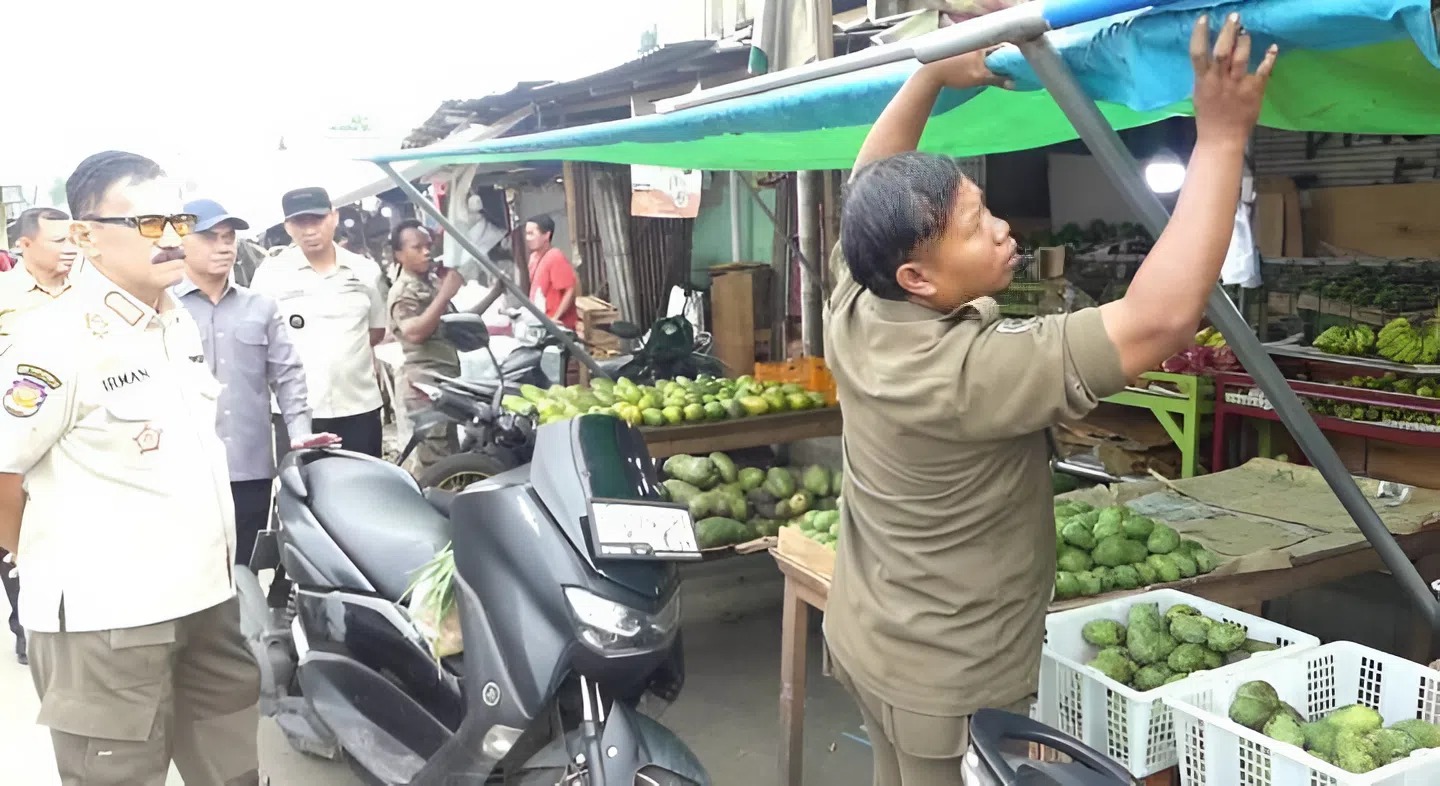
The Head of the Tangerang City Civil Service Police Unit (left) supervising the relocation of street vendors from Pasar Anyar.
TANGERANG – The Tangerang City Government, through the Regional Public Market Enterprise and the Civil Service Police Unit, relocated hundreds of street vendors who had been trading around Pasar Anyar.
This step was taken as an effort to regulate the streets and encourage traders to occupy the market area provided inside the building. This relocation targets a total of 502 street vendors who usually trade along Ahmad Yani Street, Ki Asnawi Street, Haji Abdullah Street, Ciremai Street, to Salak Alley.
All traders were instructed to dismantle their stalls and move their merchandise to the new location prepared inside Pasar Anyar. This regulation is an enforcement of Regional Regulation Number 8 of 2018 concerning Public Peace, Order, and Community Protection.
The main goal is to restore the function of the highway as a transportation route, while also facilitating access for buyers and traders to the newly renovated market building.
This regulation process involved 350 combined personnel consisting of the Civil Service Police Unit, the Indonesian National Armed Forces, the Indonesian National Police, and related agencies, supported by two units of heavy equipment.
The Head of the Tangerang City Civil Service Police Unit ensured that, starting today, road access surrounding Pasar Anyar must be clear of street vendor activities.
Public Asked to Shop Inside Pasar Anyar Building
He urged the public to shop inside the market building.
This relocation is expected to create public order, provide shopping comfort for the community, and ensure business certainty for traders who now occupy more decent places.
To support this, public minibus routes will be rearranged and a special area for picking up and dropping off passengers will be provided in the market yard. The Director of the Tangerang City Regional Public Market Enterprise emphasized that this relocation is very important to support the accessibility of Pasar Anyar.
He added that this regulation will also support the rearrangement of public transportation routes so they can enter the north-to-south lane and circulate around the market.
Pasar Anyar
Pasar Anyar is a traditional market located in Bogor, Indonesia, known for its vibrant atmosphere and diverse goods. Historically established during the Dutch colonial era, it has served as a central trading hub for local agricultural produce, textiles, and daily necessities for generations. Today, it remains a bustling center of commerce and local culture, reflecting Bogor’s rich community life.
Ahmad Yani Street
Ahmad Yani Street is a major thoroughfare in many Indonesian cities, most notably in Semarang, Central Java. It is named after General Ahmad Yani, a national hero who was a leader in the Indonesian National Armed Forces and a victim of the 1965 coup attempt. The street serves as a key commercial and transportation artery, symbolizing modern urban development while honoring the nation’s military history.
Ki Asnawi Street
Ki Asnawi Street is a historic and culturally significant thoroughfare in the city of Kudus, Central Java, Indonesia. It is named after Sunan Kudus (also known as Ja’far Shadiq or Ki Asnawi), one of the nine Islamic saints (Wali Songo) who spread Islam in Java in the 15th-16th centuries. The street is famous for its traditional Javanese architecture, historic mosques like the Menara Kudus Mosque, and as a center for the local kretek (clove cigarette) industry.
Haji Abdullah Street
Haji Abdullah Street is a historic commercial and cultural artery in the heart of Old Dhaka, Bangladesh. It is named after a prominent 19th-century merchant and is renowned for its traditional shops selling perfumes (attar), spices, textiles, and jewelry, preserving a centuries-old trading atmosphere. The street offers a vibrant glimpse into Dhaka’s rich Mughal and colonial-era mercantile past.
Ciremai Street
Ciremai Street is a major thoroughfare in the city of Cirebon, West Java, Indonesia, named after the nearby Mount Ciremai, the highest volcano in West Java. The street is a central commercial and transportation artery, historically significant as part of the old post road connecting key regions in Java during the Dutch colonial era. Today, it remains a vibrant hub of local activity, lined with shops, markets, and historic buildings that reflect Cirebon’s blend of Javanese, Sundanese, and Chinese cultural influences.
Salak Alley
Salak Alley is a historic and narrow street located in the old city of Jeddah, Saudi Arabia, within the Al-Balad district, a UNESCO World Heritage site. Historically, it was a bustling market lane known for selling a variety of goods, including spices and textiles, and it exemplifies the traditional Hejazi architecture with its coral stone buildings and ornate wooden balconies (rawasheen). Today, it stands as a preserved cultural landmark that offers visitors a glimpse into the region’s mercantile past and architectural heritage.
Regional Regulation Number 8 of 2018
“Regional Regulation Number 8 of 2018” is not a physical place or cultural site, but a legal document. It is a bylaw enacted by a regional government in Indonesia in 2018 to govern specific local administrative, economic, or social matters within its jurisdiction. Its history is simply its legislative process, created to address local needs and implement higher-level national laws at the regional level.