Medan –
Medan is known as a region rich in ethnic and cultural diversity. Various ethnic groups such as Malay, Javanese, Sundanese, Batak, Chinese, Arab, and Indian live side by side, shaping the city’s multicultural character.
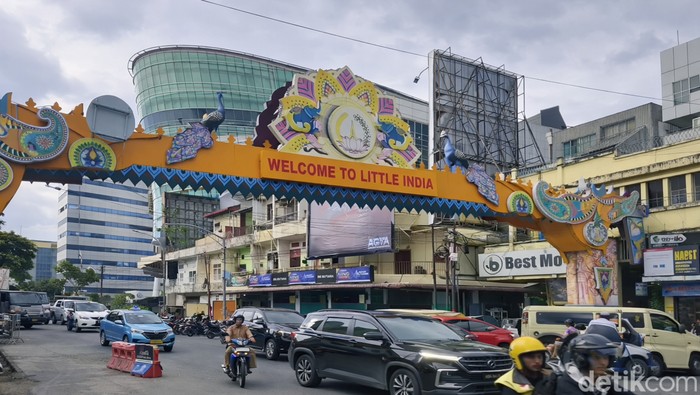
Amid the ethnic diversity coexisting in Medan, there is one area known as the center of the Indian community settlement, namely Kampung Madras. In this area, Indian communities like the Tamil and Sikh have long settled and become part of the city’s social dynamics.
Behind this diversity, what is the trace of Indians in Kampung Madras, Medan? Here is the overview.
A history lecturer at the University of North Sumatra explained that this diversity makes Medan a melting pot, where various cultures blend and give rise to a harmonious life.
“Medan is known as a city with a heterogeneous and multicultural population. Various ethnic groups live side by side in this city. Medan’s growth has become a melting pot so that various cultures mix, resulting in tolerance thriving in this city. One of the distinctive ethnic groups of Medan is the Indians. In Medan, there are Tamil and Sikh people who have long resided in Medan,” he said.
Early Traces from Trade Routes
He stated that the relationship between Indians and the Nusantara region, including North Sumatra, has been ongoing for a long time, even since the early AD era through maritime trade routes in the Malacca Strait.
“Based on history, the relationship and arrival of Indians in Indonesia has been longstanding. Traces and historical evidence began in the early first century AD when there was a maritime route for Indian traders in the Malacca Strait seeking spices and gold. In the 7th century, relations between Indians also occurred with the Srivijaya Kingdom in Palembang,” he explained.
This relationship then left archaeological traces that can still be found today, one of which is in the Kota Cina Site area.
“Furthermore, Indian heritage in the Medan area can be seen from findings at the Kota Cina Site, Marelan. The discovery of South Indian-style statues at the Kota Cina Site proves a strong relationship between Medan and South India. Tracing the origins and history of the Deli Sultanate also cannot be separated from the first Sultan of the Deli Sultanate, Gotjah Pahlawan, who was an Acehnese commander of Indian descent,” he said.
Arriving as Plantation Workers
The presence of Indians in North Sumatra became more significant from the late 19th century, when this region developed into a plantation area.
“The more influential relationship between Indians and North Sumatra occurred from the late 19th century when North Sumatra was opened as a plantation region. The Indians recruited as plantation workers were Tamil people from the Coromandel Coast, South India. In addition, a group of Sikh people also migrated to Medan, North Sumatra,” he revealed.
In plantation company records, there is a specific term for this group of workers.
“In plantation company records, the Indian workers were referred to as Klingalezeen or Keling people. Meanwhile, the Sikh people were called Bengaleezen or Bengali people. Interestingly, certain jobs were assigned to these Tamil workers. Their jobs included building roads, digging ditches, and serving as ox-cart drivers,” he explained.
Meanwhile, he explained that the Sikh group had a different role in the plantation environment.
“Unlike the Tamil people, the Sikh or Bengali people were employed as supervisors or plantation overseers, because they were usually former soldiers or police officers. Besides the Sikh or Bengali people working on plantations, there were also Bengali people who became cattle breeders, cattle sellers, cart drivers, security guards, and even moneylenders, commonly called chetti,” he continued.
Religious Traces and Kampung Madras
Besides being workers, the Indian community also left a strong mark in the religious and cultural fields in Medan.
“Indians in Medan, North Sumatra, also include Indian Muslims, for whom there are mosques or places of worship in Medan, such as the Ghaudiyah Mosque and the Jami’ Mosque,” he said.
To this day</