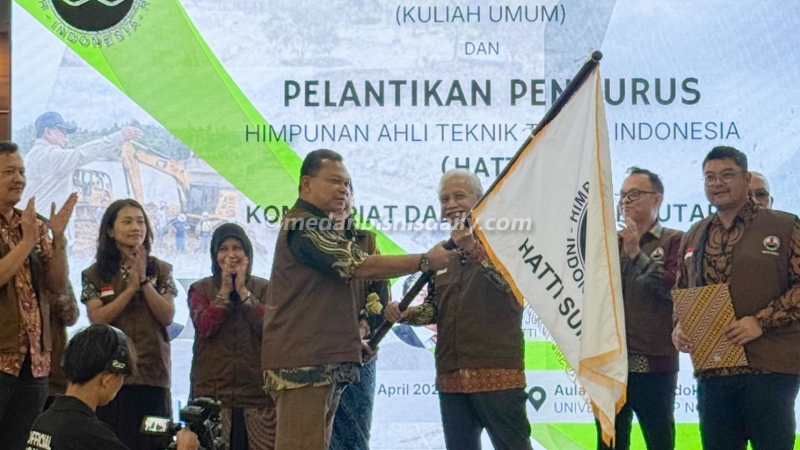
The Board of the Indonesian Geotechnical Engineering Association (HATTI) for the North Sumatra Regional Commissariat for the 2026-2030 term has been inaugurated. The inauguration was combined with a seminar (public lecture) held at the Auditorium of the Faculty of Medicine, HKBP Nommensen University (UHN) Medan, on Thursday.
Following the inauguration, the HATTI North Sumatra board prioritized several programs. These include a public lecture at USU in early May, followed by a national seminar in September 2026. The national seminar is a response to the increasing risk of flood and landslide disasters in the regions of North Sumatra, West Sumatra, and Aceh.
Chairman of HATTI North Sumatra, Ir Berlin A Tampubolon, accompanied by Secretary Ir Irwan Suranta Sembiring, stated this after the inauguration and seminar activities.
Berlin emphasized that a geotechnical approach must become the main foundation in every development, especially in areas with high disaster vulnerability.
“We can no longer build without understanding soil conditions. Geotechnics must be the basis of every plan, especially in landslide and flood-prone areas like parts of North Sumatra,” said Berlin.
He revealed that the upcoming national seminar will carry the theme ‘Mitigation and Rehabilitation of Natural Disasters: Challenges and Geotechnical Strategies for Sustainable Development in North Sumatra.’
According to Berlin, the event is not just an academic forum but is also designed as a space for cross-sector collaboration, involving the government, academics, practitioners, and the construction industry.
Chairman of the HATTI 2026 National Seminar Committee, Dr Ir Ernesto M. Silitonga, emphasized that the seminar aims to produce applicable recommendations that can be directly implemented.
“We want this forum to generate concrete solutions, not just discussions. There must be an output that can be used in disaster planning and management,” he stressed.
Geographically, the regions of North Sumatra and Aceh have complex soil characteristics, such as clay, weathered rock, and hilly contours with steep slopes. This condition increases the potential for landslides, especially during heavy rainfall.
Vice Chairman of the HATTI North Sumatra 2026 National Seminar, Dr Ir Immanuel Panggabean, stated that the role of geotechnical experts is crucial, not only in the planning stage but also in post-disaster management.
“Slope stability analysis, soil investigation, and mitigation design must be standards in every project. This can no longer be considered an afterthought,” he said.
Meanwhile, from the Scientific and Professional Development Division, Ir Adi Yesaya Sukatendel highlighted the importance of utilizing technology in disaster mitigation.
He mentioned the use of early warning systems, slope monitoring tools such as inclinometers, and the integration of Building Information Modelling (BIM) with geospatial data (GeoBIM) as strategic steps for the future.
“Technology must be part of the solution. With accurate data, risks can be minimized from the start,” he said.
Shortage of Geotechnical Experts
Secretary General of HATTI, Ir Andi KS Kartawiria, added that the need for geotechnical experts in North Sumatra is not just about numbers, but also about urgency in addressing development challenges.
“Every infrastructure project is highly dependent on geotechnics. Without it, the risk of construction failure is very high,” he said.
He also highlighted field challenges, such as a lack of experts and limited data, which often cause delays in disaster response, especially when access is cut off due to landslides.
Through this national seminar, HATTI North Sumatra aims to drive a paradigm shift from a reactive to a preventive approach in disaster management.
The geotechnical approach is expected to minimize risks from the initial stages, including through mapping vulnerable areas and recommending more adaptive spatial planning.
Going forward, HATTI North Sumatra targets the creation of a concrete and implementable geotechnical-based disaster mitigation roadmap as an outcome of the forum.
This step is considered important to support resilient, safe, and sustainable infrastructure development, not only in North Sumatra but also in the Sumatra region as a whole.