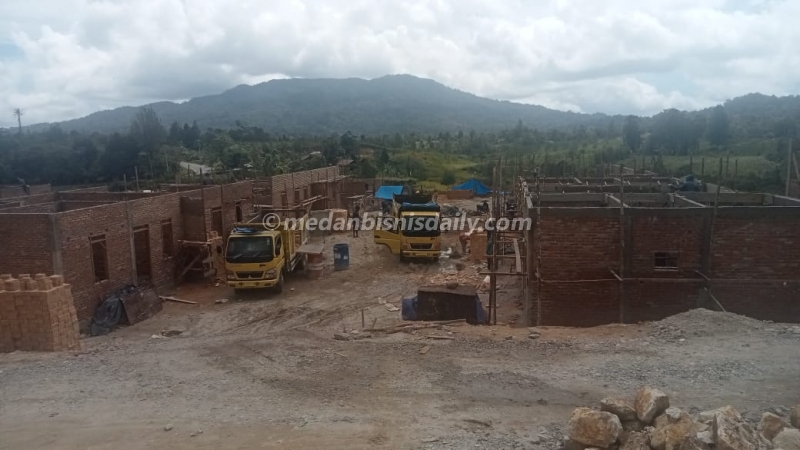
Sand material used in the construction of 103 permanent housing units for flood and landslide victims in Tor Nauli Hamlet, Dolok Nauli Village, Adian Koting District, North Tapanuli Regency, North Sumatra, is suspected to originate from unlicensed sand mining activities.
This suspicion arose after a field investigation was conducted on Saturday. At several points, sand extraction activity using dredging machines and suction equipment was observed in an area said to be around the Sigeaon watershed and the Aek Siborgung River.
A number of sand-carrying trucks were seen leaving the area. The vehicles were followed, and some were found unloading their cargo at the permanent housing construction site in Adian Koting District, which is currently still under development.
A total of 103 housing units are being built for residents affected by the floods and landslides that occurred on November 25, 2025. The construction of this permanent housing is a collaboration between the government and the Indonesian Tzu Chi Foundation. The groundbreaking ceremony was held on December 21, 2025.
Worker Statements
Several workers at the project site who were met stated they did not know the exact origin of the sand material used. However, they mentioned the project is being handled by three partner contractors: Tolkit, Mitra Keluarga, and Hutabarat.
Regarding the mention of the name Hutabarat, workers who requested their identities not be published conveyed that the partner in question is a close relative of JTP Hutabarat. They also mentioned a familial relationship with the Regent of North Tapanuli. However, this information has not been independently verified.
Report to Authorities
Previously, an environmental concern group submitted a community complaint letter to the North Tapanuli Police Chief on February 13, 2026. The complaint relates to suspected mining activities for non-metallic minerals and rocks, which are said to lack official permits at several points in the North Tapanuli region.
The reporters hope law enforcement officials will investigate and clarify the mentioned mining activities to ensure compliance with licensing regulations and prevent potential environmental impacts.
As of this report, the police, local government, and project partner contractors have not provided an official response to requests for confirmation.
Sigeaon watershed
The Sigeaon watershed is a vital ecological and cultural landscape located in the province of Benguet in the northern Philippines. Historically, it has been central to the agricultural practices and water resource management of the indigenous Ibaloi people, who have cultivated its terraced slopes for generations. Today, it remains an important area for biodiversity, irrigation, and sustaining local communities.
Aek Siborgung River
The Aek Siborgung River is a significant waterway located in North Sumatra, Indonesia, flowing through the culturally important region of Toba. It is historically tied to the Batak people, particularly the Toba Batak, and its waters have supported local agriculture, fishing, and daily life for centuries. The river also holds cultural and spiritual significance in local traditions and folklore.
Tor Nauli Hamlet
Tor Nauli is a traditional Batak Toba hamlet located in the Samosir Regency of North Sumatra, Indonesia. It is known for its well-preserved examples of Batak architecture, including distinctive wooden houses with saddleback roofs, and serves as a cultural site showcasing the ancestral heritage and social structure of the Batak people. Historically, such hamlets were organized around family clans and functioned as self-sufficient communities centered on a ceremonial stone plaza called an *halaman*.
Dolok Nauli Village
Dolok Nauli Village is a traditional Batak Toba village located near Lake Toba in North Sumatra, Indonesia. It is known for its well-preserved *rumah adat* (traditional houses) with distinctive boat-shaped roofs and intricate carvings, which reflect the ancient architectural and spiritual heritage of the Batak people. The village offers a living cultural experience, showcasing the community’s ancestral customs, music, and social structure that have endured for centuries.
Adian Koting District
Adian Koting is a district located in North Tapanuli Regency, North Sumatra, Indonesia. Historically, it is part of the Batak Toba cultural region, an area known for its traditional villages, distinctive *rumah adat* (traditional houses), and rich Christian heritage following the spread of Protestantism in the 19th century. The district’s culture and community life remain closely tied to these Batak traditions.
North Tapanuli Regency
North Tapanuli Regency is an administrative region on the island of Sumatra in Indonesia, located in North Sumatra province. It is historically significant as part of the Batak cultural heartland, home to the Batak Toba people, and contains areas of Lake Toba—the largest volcanic lake in the world formed by a massive supervolcanic eruption around 74,000 years ago. The regency’s history is deeply intertwined with the pre-colonial Batak kingdoms and the later spread of Christianity by German missionaries in the 19th century.
North Sumatra
North Sumatra is an Indonesian province on the island of Sumatra, most famous for being home to Lake Toba—the world’s largest volcanic lake, formed by a cataclysmic super-eruption around 74,000 years ago. The region has a rich cultural history as the heartland of the Batak people, whose distinct traditions, architecture (like the boat-shaped *rumah adat*), and Christianity co-exist with significant Malay and Islamic influences. Its capital, Medan, also showcases colonial-era landmarks from its history as a major center of the Dutch East Indies plantation economy.
Indonesian Tzu Chi Foundation
The Indonesian Tzu Chi Foundation is the local branch of the global Buddhist Tzu Chi humanitarian organization, established in Indonesia in the early 1990s. Rooted in the principles of compassion and relief, its history in the country is defined by providing disaster response, healthcare, education, and community development, often playing a critical role during national crises like the 2004 tsunami and various natural disasters. It serves as a significant cultural and social institution, promoting interfaith harmony and volunteerism across the Indonesian archipelago.