Deli Serdang. The Special Committee for Local Revenue of the Deli Serdang Regional House of Representatives has uncovered suspected revenue leaks amounting to billions of rupiah from four CitraLand residential areas in the region.
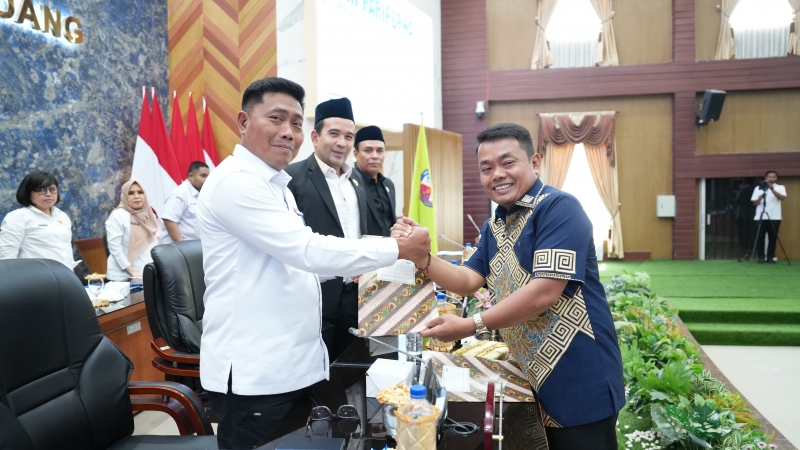
This finding was presented during a plenary session led by the House Speaker and Deputy Speaker, attended by the Vice Regent.
The report from the Special Committee also included members such as the Committee Vice Chair, Secretary, and other committee members.
It was stated that the development of CitraLand housing in four locations — in Telagasari Village, Helvetia CitraLand, Medan Estate Village, and Sampali Village — is suspected to have caused revenue leaks.
The alleged revenue leak includes the discovery that the building area on issued building permits does not match the actual built area, such as fences and gates.
Furthermore, the built area does not match the area recorded on the Land and Building Tax notification letter. The tax object sales value rate for land and building tax is not the same as the surrounding rates.
For instance, in CitraLand Tanjungmorawa, the land tax was issued at under one million, while in that area the rate has reached 3 million per square meter.
It was also found that not all certificates for the tax on acquisition of land and building rights have been transferred from CitraLand to individual owners. After a credit agreement or ownership transfer, CitraLand should split or transfer the name to the home buyer.
According to the committee, the transfer fee for one house can reach 70 million rupiah.
Further tax leaks were found in the extraction of groundwater. At CitraLand, not all groundwater extraction activities have permits.
It was found that CitraLand drills its own groundwater to supply clean water to each house. Payments are collected from each house, and CitraLand pays a retribution fee to the local government, but the payment amount was found to be inconsistent.
Water usage payments per house can reach 200,000 to 300,000 rupiah.
The committee chair explained that the amount of the suspected leak is based on calculations by the committee, according to received documents and field reviews at four CitraLand housing locations.
“A discrepancy was found between the documents and the field review results,” he explained.
He also emphasized that the suspected leak may be due to errors by the Regional Revenue Agency staff or intentional acts by certain individuals.
This was raised with the Revenue Agency, which admitted that the suspected error was due to staff not having validated all CitraLand assets.
It was added that after the findings document is prepared in detail, the House will submit it to the Provincial Prosecutor’s Office for follow-up, requesting serious attention to the suspected revenue leak.
Meanwhile, the Vice Regent appreciated the work of the Special Committee and stated they would work together with the local government to eradicate tax evaders.
“We will eradicate all tax evaders, because taxes are for the people’s benefit. The executive and legislative branches are united for the prosperity and welfare of the community,” he affirmed.
The Vice Regent also assured that if any Revenue Agency staff are involved in wrongdoing under the current leadership, they will be eradicated to the roots.
“(Tax evaders), we will eradicate them in the era of the House Speaker and Deputy Speaker,” he said.
Meanwhile, a CitraLand spokesperson denied the allegations when contacted, stating that the issue had been discussed with the House previously and was proven with CitraLand documents.
“Good evening, thank you for the confirmation. Regarding this matter, we can convey that this issue was previously discussed in a meeting with the House last year and has been fully clarified and supplemented with supporting documents. We ensure that all obligations, including land and building tax, have been fulfilled in accordance with applicable regulations from the local government,” he wrote.
CitraLand
CitraLand is a large-scale, integrated residential and commercial development in Indonesia, pioneered by the Ciputra Group starting in the 1990s. It is known for its master-planned, self-contained communities featuring parks, schools, shopping centers, and recreational facilities, designed to offer a modern suburban lifestyle. The project reflects a significant trend in Indonesian urban development, transforming previously rural areas into thriving, organized townships that prioritize convenience and quality of life.
Telagasari Village
Telagasari Village, located in Indonesia, is known for its traditional cultural heritage and agricultural roots, particularly in rice farming. Historically, the village has preserved local customs and communal practices that date back generations, often centered around agrarian life and spiritual rituals. Today, it remains a site where visitors can experience authentic rural traditions and the enduring connection between the community and its ancestral land.
Helvetia CitraLand
Helvetia CitraLand is a residential and commercial development in Medan, Indonesia, built on land that was once a Dutch-owned tobacco plantation from the colonial era. The area’s name, “Helvetia,” reflects its historical ties to Swiss settlers involved in the plantation industry. Today, it has been transformed into a modern, integrated township featuring homes, shopping centers, and recreational facilities.
Medan Estate Village
Medan Estate Village is a historic plantation settlement located in North Sumatra, Indonesia, originally established during the Dutch colonial era as part of a vast tobacco and rubber estate. The village served as a hub for European planters and local workers, featuring colonial-style houses, a church, and a cemetery that reflect its agricultural past. Today, it stands as a quiet heritage site, offering a glimpse into the region’s colonial history and plantation economy.
Sampali Village
Sampali Village is a historic settlement in North Sumatra, Indonesia, known for its traditional Karo Batak architecture and cultural heritage. The village features iconic rumah adat (traditional houses) with distinctive elongated roofs and intricate carvings, reflecting the customs of the Karo people. Its history dates back centuries as a center for local governance and community life, though it has evolved to accommodate modern influences while preserving its cultural identity.
CitraLand Tanjungmorawa
CitraLand Tanjungmorawa is a large-scale integrated residential and commercial development located in Tanjungmorawa, Deli Serdang, North Sumatra, Indonesia. Developed by the Ciputra Group, it was established to provide a modern, master-planned township with amenities like schools, shopping centers, and recreational areas, catering to the growing urban population outside Medan. The area has evolved from agricultural land into a thriving suburban hub, reflecting the region’s rapid urbanization and real estate growth since the early 2000s.
Deli Serdang Regional House of Representatives
The Deli Serdang Regional House of Representatives (DPRD) is the legislative body for the Deli Serdang Regency in North Sumatra, Indonesia. Its history is tied to the administrative evolution of the region, which was established as a regency in 1946, with the DPRD serving as the local parliament to represent the people and oversee regional governance. The institution plays a key role in drafting local regulations and overseeing the executive branch’s implementation of policies for the regency.
Provincial Prosecutor’s Office
The Provincial Prosecutor’s Office is a government building that serves as the headquarters for the chief prosecuting authority in a province, responsible for overseeing criminal investigations and legal prosecutions. Historically, such offices have evolved from early judicial systems to become key institutions in upholding the rule of law, often located in central urban areas to facilitate access to courts and law enforcement. The specific architecture and history of a given office may reflect the region’s legal traditions and periods of administrative development.