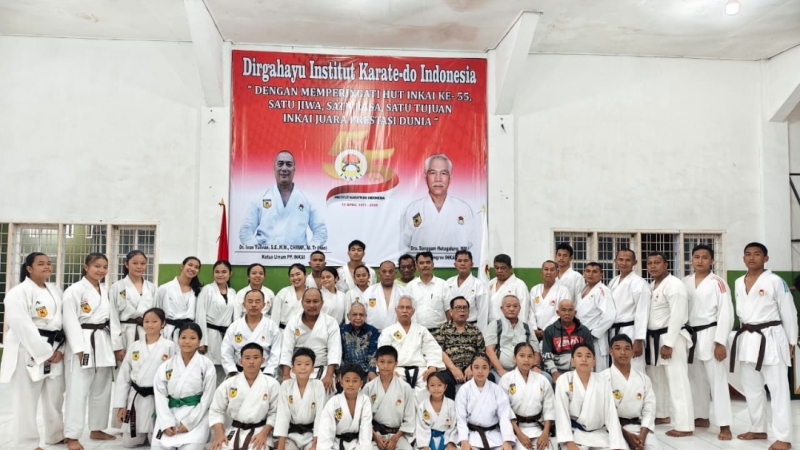
The Provincial Board (Pengprov) of the Indonesian Karate-Do Institute (INKAI) of North Sumatra commemorated the 55th anniversary of INKAI at the INKAI North Sumatra Dojo, on Jalan Pasar Merah/HM Jhoni, Medan City.
The 55th anniversary commemoration, themed “With the Commemoration of INKAI’s 55th Anniversary, One Soul, One Feeling, One Goal: INKAI as a Champion of World Achievement,” took place in a warm and united atmosphere.
The Chairman of the INKAI North Sumatra Provincial Board invited all karatekas in North Sumatra to use the commemoration of INKAI’s 55th anniversary as a moment to enhance achievements to the national and even international level.
“I invite all karatekas to make INKAI’s 55th birthday a momentum to further remind us of achievements, towards karatekas with integrity and professionalism,” he said.
At INKAI’s 55th year, he further stated, it has been marked by dynamic developments and ups and downs in coaching karate athletes, not only from internal aspects but also external ones.
According to him, this is a challenge that must be faced wisely. “In any condition, karatekas must be able to face all challenges, so they become more trained and tested,” he added.
He expressed gratitude for all the hard work of past and present administrators, including the karatekas who have worked together to maintain the dignity of the INKAI organization.
He said it was not easy, but with one determination and drive, INKAI continues to exist to this day. “Therefore, we urge all karatekas to keep training, training, and training,” he concluded.
Meanwhile, the Advisor of INKAI North Sumatra, who is also the Secretary General of FORKI North Sumatra, congratulated INKAI on its 55th anniversary. He stated that karate is a hard sport, which contains artistic value. “Therefore, karatekas must also be intelligent,” he mentioned.
He cited several INKAI achievements to be proud of, including in 1975 when INKAI dominated and was crowned overall champion in the formation of the National Team for the WOUKO world championship.
However, he lamented the current slump in the sport of karate. This is partly due to its exclusion from the National Grand Design of Sports (DeBON).
Attending the anniversary commemoration were, among others, the Chairman of the INKAI North Sumatra Foundation, the Secretary General of the INKAI North Sumatra Provincial Board, the Chairman of the Black Belt Council, the Head of the Fund Division, and members of the Black Belt Council.
INKAI North Sumatra Dojo
Based on available information, the “INKAI North Sumatra Dojo” appears to be a local training center (dojo) for the Indonesian Karate-Do Institute (INKAI), a major national karate organization in Indonesia. While specific founding details for this particular branch are not widely documented, INKAI itself has a long history, having been established in 1963 to promote and develop traditional Japanese karate (specifically the Shōtōkan style) across the Indonesian archipelago. Therefore, this dojo in North Sumatra is part of that broader network, serving as a community hub for martial arts training and discipline.
Jalan Pasar Merah/HM Jhoni
“Jalan Pasar Merah/HM Jhoni” is a major street in Medan, Indonesia, historically named after the “Pasar Merah” or “Red Market,” a central trading hub during the colonial era. The road was later co-named to honor HM Jhoni, a local nationalist figure and mayor of Medan in the mid-20th century. Today, it remains a vital commercial and transportation artery in the city’s bustling business district.
Medan City
Medan is the capital and largest city of North Sumatra, Indonesia, historically established as a key trading hub by the Sultanate of Deli in the 16th century. Its modern growth was heavily driven by the late 19th-century Dutch colonial plantation boom, particularly for tobacco, which led to the construction of many historic buildings like the Maimun Palace. Today, it is a bustling, multicultural gateway to Sumatra, known for its diverse architecture and culinary scene.
North Sumatra
North Sumatra is an Indonesian province on the island of Sumatra, most famous for being home to the immense Lake Toba—the largest volcanic lake in the world, formed by a super-eruption around 74,000 years ago. The region has a rich cultural history as the homeland of the Batak people, whose distinct traditions and architecture, like the boat-shaped *rumah adat*, are prominent. It also features significant biodiversity within the Leuser Ecosystem rainforest and was historically influenced by early Hindu-Buddhist kingdoms and later Islamic sultanates.
Indonesian Karate-Do Institute (INKAI)
The Indonesian Karate-Do Institute (INKAI) is the official national governing body for the traditional Japanese martial art of Karate in Indonesia. It was founded in 1964 by Sabeth Muchsin, who introduced the style after training in Japan, and it is affiliated with the Japan Karate Association (JKA). INKAI plays a central role in standardizing instruction, organizing national competitions, and selecting athletes to represent Indonesia in international events like the SEA Games.
FORKI North Sumatra
“FORKI” in North Sumatra refers to the regional branch of the Indonesian Karate-Do Federation (Federasi Olahraga Karate-Do Indonesia), the nation’s official governing body for the sport of karate. It is not a physical cultural site, but an administrative sports organization responsible for promoting, developing, and managing karate competitions and training across the province. Its history is tied to the national federation’s establishment in the 1960s, which standardized karate as a competitive sport throughout Indonesia.
National Team for the WOUKO world championship
The “National Team for the WOUKO world championship” is not a specific physical place or cultural site, but rather a competitive national delegation. It represents a country in the WOUKO (World Open Karate Organization) World Championship, a major international karate tournament. Its history is tied to the development of karate as a global sport and the formation of national teams to compete at the highest level in open-style competitions.
National Grand Design of Sports (DeBON)
The “National Grand Design of Sports (DeBON)” is not a widely recognized historical or cultural site. It appears to be a modern concept or project name, possibly related to sports infrastructure or policy planning in Indonesia, but it lacks a significant, documented public history or established presence as a traditional landmark.