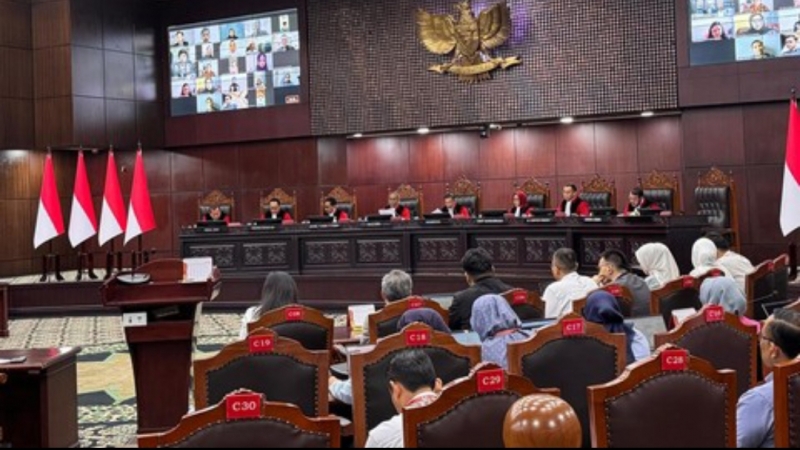
The Constitutional Court (MK) rejected a judicial review petition of Law Number 40 of 1999 concerning the Press. The MK stated that columnists cannot be categorized as journalists.
The petition challenged Article 8 of the Press Law regarding the status of columnists. The petitioner requested that the article also include columnists and freelance contributors in receiving legal protection like journalists. The petition was registered under number 192/PUI-XXIII/2025.
“Considering the petitioner’s argument concerning the norm of Article 8 of Law 40/1999 and the explanation of Article 12 of Law 40/1999, the fundamental issue the court must answer is whether the position of a columnist and/or freelance contributor is equated with a journalist, which would require the norm provision of Article 8 of Law 40/1999 to be supplemented with the phrase ‘columnists and freelance contributors’ so that the formulation of Article 8 of Law 40/1999 is interpreted to mean: in carrying out their profession, journalists, columnists, and freelance contributors receive legal protection,” stated the court’s consideration.
The court explained that in Article 1 paragraph 4 of the Press Law, there is a formulation defining a journalist. The article states that a journalist is a person who regularly carries out journalistic activities.
“The provision of Article 7 of Law 40/1999 can be interpreted as providing a limitation regarding the definition of a journalist, namely: first, being a member of a journalist professional organization, and second, being bound by a journalistic code of ethics,” the court said.
The MK explained that in the development of the journalistic world, there is the term freelance journalism or journalists who are independent in their employment relationship and not bound to a press company. On the other hand, the MK also referred to Article 1 point 4 of Law 40/1999, which states that a journalist is someone who regularly carries out journalistic activities.
“The word ‘regularly’ indicates journalistic activity carried out continuously; within reasonable reasoning linked to Article 1 point 4 of Law 40/1999, the principle of ‘regularly’ requires a journalist to be under the auspices of a press company in carrying out their profession professionally,” the court stated.
According to the MK, a journalist can be given the title of columnist when they are a regular contributor to a column space in a media outlet. That title can also be given to members of the public who utilize media space to express opinions. However, the MK emphasized that members of the public who regularly write opinion pieces in the media cannot be grouped into the profession of journalist.
“A journalist can be a regular contributor to a column space published routinely by a media outlet; that person can be called a columnist. Furthermore, the title of columnist can be given to members of the public who utilize space in print or electronic media publications to convey their personal opinions as a form of expressing views. However, such persons cannot be protected under the regime of Article 8 of Law 40/1999 because they cannot be categorized as having the profession of journalist,” the court explained.
The MK stated that Article 28E paragraph 2 of the 1945 Constitution has provisions for the public in expressing opinions. However, the rules in the Press Law concerning journalists’ work contain different and specific provisions regarding journalist protection.
“Press freedom has a more specific subject, applying only to the press world, namely journalists and including press companies,” the court clarified.
“This distinction certainly applies to journalists who convey information in the media versus the general public who disseminate ideas in mass media as part of freedom of opinion and expression. The scope regulated in Law 40/1999 is limited to regulations concerning the ecosystem within the press world,” the court continued.
The MK also emphasized that the work of columnists or freelance contributors does not fall into the category of journalistic work. The MK reasoned that this is because there is no curation process by an editor as there is with the journalistic work of a journalist.
“Work written by the general public, for example in the form of opinions, specific columns, and others, even if curated by an editor, is not categorized as journalistic work and therefore does not become part of the press company’s responsibility,” the court said.
The MK then concluded that the petitioner’s lawsuit was legally groundless. The MK therefore rejected the petitioner’s lawsuit in its entirety.
“The Court adjudicates, rejecting