Bank Mandiri continues to strengthen its commitment as a strategic partner of the government in strengthening the productive sector and driving sustainable people’s economic growth.
Through the distribution of People’s Business Credit (KUR), this bank, with the stock code BMRI, is actively providing broader access to capital for Micro, Small, and Medium Enterprises (MSMEs) as the backbone of the national economy, in line with the spirit of Serving with All Heart.
The Regional CEO of Bank Mandiri Region I / Sumatra 1 stated that this step aligns with the government’s focus on accelerating the people’s economy, which creates inclusive and sustainable economic growth, while expanding business opportunities and strengthening the foundation of the national economy.
“As of February 2026, Bank Mandiri Region I / Sumatra 1 has disbursed KUR amounting to IDR 677.5 billion, or equivalent to 16.5 percent of Bank Mandiri’s 2026 KUR target in the regions of North Sumatra, Riau, and the Riau Islands,” he said in a statement.
Furthermore, it was conveyed that in terms of credit quality, the KUR portfolio of Bank Mandiri Region I / Sumatra is well maintained, with a non-performing loan rate of 1.07%, reflecting sustainable excellence in business management.
Additionally, KUR distribution as of February 2026 was dominated by the productive sector, amounting to IDR 371 billion or 55% of the 2026 KUR disbursement. This distribution is tangible evidence of the synergy between the government, banking, and the business sector in accelerating people-based economic growth as part of the nation’s economic driving ecosystem.
Since the KUR program was launched by the government in 2008 until February 2026, the total accumulated KUR disbursement by Bank Mandiri has reached IDR 310.59 trillion to 3.65 million debtors throughout Indonesia. This low-interest credit has helped millions of business actors increase their business capacity and expand their markets.
In accelerating and maintaining the quality of KUR disbursement, Bank Mandiri also implements an ecosystem-based financing approach from wholesale derivative customers oriented towards strengthening leading production sectors in various regions. Through a closed-loop strategy, the synergy between wholesale customers, MSME actors, and business partners in one value chain is optimized to improve business efficiency and sustainability.
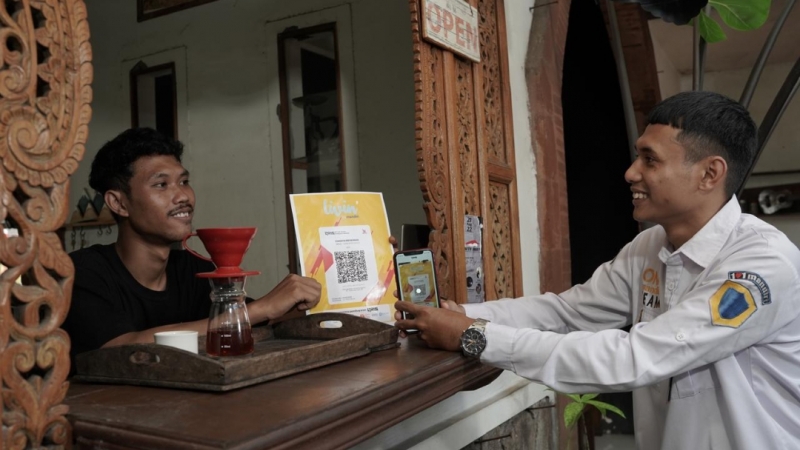
Furthermore, Bank Mandiri consistently serves the daily transaction needs and installment payments of KUR debtors through Mandiri Agents, which are spread across various MSME business ecosystems. This program is accompanied by financial service education and digital literacy so that business actors can manage their finances inclusively and modernly.
Going forward, Bank Mandiri is ready to support the government’s efforts in accelerating KUR distribution in 2026. This commitment is carried out through strengthening ecosystem-based financing strategies, through synergy within the integrated Mandiri Group.
Bank Mandiri
Bank Mandiri is a prominent Indonesian state-owned bank, established in 1998 during the Asian financial crisis through the merger of four struggling state banks. Its headquarters is located in Jakarta, housed in a historic art deco building originally built for the Dutch trading company, which reflects the country’s colonial past and economic evolution. Today, Bank Mandiri is one of Indonesia’s largest banks by assets, playing a key role in the nation’s financial sector.
Sumatra
Sumatra is a large Indonesian island known for its rich natural resources and diverse cultures, including the Batak, Minangkabau, and Acehnese peoples. Historically, it was home to powerful kingdoms like Srivijaya (7th–13th centuries), a major Buddhist maritime empire, and later became a key site for Dutch colonial spice and rubber plantations. Today, its cultural sites include traditional villages, mosques, and the tropical rainforests of Gunung Leuser National Park.
</div
Bank Mandiri
Bank Mandiri is one of Indonesia’s largest state-owned banks, established in 1998 through the merger of four legacy banks during the Asian financial crisis. Its headquarters, known as the Bank Mandiri Tower, is located in Jakarta and stands as a symbol of the nation’s financial resilience and modernization. The bank’s name reflects its mission to be a “mandiri” (self-reliant) pillar of Indonesia’s economy.
Sumatra
Sumatra is a large Indonesian island known for its rich biodiversity and cultural diversity. Historically, it was home to powerful kingdoms like Srivijaya, a major Buddhist maritime empire that thrived from the 7th to the 13th centuries, controlling trade routes across the Strait of Malacca. Today, Sumatra is famous for its natural landscapes, including rainforests and volcanoes, as well as its distinct ethnic groups and traditions.
North Sumatra
North Sumatra is a province in Indonesia known for its stunning natural landscapes, including Lake Toba, the world’s largest volcanic lake, which was formed by a massive supervolcanic eruption around 74,000 years ago. The region has a rich cultural history, shaped by the Batak people, who have preserved their unique traditions, architecture, and music. During the colonial era, North Sumatra became a major center for Dutch plantation agriculture, particularly for tobacco and rubber, which influenced its economic development.
Riau
Riau is a province on the island of Sumatra, Indonesia, historically known as the center of the powerful Malay Sultanate of Siak Sri Indrapura. It played a significant role in regional trade and culture, particularly during the height of the spice trade and Malay maritime influence. Today, Riau is recognized for its rich Malay heritage, traditional arts, and natural resources, including oil palm and petroleum.
Riau Islands
The Riau Islands, an archipelago in western Indonesia, have long served as a crucial maritime crossroads linking the Malacca Strait and the South China Sea. Historically, they were part of powerful Malay sultanates and later became a center for trade and cultural exchange under Dutch colonial influence. Today, the islands are known for their diverse heritage, vibrant Malay culture, and as a popular tourist destination for nearby Singapore and Malaysia.
Indonesia
Indonesia is a vast archipelago nation in Southeast Asia, comprising over 17,000 islands with a rich history shaped by Hindu-Buddhist kingdoms, Islamic sultanates, and European colonial rule, particularly under the Dutch. It declared independence in 1945 after centuries of colonization, becoming the world’s largest archipelagic state. Today, Indonesia is known for its diverse cultures, languages, and iconic sites like Borobudur temple and Bali’s terraced landscapes.
Jakarta
Jakarta is the capital and largest city of Indonesia, located on the northwest coast of Java. Originally a small port named Sunda Kelapa, it was renamed Jayakarta in the 16th century before becoming Batavia under Dutch colonial rule, serving as the center of the Dutch East Indies. After Indonesia’s independence, it was renamed Jakarta and has since grown into a bustling metropolis, facing challenges such as traffic congestion and flooding while preserving landmarks like the old town of Kota Tua.
Gunung Leuser National Park
Gunung Leuser National Park, located in northern Sumatra, Indonesia, is a UNESCO World Heritage Site and part of the Tropical Rainforest Heritage of Sumatra. Established in 1980, it protects one of the last remaining habitats for critically endangered species such as the Sumatran orangutan, tiger, and elephant. The park’s rugged terrain, including the namesake Mount Leuser, and its rich biodiversity make it a vital conservation area and a popular destination for eco-tourism and trekking.