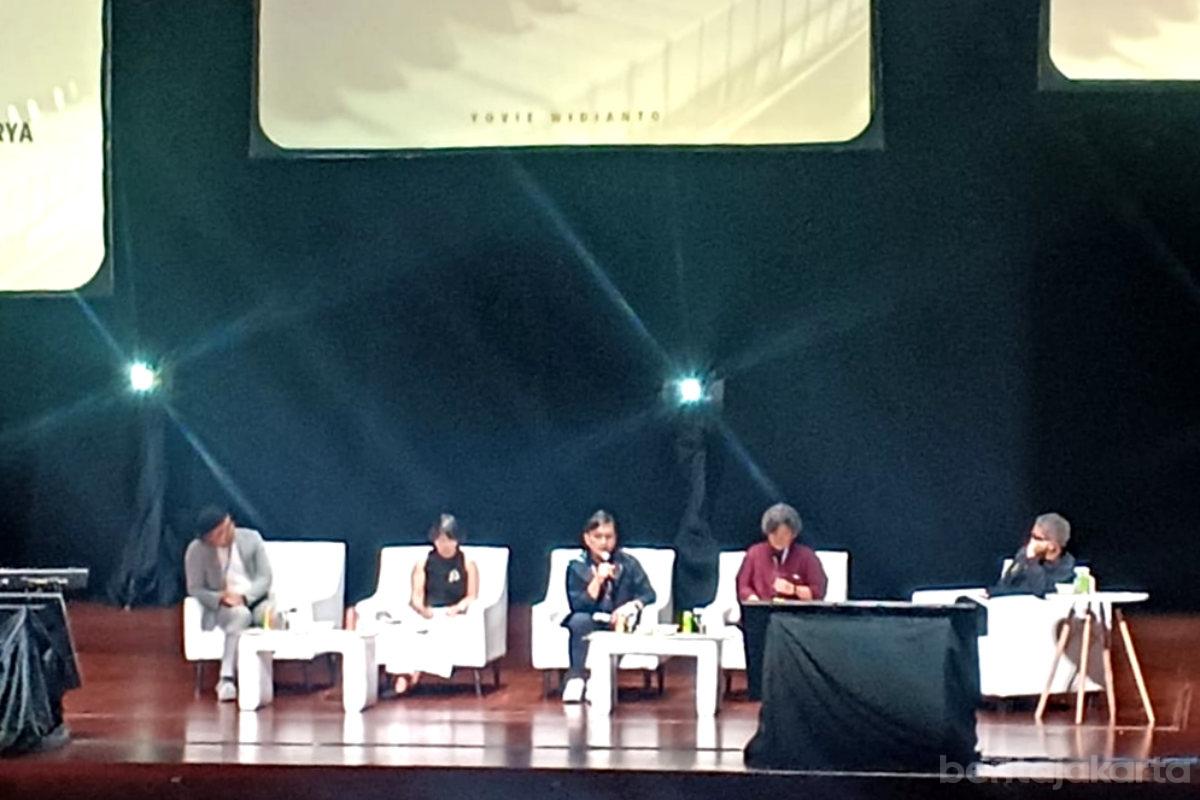
The Jakarta Future Festival (JFF) 2026 held an urban talk with the theme “Accelerating Local Creations to Create Global Products” at the Grand Theater, Taman Ismail Marzuki (TIM), Jalan Cikini Raya, Cikini, Menteng, Central Jakarta, Saturday (6/6).
“The government must be able to create stimulants,”
The forum, featuring speakers including Special Staff to the President of Indonesia for Creative Economy Yovi Widianto, Founder of Jakarta Fashion Week (JFW) Svida Alisjahbana, Music and Culture Industry Practitioner Ki Ageng Bondan, and Creative Economy Academic Dwi Sita Larasati, discussed strengthening the creative economy ecosystem in building Jakarta towards a global city.
Special Staff to the President of Indonesia for Creative Economy Yovi Widianto said the government continues to strive to encourage the creative economy to keep growing. Not only by organizing various events, but also through policy support such as reducing royalty taxes to around 1.5 percent.
“The government must be able to create stimulants. That is a concrete contribution to the creative economy,” he said.
Yovi explained that for nearly 500 years, Jakarta has been a city open to the world. As a melting pot city, it is not only visited by artists from various regions but also regularly hosts guests from different countries.
Therefore, he believes that artists in Jakarta are already very ready to go global, and it is up to the government to accelerate this process.
“So far, many local artists have worked sporadically and managed to penetrate the global market,” he said.
He also advised that artists should not worry about the development of AI technology, as this technology can be used as a tool to continue growing.
“In the past, we worked sporadically and many achieved success. Even more so now with government support,” he emphasized.
Meanwhile, Founder of Jakarta Fashion Week (JFW), Svida Alisjahbana, highlighted the importance of giving young people space to create.
“The JFW event, which has been held for 19 years, has provided many opportunities for young designers,” she said.
She continued that fashion as a creative economy product is not only seen as a commodity but also communicates identity. For example, fashion identity is very strong in top global cities like Paris, Milan, and New York, thus strengthening the city’s brand.
“With all the potential and advantages we have, I am optimistic that Jakarta can become the fashion capital of Southeast Asia. For that, the role of all parties, from industry players to government media, is needed to accelerate this,” she explained.
As an example of the government’s role, Svida mentioned two sales locations in Jakarta dedicated to the fashion industry: Thamrin City and Pasar Mayestik. However, those currently operating in Mayestik are small-scale fashion industry players.
“If possible, those in Mayestik should be given training or something similar. So that later Jakarta will also have a complete fashion shopping experience,” she stated.