Regional governments asked not to hire new temporary workers or dismiss current employees.
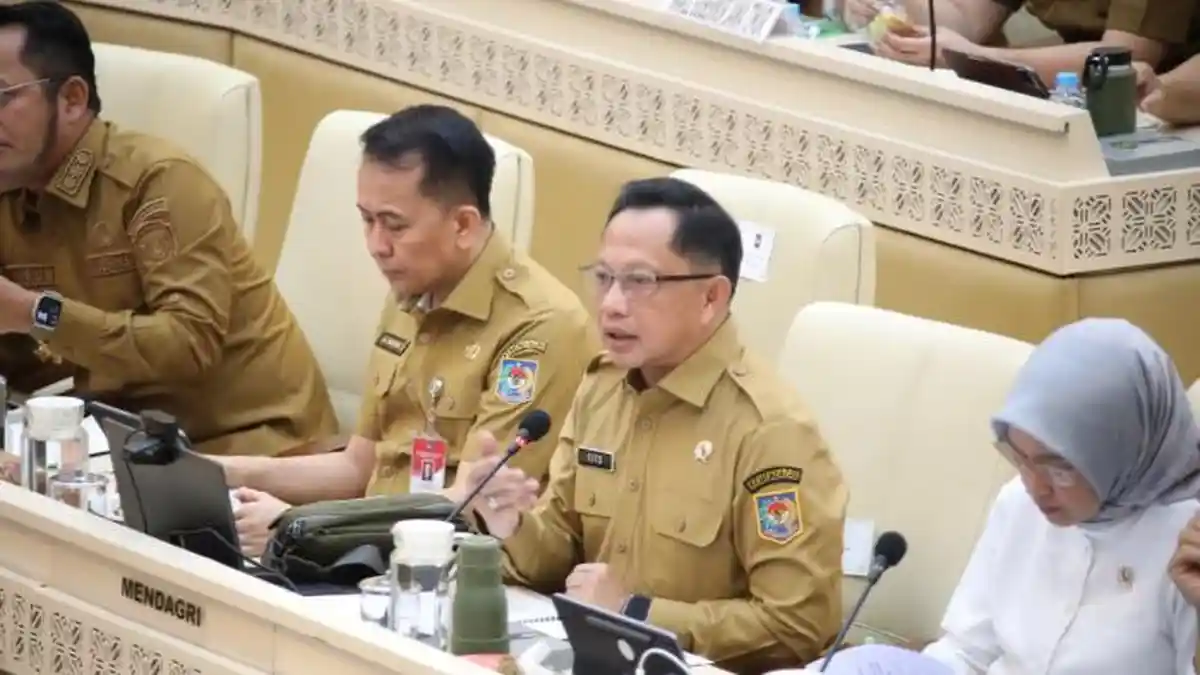
Minister Tito attends a hearing session with Commission II of the House of Representatives regarding issues concerning Government Employees with Work Agreements and honorary staff in the Commission II meeting room in Jakarta, Monday (June 8, 2026).
Ministry of Home Affairs
Minister of Home Affairs Muhammad Tito Karnavian confirmed that he does not expect any option for employee termination.
He conveyed this during a hearing session with Commission II of the House of Representatives regarding issues concerning Government Employees with Work Agreements and honorary staff.
“We do not expect any option for employee termination,” Tito explained in the Commission II meeting room in Jakarta, Monday (June 8, 2026).
During the session, the Minister also outlined several strategies to adjust the personnel expenditure structure to a maximum of 30 percent, as mandated by the Law on Central and Regional Financial Relations starting in 2027.
On the expenditure side, he encouraged regional governments not to conduct new recruitment or terminate existing employees.
“[Regional heads] must be firm: no new recruitment of honorary staff,” Tito said.
Then, on the revenue side, the Minister encouraged regional governments to be creative in increasing Regional Original Revenue.
He cited the success of Pekanbaru City, which managed to optimize its Regional Original Revenue from 800 billion to over 1 trillion rupiah through simplified licensing processes.
He also presented another example, such as Banyuwangi Regency, which successfully linked restaurant and hotel taxes directly to regional governments, impacting Regional Original Revenue.
The Minister also encouraged the optimization of Regional-Owned Enterprises as instruments to increase Regional Original Revenue.
In addition to these efforts, he confirmed having held meetings with the Minister of Administrative and Bureaucratic Reform Rini Widyantini and the Minister of Finance Purbaya Yudhi Sadewa.
As a result, the meeting held in early May pushed for extending the transition period for implementing the Law on Central and Regional Financial Relations by one more year.
“Not through a revision of the Law on Central and Regional Financial Relations, but by including it in the 2027 State Budget Law, extended by one year. According to the legal principle Lex Posterior Derogat Legi Priori, the later rule overrides the earlier one,” Tito emphasized.
Commission II of the House of Representatives
Commission II of the House of Representatives of Indonesia is a key legislative body responsible for overseeing domestic governance, regional autonomy, and public administration. It handles matters related to the Ministry of Home Affairs, the Civil Service Agency, and election-related agencies. Historically, this commission has played a vital role in shaping Indonesia’s decentralization policies and electoral reforms since the country’s transition to democracy in the late 1990s.
Commission II meeting room
The Commission II meeting room is a designated space within a larger governmental or organizational complex, often used for committee sessions and diplomatic discussions. Its history typically reflects the administrative or legislative functions of the body it serves, having hosted key debates and decisions over time. The room’s significance lies in its role as a venue for formal dialogue and policy-making processes.
Jakarta
Jakarta, the capital of Indonesia, is a sprawling metropolis on the northwest coast of Java with a history dating back to the 4th century as the port city of Sunda Kelapa. It was later renamed Batavia by the Dutch during the colonial era, serving as the center of the Dutch East India Company’s operations. Today, Jakarta is a vibrant, bustling city that blends modern skyscrapers with historic landmarks like the old town (Kota Tua), reflecting its rich and complex past.
<h3 class="text-lg font-semibold mb-2
Jakarta
Jakarta, the capital of Indonesia, is a bustling megacity on the northwest coast of Java with a history dating back to the 4th century as the port of Sunda Kelapa. It was later renamed Batavia by the Dutch during colonial rule, serving as the center of the Dutch East India Company’s trade and administration. After Indonesia’s independence in 1945, it was officially named Jakarta and has since grown into a dynamic cultural and economic hub, blending modern skyscrapers with historic landmarks like the old port and colonial-era buildings.
Pekanbaru City
Pekanbaru is the capital of Riau Province in Sumatra, Indonesia, and serves as a major economic hub for the region’s oil, palm oil, and rubber industries. Historically, it grew from a small fishing village into a bustling city, with its development accelerating in the 20th century due to the discovery of oil and the establishment of trade routes along the Siak River. Today, Pekanbaru is known for its blend of modern infrastructure and traditional Malay culture, including landmarks like the An-Nur Great Mosque.
Banyuwangi Regency
Banyuwangi Regency is a regency located at the easternmost tip of Java Island, Indonesia, known for its stunning natural landscapes and rich cultural heritage. Historically, it was part of the Blambangan Kingdom, the last Hindu-Buddhist kingdom in Java, which resisted Islamic expansion until the 18th century. Today, Banyuwangi is famous for attractions like the Ijen Crater and the traditional Gandrung dance, and it serves as a gateway to Bali.