KLH and UIII Partner to Turn Campus into a Biodiversity Conservation Hub
The green corridor of Depok City is projected to become increasingly solid. The Ministry of Environment has officially established a strategic partnership with the Indonesian International Islamic University to transform part of the campus ecosystem area into a Biodiversity Park.
This monumental project is designed as a concrete government step to strengthen the national biodiversity fortress while providing protection space for animals and plants amid rapid urbanization.
Biodiversity Restoration and International Biodiversity Day Commitment
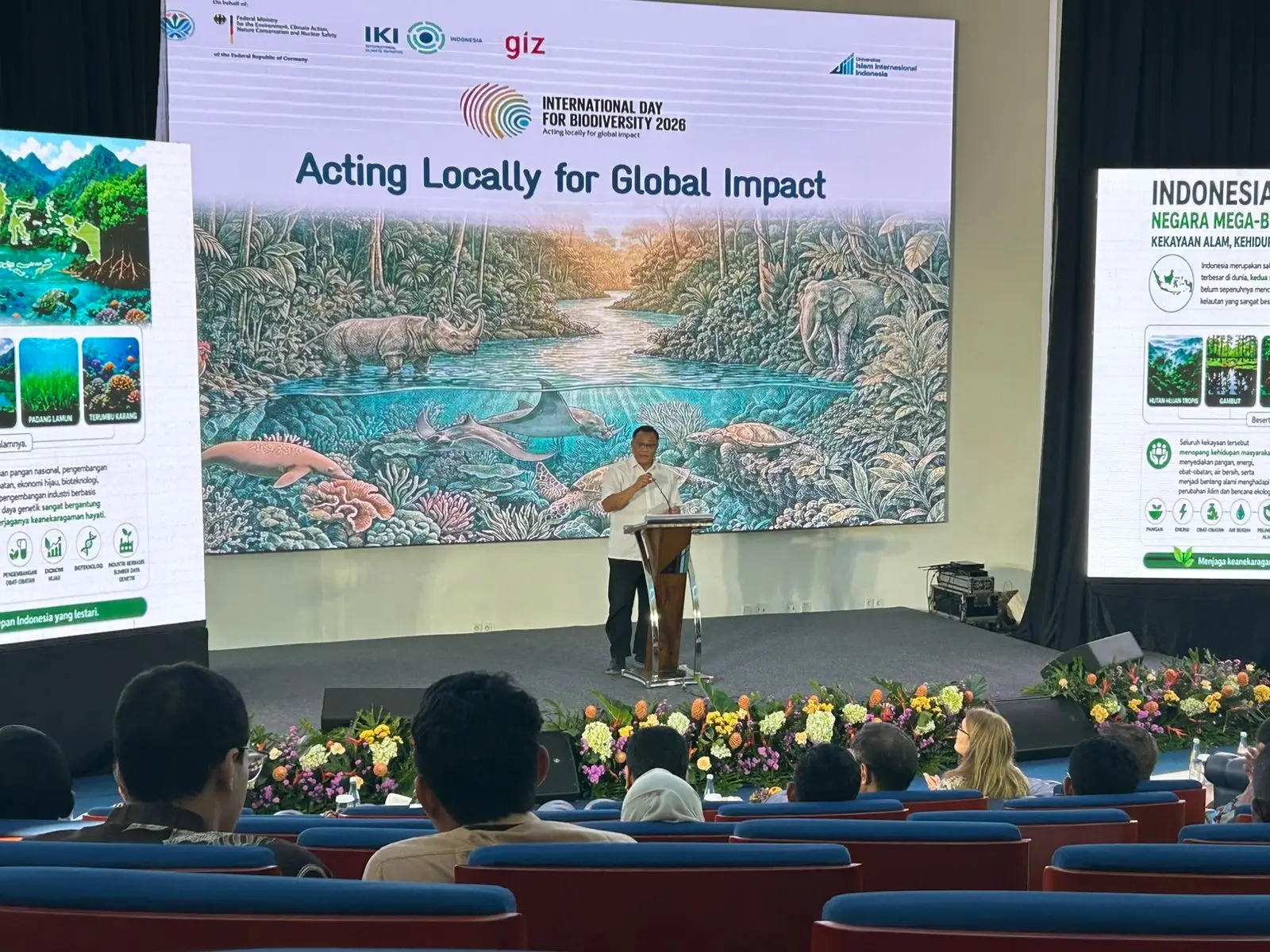
The plan for this green infrastructure development was announced directly by the Minister of Environment during the commemoration of International Biodiversity Day centered at the UIII campus on Thursday.
The Minister of Environment emphasized that the Biodiversity Park project within the campus area is not merely an artificial greening program, but a measurable ecosystem restoration movement.
“The Ministry of Environment and UIII unite an absolute vision to care for and preserve the biodiversity of the archipelago. Through this Biodiversity Park instrument, we ensure the sustainability of environmental carrying capacity in the capital’s buffer zone remains well maintained,” explained the Minister.
Three Main Pillars: Conservation, Education, and Air Quality
Functionally, the transformation of UIII land into a Biodiversity Park will carry three main utilization pillars:
Conservation Zoning: Becoming a refuge for the preservation of various local flora and fauna species that are beginning to fragment.
Public Education Center: Providing a natural laboratory and open research space for the general public, academics, and the younger generation to delve into environmental science.
City Air Filter: Supporting greenhouse gas emission reduction programs and boosting the Air Quality Index in the metropolitan area of Depok City.
Accelerating Green Campus Parameters via UI GreenMetric
Furthermore, the ministry hopes that UIII’s bold step can trigger a domino effect for other higher education institutions in Indonesia to adopt a similar blueprint. The presence of the Biodiversity Park is believed to strengthen UIII’s status in realizing the globally recognized green campus concept.
The environmental authority also directs that the management of this new conservation area refer to credible international assessment instruments.
“We have the UI GreenMetric assessment indicator that can be adopted as an evaluation parameter. This standard is very good to use as a benchmark for campus and state institution commitments in measuring the effectiveness of environmental conservation and biodiversity sustainably,” concluded the Minister.
Indonesian International Islamic University
The Indonesian International Islamic University (UIII), located in Depok, West Java, is a state university established in 2016 to promote moderate Islamic scholarship and international collaboration. Its creation was driven by the need for a global Islamic higher education institution that integrates modern sciences with Islamic studies, drawing on Indonesia’s tradition of religious pluralism. The university aims to foster cross-cultural understanding and produce leaders for the global Muslim community.
Biodiversity Park
The Biodiversity Park is a conserved natural area dedicated to protecting and showcasing a wide variety of native plant and animal species, often located within or near urban environments. Its history typically involves the restoration of degraded land, such as former mining sites or agricultural fields, into a thriving ecological habitat. The park serves as both a sanctuary for wildlife and an educational resource, highlighting the importance of biodiversity and environmental conservation.
Depok City
Depok City, located in West Java, Indonesia, has a unique history dating back to the 18th century when it was established as a private estate by the Dutch East India Company official Cornelis Chastelein. After his death in 1714, Chastelein freed his slaves and granted them land, forming a distinct community known as the “Depokse” or Belanda Depok. Today, Depok has grown into a bustling satellite city of Jakarta, known for its educational institutions like the University of Indonesia and its blend of modern urban development with historical
Depok City
Depok City, located in West Java, Indonesia, was originally a private estate established in the 18th century by Cornelis Chastelein, a Dutch colonial official. After his death, the land was freed and divided among local workers, leading to the development of a diverse community. Today, Depok has grown into a bustling satellite city of Jakarta, known for its educational institutions and rapid urbanization.
Indonesian International Islamic University
The Indonesian International Islamic University (UIII) is a state university established in 2016 in Depok, West Java, with the aim of becoming a leading center for Islamic studies and global scholarship. It was founded under the auspices of the Indonesian Ministry of Religious Affairs to promote moderate Islamic thought and international academic collaboration. The university emphasizes research and graduate-level education, drawing students and faculty from around the world.
Biodiversity Park
Biodiversity Park is a protected urban green space designed to conserve and showcase local flora and fauna, often serving as an educational hub for environmental awareness. Its history typically involves the restoration of degraded or abandoned land, such as former mining sites or wastelands, which were transformed into thriving ecosystems through native plantings and habitat creation. These parks aim to reconnect communities with nature while preserving regional biodiversity for future generations.
International Biodiversity Day
International Biodiversity Day, observed annually on May 22, was established by the United Nations in 1993 to promote awareness and understanding of biodiversity issues. The date commemorates the adoption of the Convention on Biological Diversity in 1992, a key international treaty dedicated to conserving biological diversity, using its components sustainably, and sharing benefits from genetic resources fairly. Each year, the day focuses on a specific theme to highlight critical threats and actions needed to protect the planet’s rich variety of life.
UI GreenMetric
UI GreenMetric is a global ranking system that evaluates universities based on their commitment to sustainability and environmental management. It was launched in 2010 by the University of Indonesia to encourage higher education institutions worldwide to adopt greener practices and share data on energy use, waste management, and campus infrastructure. The initiative has since grown to include hundreds of participating universities, fostering a collaborative network for sustainable development in academia.