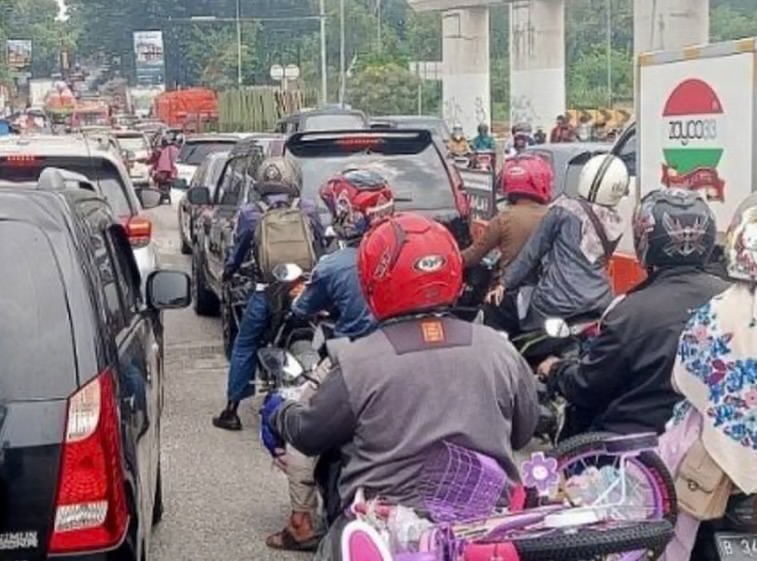
First Day of Eid, Several Points in Depok Hit by Severe Traffic Jams
Depok – The first day of Eid al-Fitr 2026 in Depok City was marked by severe traffic congestion on several main roads, Saturday (21/3/2026). The congestion occurred on Sawangan Main Road, Nusantara Road (Pancoran Mas), Muchtar Main Road (Sawangan), and Kuba Emas Road (Limo).
The Head of the Traffic Division stated that the surge in vehicles was triggered by an increase in local homecoming traffic during Eid.
“Local homecoming traffic on the first day of Eid experienced congestion at several points in Depok City,” they said.
To ease the congestion, the Transportation Office deployed dozens of personnel to vulnerable points from morning until evening. Traffic management was carried out alternately, including the enforcement of illegal parking regulations to smooth the flow of vehicles.
In addition, congestion also occurred on routes leading to tourist locations. Residents took advantage of the Eid holiday to visit family and friends while also visiting destinations such as town squares, lakes, and cemetery areas which saw many visitors.
The Transportation Office also urged the public to increase their vigilance, especially in supervising children amidst the crowds.
Sawangan Main Road
Sawangan Main Road is a major thoroughfare in Sawangan, a district within Depok, West Java, Indonesia. Historically, it has developed as a central commercial and transportation artery, reflecting the area’s growth from a more rural region into a populated suburban part of the Greater Jakarta metropolitan area. Today, it is lined with shops, markets, and offices, serving as a vital hub for local daily life and economic activity.
Nusantara Road
Nusantara Road is a major thoroughfare in Indonesia’s new capital city, Nusantara (IKN), located in East Kalimantan on the island of Borneo. As a central artery in the purpose-built capital, its history is contemporary, having been constructed beginning in the early 2020s as part of Indonesia’s strategic plan to relocate the administrative center from Jakarta. The road symbolizes the nation’s future-oriented development and its vision for a “smart, green” capital in the heart of the archipelago.
Pancoran Mas
Pancoran Mas is a historic neighborhood and cultural site located in Depok, West Java, Indonesia. Its name, meaning “Golden Spring,” originates from a legendary freshwater spring and is historically significant as part of the 17th-century estate of Cornelis Chastelein, a key figure in Depok’s early development. Today, it is a bustling urban area known for its traditional market and as a center of local community life.
Muchtar Main Road
Muchtar Main Road is a major thoroughfare in the city of Almaty, Kazakhstan, historically known as Gorky Street. It was renamed in 1993 in honor of the Kazakh poet and national intellectual, Mukhtar Auezov. Today, it is a central artery lined with shops, businesses, and cultural landmarks, reflecting both the city’s Soviet-era urban planning and its modern development.
Kuba Emas Road
“Kuba Emas Road” is a major thoroughfare in Bandung, Indonesia, historically known for its concentration of goldsmiths and jewelry shops, which is reflected in its name meaning “Golden Dome Road.” The area is part of the city’s commercial heritage and remains a popular destination for purchasing gold and traditional jewelry.
Limo
“Limo” is not a widely recognized specific place or cultural site. It is most commonly a shorthand for **limousine**, a type of luxury vehicle. If you are referring to a location, it may be a misspelling or a reference to a local business, so please double-check the name (e.g., Lima, Peru; Limoges, France; or a district like Limo in Kenya).
town squares
Town squares are open public spaces found in the center of towns and cities, historically serving as the primary venue for markets, public gatherings, and civic events. Their origins often date to medieval times in Europe, where they were established as the commercial and social heart of a community. Today, they remain vital hubs for social interaction, festivals, and as symbols of local identity and history.
lakes
Lakes are natural or artificial bodies of water found worldwide, formed over thousands of years by glacial activity, tectonic shifts, volcanic craters, or human engineering. They have played a crucial role in human history, serving as vital sources of freshwater, transportation routes, and centers for settlement and trade for ancient civilizations. Today, they remain important for ecosystems, recreation, and cultural symbolism in many societies.