Anticipating the Asset Forfeiture Law: UGM Legal Expert Urges Formation of an Independent Management Body Under the President.
Depok (06/04/2026) – The discussion of the Asset Forfeiture Bill in parliament has raised crucial ideas regarding the management of state-confiscated assets. A legal expert from Gadjah Mada University (UGM) has formally proposed that the government establish a specialized asset management agency directly under the President of the Republic of Indonesia.
This proposal was presented during a public hearing with the House of Representatives Commission III at the Parliament Complex in Senayan on Monday (06/04/26). This step is considered urgent to strengthen the authority and legal basis for managing state assets derived from criminal acts.
Centralization of Authority for Institutional Strengthening
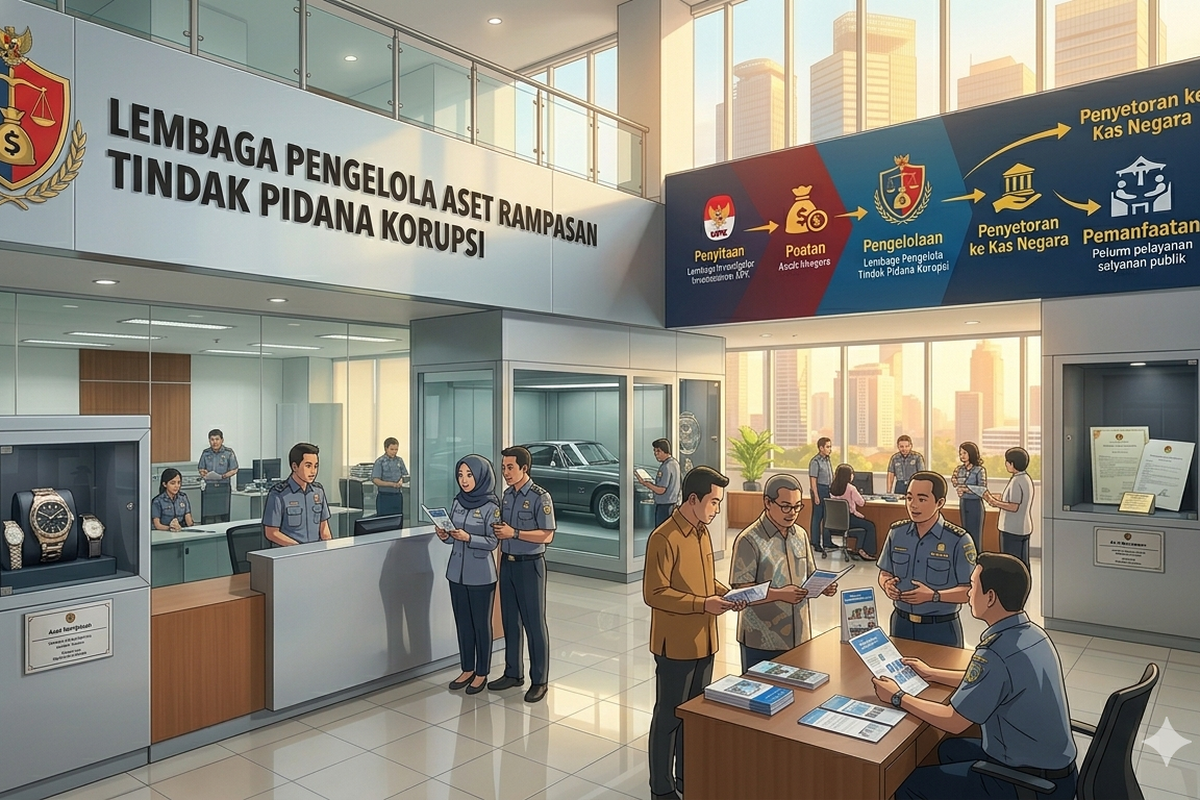
According to the expert, asset management has so far been fragmented across various agencies, such as the State Confiscated Objects Storage House and the Directorate General of State Assets under the Ministry of Finance. Placing a new agency directly under the President’s control is seen as a symbol of urgency and as a way to strengthen functions from upstream to downstream.
“This agency must be strong because its functions include storage, maintenance, and utilization of assets. A position under the President will show that this is a national priority with much stronger authority,” the expert emphasized.
Projected Surge in Asset Value Post-Regulation
The urgency of forming this body is based on the logical reasoning that the passage of the Asset Forfeiture Bill will significantly boost the volume of assets successfully seized by the state. Current data shows staggering figures:
Attorney General’s Office: Records of confiscated assets from criminal acts amount to Rp800 trillion, including land, buildings, shares, and mining concessions.
Corruption Eradication Commission: Successfully carried out asset recovery worth Rp2.5 trillion in the 2020-2024 period.
“When this law is passed, asset recovery efforts will be much more massive. Logically, the burden of managing assets whose value must be maintained will also skyrocket,” he added.
Economic Value Management: Preventing Asset Depreciation
One crucial point in the proposal is a management mechanism oriented towards added value. He warned that the bill should not only focus on law enforcement aspects (confiscation) but also on business and economic aspects.
Three Main Management Focuses:
Value Protection: Ensuring that assets do not experience economic depreciation or physical damage during the seizure period.
Legal Certainty for Third Parties: Regulating procedures for the fair return of assets if it is proven that a good-faith third party has rights to the assets.
Public Benefit: Ensuring that confiscated assets can be converted into added value for the national economy and the broader public interest.
Strategic Conclusion
The transformation of the bill into the Asset Forfeiture Law brings the logical consequence of needing an institution with greater capacity than existing ones. With a strong structure under the President, the asset management agency is expected to not only be a “storage warehouse” but also a driving force for the professional and accountable recovery of state losses.
The House of Representatives is now considering this input as part of finalizing the draft Asset Forfeiture Law, which is predicted to become the most progressive legal instrument in combating economic crime in Indonesia.
Gadjah Mada University (UGM)
Gadjah Mada University (UGM) in Yogyakarta, Indonesia, is the country’s oldest and most prestigious state university, established in 1949 during the Indonesian National Revolution. Named after the famed 14th-century Majapahit prime minister Gadjah Mada, it was founded to cultivate national leaders and intellectuals. Today, UGM is a leading research university, known for its historic campus and significant role in Indonesia’s academic and cultural development.
House of Representatives Commission III
The House of Representatives Commission III is a key working body within Indonesia’s national parliament, primarily responsible for overseeing legal affairs, human rights, and security. Its history is tied to the broader development of Indonesia’s legislative system, evolving through various parliamentary restructurings since the post-Suharto reform era to enhance checks and balances. The commission plays a crucial role in reviewing laws, monitoring government institutions such as the police and judiciary, and ensuring accountability in the country’s legal and security sectors.
Parliament Complex in Senayan
The Parliament Complex in Senayan, Jakarta, is the seat of Indonesia’s legislative branch, housing the People’s Consultative Assembly (MPR) and the House of Representatives (DPR). Built in the 1960s during the era of President Sukarno, the complex was designed to symbolize Indonesia’s democratic governance and national identity. Its iconic main building, known as the Nusantara Building, features a distinctive dome and has hosted major political events, including presidential inaugurations and state addresses.
State Confiscated Objects Storage House
The State Confiscated Objects Storage House is a facility in Myanmar used to hold items seized by the government, often from drug traffickers or illegal antiquities dealers. It contains a vast collection of valuable artifacts, including ancient statues, jewelry, and religious objects, many of which have been recovered from black markets. The site reflects the country’s efforts to preserve its cultural heritage amidst ongoing challenges with looting and illicit trade.
Directorate General of State Assets
The Directorate General of State Assets is a key government agency in some countries, such as Indonesia, responsible for managing and overseeing state-owned assets and property. Its history often traces back to post-colonial or reform-era efforts to centralize and improve the administration of national wealth for public benefit. The agency plays a crucial role in asset valuation, utilization, and disposal to support state revenue and development goals.
Ministry of Finance
The Ministry of Finance is a government building responsible for managing a nation’s economic policies, public revenue, and expenditures. Historically, such ministries emerged in the 18th and 19th centuries as centralized fiscal systems developed, with notable examples like the British Treasury playing a key role in shaping modern financial governance. Today, the Ministry of Finance is a critical institution in any country, overseeing budgets, taxes, and economic stability.
Attorney General’s Office
The Attorney General’s Office is a key government institution responsible for providing legal advice to the state and representing the government in legal matters. Its history often traces back to the establishment of the role of the attorney general in medieval England, evolving into a formal office that oversees prosecutions and upholds the rule of law. Today, it serves as a vital link between the judiciary and the executive branch, ensuring legal integrity in governance.
Corruption Eradication Commission
The Corruption Eradication Commission (KPK) is an independent Indonesian government agency established in 2002 to combat and prevent corruption, a long-standing issue in the country. It was formed following widespread public demand for reform after the fall of the Suharto regime, and has since been involved in high-profile investigations and prosecutions of politicians, officials, and business figures. Despite facing political challenges and attempts to weaken its authority, the KPK remains a key institution in Indonesia’s fight against systemic corruption.