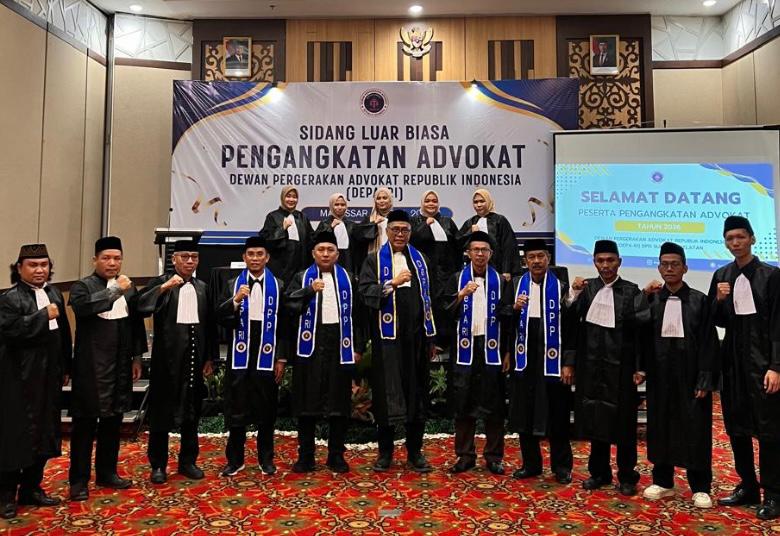
Makassar – The General Chairperson of the Indonesian Republic Advocate Movement Council (DePA-RI), Dr. TM Luthfi Yazid, expressed deep concern, empathy, and solidarity with the victims of alleged sexual harassment involving 16 students from the Faculty of Law, University of Indonesia (FH UI).
Speaking on the sidelines of the inauguration of new lawyers in Makassar, South Sulawesi, on Sunday (4/19), Luthfi emphasized that as an organization upholding the rule of law and the protection of human rights, DePA-RI views any form of sexual violence as unjustifiable and a serious issue that should not be tolerated.
Previously, the alleged sexual harassment case at FH UI drew public attention and caused shock after conversations in a group chat, allegedly containing inappropriate content, spread widely on social media.
Sixteen FH UI students are suspected of involvement in acts of sexual harassment against dozens of female students and even lecturers. This suspicion emerged alongside the circulation of chat screenshots that quickly spread across various digital platforms, triggering strong public reactions.
The General Chairperson of DePA-RI further stated that sexual violence does not always manifest physically. It can hide in words, be legitimized in private spaces, and become normalized through conversations that degrade women’s dignity.
Regulations concerning forms of sexual violence are explicitly outlined in the Law on Sexual Violence Crimes (Law 12/2022) and Ministerial Regulation No. 30/2021.
In the Rape Culture Pyramid, according to Luthfi, the normalization of a culture that objectifies women is the foundation for other, more severe forms of sexual violence, the peak of which is rape, sexual assault, and forced sexual intercourse.
DePA-RI assesses that cases of sexual harassment cannot be viewed in isolation. They reflect a more fundamental issue related to legal awareness, gender sensitivity, and collective responsibility in building a safe, just, and dignified environment.
Therefore, efforts for prevention and handling must not stop at the institutional level but must also include strengthening character education within the family. Furthermore, society as a social element should play a role in creating a safe and conducive environment for the prevention and handling of sexual harassment cases.
In this regard, DePA-RI strongly condemns all forms of sexual violence that degrade human dignity and harm human rights and the values of justice in educational settings and community life.
DePA-RI also urges concrete efforts to establish mechanisms for prevention, handling, and strengthening comprehensive education on sexual violence, especially within university environments.
On the other hand, the University of Indonesia is called upon to take firm, transparent, and accountable steps in handling the sexual harassment case and to use the incident as material for a thorough evaluation while upholding the principles of justice and support for victims.
Furthermore, DePA-RI invites all levels of society not to underestimate cases of sexual violence and to actively participate in building a culture of mutual respect, integrity, and gender sensitivity.
It was also stated that DePA-RI prioritizes a victim-oriented approach in all its handling processes, ensuring victims are heard, protected, have their identities kept confidential, receive acknowledgment and an apology from the perpetrators, and have their rights fulfilled according to the principles of justice.
“We believe that transparent, accountable, and just law enforcement is a constitutional mandate and the only way to ensure that sexual violence does not recur,” said the General Chairperson of DePA-RI.
The state, he continued, must be present and ensure that the law stands firm without favoritism towards anyone who commits a crime, and the case at FH UI should serve as material for reflection and introspection for other educational institutions in building a safe, inclusive, just, and dignified environment.
“This is our statement of stance as a form of our moral and professional responsibility in upholding the rule of law, justice, and the protection of human rights in Indonesia,” said Luthfi Yazid on the sidelines of the DePA-RI lawyer inauguration.
At the lawyer inauguration event, the General Chairperson of DePA-RI was accompanied by the Chairperson of the DePA-RI Regional Council for South Sulawesi, Sudirman Jabir, SH, MH, and other board members, namely Asri Ameru, SH; Muh Hanafi, SH, MH; Arpin, SH, MH; and Chandra Makawaru, SH, MH.
The