Jakarta – Indonesia plays a major role in shaping a just Global Governance system because since its independence, Indonesia has adhered to the free and active foreign policy principle as reflected in its constitution, namely participating in implementing world order based on independence, perpetual peace, and social justice.
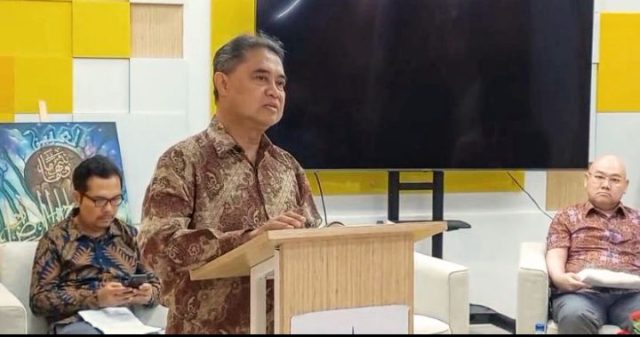
This statement was made during an international forum with the topic ASEAN Wisdom: Indonesia’s Role in the “Global Governance Initiative” held at The China Space room, Istiqlal Mosque Jakarta on November 25, 2025.
Other speakers at the event included the Editor-in-Chief of Jakarta Post and a lecturer from President University, with moderation provided by a representative from the strategic studies center Tenggara Strategics.
Opening remarks were also delivered by a representative of the Chairman of Wanxinda Group Indonesia. The event coordinator was a representative from the Global Development Research Center based in Jakarta.
Indonesia, as the largest developing country in Southeast Asia and an active member of the Association of Southeast Asian Nations (ASEAN), holds a strategic position to influence the global governance architecture through multilateral diplomacy and regional leadership.
The principles upheld by Indonesia provide a philosophical foundation for its role in advocating for the interests of developing countries, particularly ASEAN nations, in global forums.
Indonesia leverages its strategic position to strengthen the voice of developing countries, especially ASEAN nations, through three interconnected approaches rooted in the principle of sovereign equality.
“As both an ASEAN leader and a bridge between developed countries (Global North) and developing countries (Global South), Indonesia uses its diplomatic capital to transform multilateral forums into fair and inclusive platforms of representation,” explained the speaker who currently serves as Coordinator of the Political Science Laboratory.
People-Oriented Approach
Touching on the need for human quality-oriented development worldwide, it was stated that Indonesia operationalizes a people-oriented approach in global governance through three strategic dimensions.
These three strategic dimensions are: protecting citizens as a foreign policy priority, bridging the North-South development gap through concrete initiatives, and advancing inclusive participation in global decision-making processes.
The first dimension is pro-people diplomacy as the foundation of Indonesia’s foreign policy, where Indonesia since the administration era has institutionalized “pro-people diplomacy.”
This pro-people diplomacy serves as the core framework for Indonesia’s international engagement, fundamentally reorienting foreign policy from being elite-centered to focusing on citizens.
At the same occasion, a lecturer from President University stated that Indonesia since the era has referred to people-oriented programs as comprehensive human development.
It was also mentioned that the diverse Indonesian people, with various religions and ethnicities, are united as one Indonesia. Therefore, human-centered development should also be a global concern.
The discussion also addressed how Indonesia actively confronts double standards in the application of international law through principled advocacy rooted in two interconnected strategies.
These two strategies are: advocating for the universal application of legal norms and promoting multilateralism as an alternative to unilateral “house rules” imposed by a handful of countries.
Through its leadership in G20 and ASEAN, Indonesia emphasizes that a legitimate international order requires all countries to bear identical obligations and rights under the law and rejects power-based hierarchies.
Indonesia’s firm stance against inconsistencies in the application of international law reflects a deep commitment to justice principles that have long been the foundation of Indonesian foreign policy.
Indonesia understands that the credibility of the international legal system depends on its consistent and non-discriminatory application, regardless of the political identity or geopolitical affiliation of the countries involved.