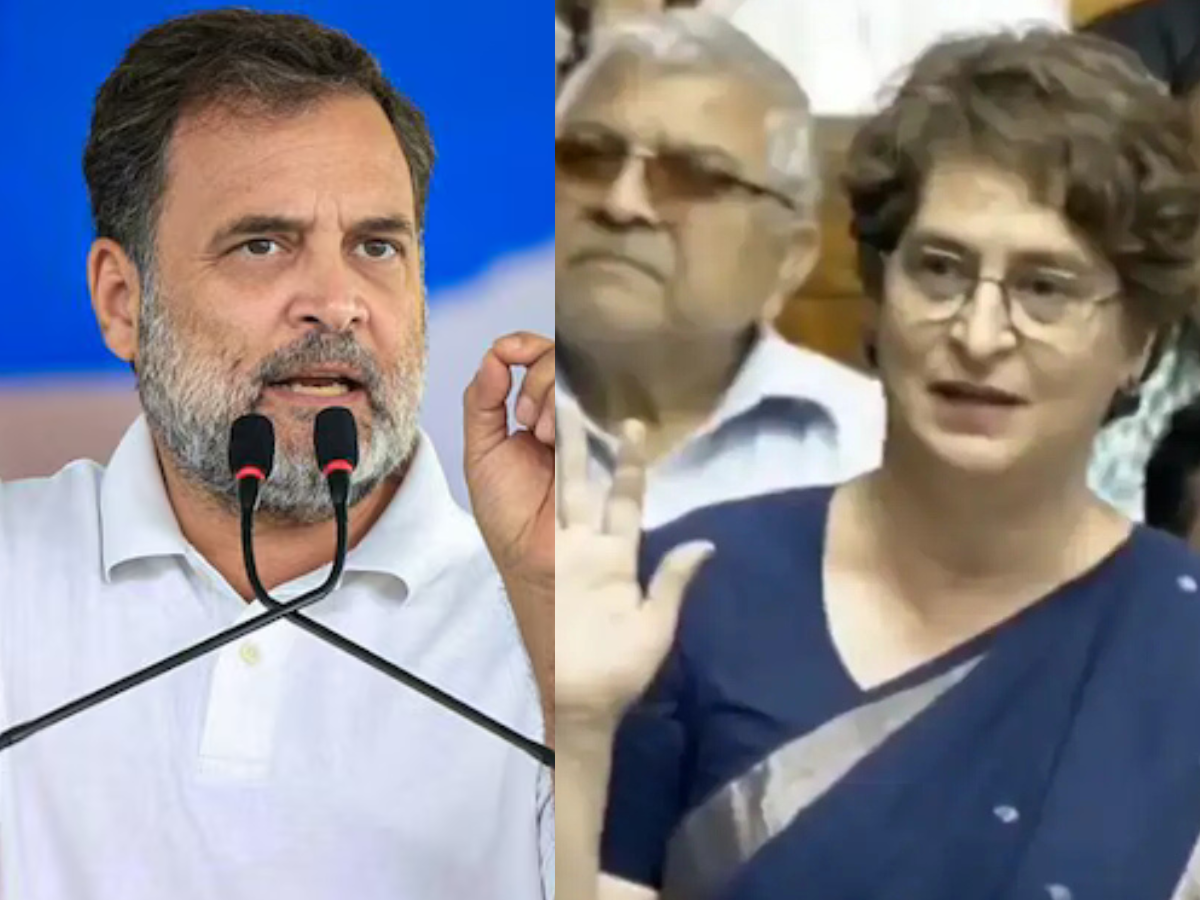
Why did the opposition not allow the Women's Reservation Bill to pass? Congress explains its 'game plan'

Women’s Reservation Bill: The Women’s Reservation Bill was not passed in the Lok Sabha. There were 298 votes in favor and 300 votes against it. The bill required 352 votes to pass. This bill has not been passed with a two-thirds majority. Therefore, there is no possibility of any further proceedings. While the BJP expressed anger over the Women’s Reservation Bill not being passed, the Congress also has its reaction on the matter.

‘This is not a women’s bill…’

On the bill not being passed, a Congress leader said, ‘It was an assault on the Constitution and we have defeated it, so that is a good thing. We have clearly stated that this is not a women’s bill; it is an attempt to change India’s political structure, its electoral framework. We have stopped it. I am telling the Prime Minister that if you want women’s reservation, then bring out the 2023 Women’s Reservation Bill, implement it from today, and the entire opposition will give you 100 percent support, and we will get women’s reservation implemented immediately.’ Not only this, the leader also thanked another leader over the phone for their support. Additionally, the leader shared a post against the bill on their social media handle.

The amendment bill has fallen.

In the name of women, they used an unconstitutional trick to break the Constitution.

India has seen it.
INDIA has stopped it.

Hail the Constitution.

The leader wrote, ‘The amendment bill has fallen. In the name of women, they used an unconstitutional trick to break the Constitution. India has seen it. INDIA has stopped it. Hail the Constitution.’

| Delhi: The Leader of the Opposition in the Lok Sabha said, “It was an assault on the Constitution and we have defeated it, so that is a good thing. We have clearly stated that this is not a women’s bill; it is an attempt to change India’s political structure, its electoral framework. We have stopped it…

‘This is a big victory for the integrity of the country…’

On the bill not being passed in the Lok Sabha, a Congress MP said, ‘This was not about women’s reservation; it was about democracy, about the integrity of the country. We could never agree that you link women’s reservation to delimitation in such a way that it goes on the old census which does not even include OBCs. It was not possible for this bill to pass. This is a big victory for the country’s democracy, for the integrity of the country.’

Delhi: On the Constitution Amendment (131st Amendment) Bill not being passed in the Lok Sabha, a Congress MP said, “This was not about women’s reservation; it was about democracy, about the integrity of the country. We could never agree that you link women’s reservation to delimitation in such a way that…

Meanwhile, the SP chief said that he is in favor of women’s reservation. His party did not oppose the bill, but along with it, those who wanted to snatch away the rights of women, the opposition drew such a Lakshman Rekha that they could not cross it.

‘We are not against women’s reservation but against delimitation…’

A Congress MP said regarding the bill not passing that he is a supporter of women’s reservation, but this has nothing to do with delimitation. He said that his vote is not against women’s reservation but against delimitation.

Delhi: A Congress MP said, “We had said that we are supporters of women’s reservation. But this has nothing to do with delimitation. Separate them. This vote is not against women’s reservation. This vote is against delimitation.”

In addition, another Congress MP said, ‘We had fully supported the Women’s Reservation Bill which was passed in 2023; the bill that has lost is the delimitation bill. Our support for women’s reservation remains even today.’ On the Women’s Reservation Bill not being passed, a Union Minister said that the Congress and the opposition are anti-women. This is tragic for democracy.


Women’s Reservation Bill

The Women’s Reservation Bill, officially the Constitution (108th Amendment) Bill, is a proposed legislation in India that seeks to reserve one-third of all seats for women in the Lok Sabha (the lower house of Parliament) and state legislative assemblies. First introduced in 1996, it faced decades of political debate and delay before finally being passed by both houses of Parliament in September 2023. Its history reflects a long struggle for gender equality in Indian political representation, aiming to systematically increase women’s participation in governance.

Lok Sabha

The Lok Sabha is the lower house of India’s bicameral Parliament, located in New Delhi. It was established with the adoption of the Indian Constitution in 1950, succeeding the Imperial Legislative Council, and its members are directly elected by the people of India. As the primary legislative body, it holds significant powers, including approving the national budget and overseeing the executive branch.

Constitution

“Constitution” most commonly refers to the foundational legal document of a nation, such as the United States Constitution ratified in 1788, which established the framework of the federal government and guaranteed fundamental rights. As a cultural and political concept, it symbolizes the supreme law and governing principles of a state, often born from historical movements for democracy, liberty, and order.

2023 Women’s Reservation Bill

The **2023 Women’s Reservation Bill**, officially the **Constitution (One Hundred and Twenty-Eighth Amendment) Bill, 2023**, is a landmark Indian legislation that reserves one-third of all seats in the Lok Sabha (the lower house of Parliament) and state legislative assemblies for women. Its history spans decades, with similar bills introduced and stalled since 1996, making its passage in September 2023 a historic milestone for gender representation in Indian politics. The law is set to be implemented after a delimitation exercise based on the next census.

Constitution Amendment (131st Amendment) Bill

The “Constitution Amendment (131st Amendment) Bill” is not a physical place or cultural site, but a proposed legislative act in India. It sought to provide a 33% reservation for women in the Lok Sabha (the lower house of Parliament) and state legislative assemblies. The bill, first introduced in 1996, had a long legislative history and was eventually passed as the **106th Constitutional Amendment Act in 2023**, marking a historic step for gender representation in Indian politics.

OBCs

“OBCs” does not refer to a specific place or cultural site. It is an acronym commonly used in India to denote “Other Backward Classes,” a collective term for socially and educationally disadvantaged castes as recognized by the Government of India. Its history is tied to social justice policies and affirmative action efforts in India’s constitution and ongoing political discourse.

Lakshman Rekha

The “Lakshman Rekha” is a mythical protective line from the ancient Indian epic *Ramayana*. According to the story, before leaving to chase a demon, Lord Rama’s brother Lakshmana drew this boundary around their hut to protect his sister-in-law Sita, warning her not to cross it. This line has since become a powerful cultural metaphor in India, symbolizing a sacred limit or boundary that should not be transgressed.

Delhi

Delhi is India’s capital city, with a history spanning over two millennia, serving as the seat of several empires including the Delhi Sultanate and the Mughals. It is a major cultural and political hub, home to UNESCO World Heritage Sites like the Red Fort and Qutub Minar, which reflect its layered historical legacy. Today, it is a bustling metropolis blending ancient monuments with modern urban life.