All efforts by the Modi government have failed! The 131st Constitutional Amendment Bill concerning women’s reservation and the increase of Lok Sabha seats did not pass in the Lok Sabha due to insufficient support. The central government is trying to obstruct the empowerment of women by blocking the passage of the women’s reservation bill. This was hinted at by the Trinamool leader.
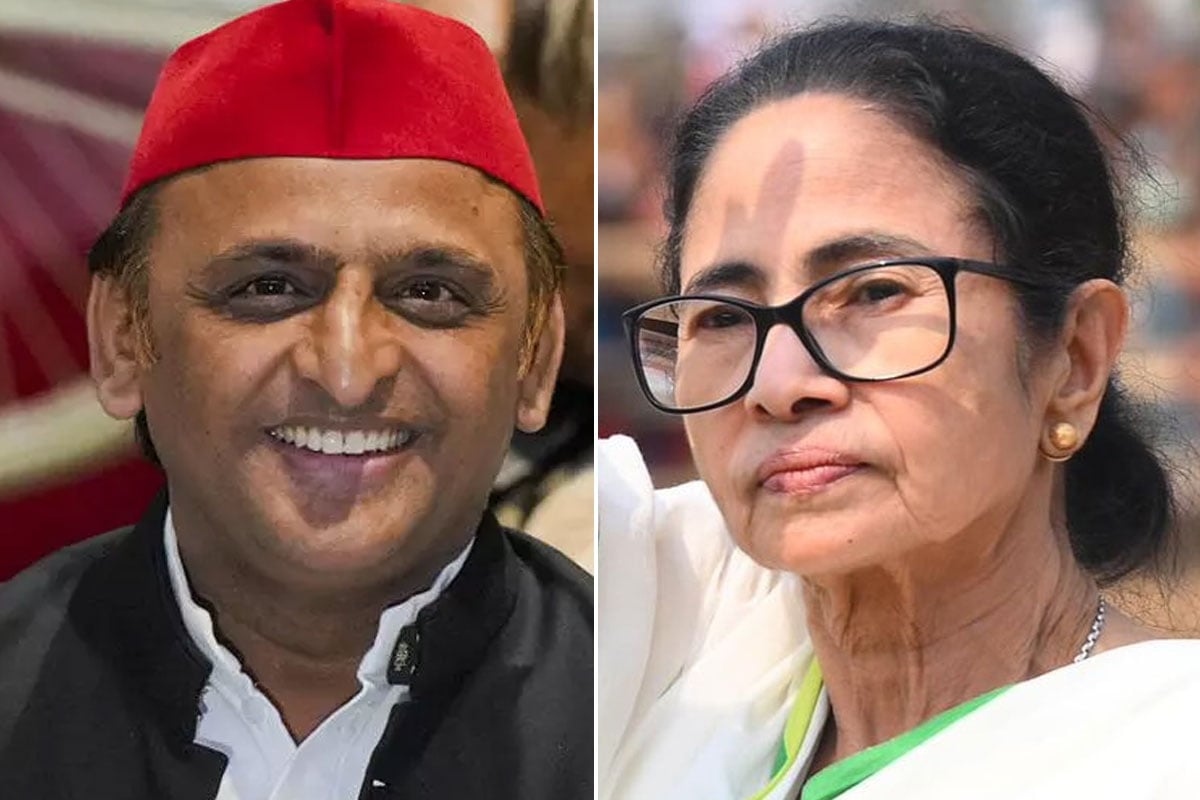
All efforts by the Modi government have failed! The 131st Constitutional Amendment Bill concerning women’s reservation and the increase of Lok Sabha seats did not pass in the Lok Sabha due to insufficient support. The central government is trying to obstruct the empowerment of women by blocking the passage of the women’s reservation bill. This was hinted at by the Trinamool leader. She had protested against this bill. Trinamool MPs protested both inside and outside Parliament. On the day the women’s reservation bill failed, Akhilesh Yadav called Mamata Banerjee. He congratulated ‘Didi’.
Sources claim that during this long conversation, the two leaders also discussed future political equations. It was also mentioned that if all MPs were present, the opposition’s vote count would have exceeded 250. At one point in the conversation, he remarked, “The wind has started to turn against the BJP.” The topic of ‘cross-voting’ also came up. Although there is a precedent of cross-voting in favor of the BJP from the opposition camp in the past, sources say the discussion indicated that this trend could now reverse. Political circles believe this phone call was not merely a courtesy exchange but a signal to further strengthen the foundation of a broader opposition unity. Analysts also believe there could be more surprises in the future numerical battles in Parliament.
Trinamool MPs Derek and Brian coordinated well. Regarding this, a Congress leader thanked Derek. After two days of discussion, when the bill was presented on Friday, 298 votes were cast in favor. On the other hand, 230 votes were cast against. 528 MPs participated in the voting. To pass the bill, a two-thirds majority, meaning 352 votes, was required.
In the three-day special session, the government was active in trying to pass three bills, the first of which was to reserve one-third of seats for women in the Lok Sabha and State Legislative Assemblies. This bill was named the ‘Nari Shakti Vandan Act’. During the voting, while 298 votes were cast in favor of the bill, 230 were cast against. Due to the lack of a two-thirds majority, the bill ultimately could not be passed. Notably, the ‘Nari Shakti Vandan Act’ bill was passed in Parliament in 2023. The bill stated that 33 percent of seats would be reserved for women. It was further stated that seat delimitation would be done after the census. Then, 33 percent of those seats would be reserved for women. But now the center is not waiting for the census.
131st Constitutional Amendment Bill
The 131st Constitutional Amendment Bill is not a place or cultural site, but a piece of Indian legislation. It led to the Constitution (One Hundred and Third Amendment) Act, 2019, which introduced a 10% reservation in government jobs and educational institutions for economically weaker sections of the general category. This amendment was a significant policy change aimed at addressing economic inequality, rather than a historical or cultural landmark.
Lok Sabha
The Lok Sabha is the lower house of India’s bicameral Parliament, located in New Delhi. Established by the Constitution of India in 1952, it is the primary legislative body where members are directly elected by the people. Its history is tied to India’s post-independence democracy, operating from the iconic Sansad Bhavan (Parliament House), a heritage building originally opened in 1927 during the British colonial era.
Nari Shakti Vandan Act
The “Nari Shakti Vandan Act” is not a physical place or cultural site, but a landmark Indian legislation. Formally known as the Constitution (One Hundred and Sixth Amendment) Act, 2023, it mandates the reservation of one-third of seats for women in the Lok Sabha (India’s lower house of Parliament) and state legislative assemblies. This historic act, passed after decades of advocacy, aims to enhance women’s political representation and participation in India’s governance.
State Legislative Assemblies
State Legislative Assemblies are the unicameral or lower houses of government in each of India’s 28 states, responsible for making laws on subjects in the State List of the Constitution. Their modern form was established after India’s independence in 1947, though many have roots in earlier provincial councils from the British colonial era. Members are directly elected by the people, and these assemblies are central to the democratic governance and regional administration of their respective states.
Parliament
The term “Parliament” most commonly refers to the Palace of Westminster in London, the meeting place of the UK’s House of Commons and House of Lords. The current Gothic Revival building was constructed between 1840 and 1870 after a fire destroyed much of the old palace, though the site has been a center of political power since the 11th century. It is a UNESCO World Heritage Site, famous for its iconic clock tower, Big Ben.
BJP
“BJP” refers to the Bharatiya Janata Party, which is a major political party in India, not a physical place or cultural site. Founded in 1980, it has its ideological roots in the Rashtriya Swayamsevak Sangh (RSS) and the broader Hindu nationalist movement. It has grown to become one of the country’s dominant political forces, leading the national government for much of the period since 2014.
Trinamool
“Trinamool” is not a specific place or cultural site, but the name of a major Indian political party, the All India Trinamool Congress (AITC or TMC), founded in West Bengal in 1998. Therefore, it does not have a historical summary as a physical location. The name “Trinamool” itself translates to “grassroots” in Bengali, reflecting the party’s political identity.
Congress
“Congress” most commonly refers to the United States Congress, the legislative branch of the U.S. federal government, established by the Constitution in 1789. It is a bicameral body consisting of the Senate and the House of Representatives, responsible for making federal laws, declaring war, and overseeing the budget. Its history is central to American democracy, evolving from the Continental Congresses of the Revolutionary era.